
Is Repairing or Replacing Your HVAC System the Right Financial Move?
This hvac repair vs replacement cost guide gives you a clear framework to make that decision without the guesswork.
Quick Answer: Should You Repair or Replace?
| Situation | Recommendation |
|---|---|
| System under 10 years old, repair under $1,000 | Repair |
| System 10-15+ years old, repair over 50% of new system cost | Replace |
| System uses R-22 refrigerant with a leak | Replace |
| Repair Cost × System Age exceeds $5,000 | Replace |
| Minor issue (capacitor, thermostat, clogged drain) | Repair |
| Cracked heat exchanger detected | Replace immediately |
Your HVAC system just broke down. It’s the middle of summer, the house is climbing toward 85 degrees, and a technician is standing in your living room waiting for an answer. Do you pay for the repair — again — or is it finally time to replace the whole thing?
It’s one of the most stressful financial decisions a homeowner faces. The repair quote feels painful. The replacement cost feels shocking. And without the right information, it’s almost impossible to know which choice actually saves you money in the long run.
The good news: this doesn’t have to be a gut-call. There are proven formulas, clear warning signs, and real financial data that make the decision much simpler than it feels in the moment.
The $5,000 Rule: A Mathematical HVAC Repair vs Replacement Cost Guide
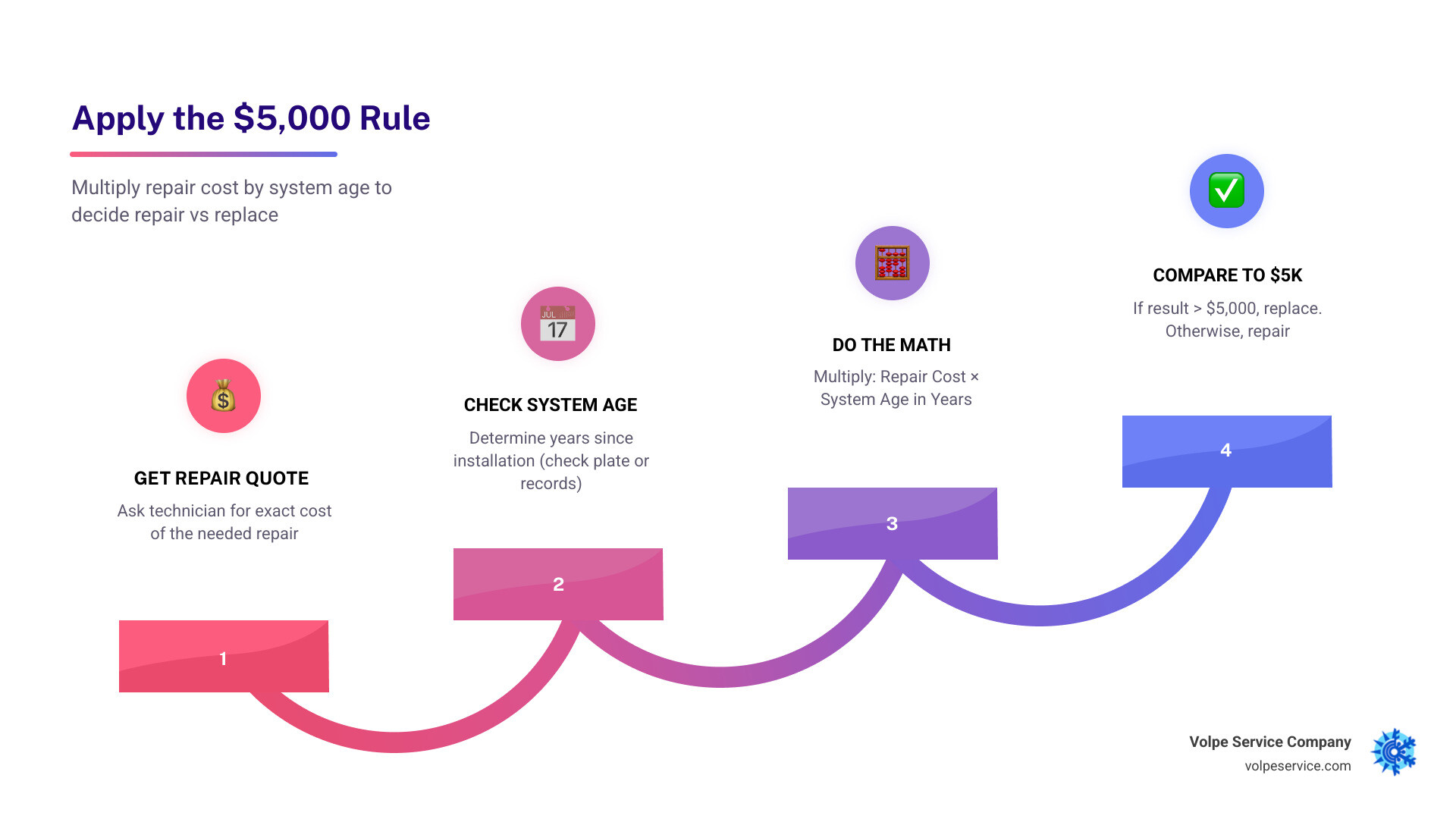
When you are staring at a repair estimate, emotions can cloud your judgment. You might feel “sunk cost” guilt—the idea that because you fixed the blower motor last year, you must fix the capacitor this year. To remove the stress, we use a data-driven approach called the $5,000 Rule.
The formula is simple: Multiply the age of your HVAC system by the repair estimate.
- If the total is under $5,000, repairing the unit is generally the smarter financial move.
- If the total is over $5,000, you should strongly consider a full replacement.
For example, if you live in Livingston and have a 14-year-old air conditioner that needs a major repair, the math quickly tips toward replacement. Even a mid-range repair on a system that old results in a “decision number” well over the threshold. This rule helps homeowners realize that keeping an old system on “life support” often costs more than the upfront investment of a new unit.
When we evaluate your home comfort, we look at Should You Repair Or Replace Your Air Conditioner 5 Factors To Consider to ensure you aren’t throwing good money after bad. Age is the most reliable indicator of whether your equipment is nearing an “expensive death spiral.”
Applying the 50% Rule to Your System
Beyond the $5,000 Rule, we also recommend the 50% Rule. This is the “golden rule” of HVAC decision-making. If the cost of a single repair exceeds 50% of the value of a brand-new system, replacement is almost always the better choice.
Why? Because a major repair on an old unit doesn’t reset the clock on the rest of the components. You might fix the compressor today, but the evaporator coil or the fan motor could fail six months from now. By opting for replacement, you get a fresh warranty and a system where all parts are designed to work together efficiently. We often discuss Ways To Limit The Cost Of Your Air Conditioner Repair with our clients in Morristown and Summit, but we are also honest when those limits have been reached.
Calculating Your Break-Even Point with an HVAC Repair vs Replacement Cost Guide
One factor many homeowners overlook is the “invisible cost” of waiting. An old, inefficient system acts like a hidden tax on your bank account every month. Modern systems are significantly more efficient than those installed just a decade ago.
- Energy Savings: Upgrading from an old SEER 10 unit to a modern SEER2 16+ system can reduce your cooling energy consumption by 20% to 40%.
- Operating Expenses: New units require fewer emergency service calls.
- ROI: If you plan to stay in your home in West Orange or Parsippany for more than three to five years, the energy savings alone can often cover a significant portion of the replacement cost.
Calculating your break-even point involves looking at your monthly utility bills and projecting the 5-year trajectory of repair costs. If your system is already requiring two or more unscheduled repairs within a 24-month period, you have already hit the “repair spiral.”
Critical Indicators for System Replacement in New Jersey
In Northern New Jersey, our climate puts unique stress on HVAC systems. From the humid summers in East Hanover to the freezing winters in Denville, your system works hard year-round. Understanding the physical signs of decline is just as important as the math.
Evaluating Component Failures with an HVAC Repair vs Replacement Cost Guide
Certain parts are the “vital organs” of your HVAC system. When they fail, it’s often a signal that the entire system is failing.
- The Compressor: This is the heart of your AC. If it fails on a unit older than 10 years, we almost always recommend replacement. The labor involved and the cost of the part make it a poor investment for an aging machine.
- The Blower Motor: While replaceable, a failing blower motor often points to years of strain from dirty filters or poor ductwork design.
- Evaporator Coils: If these are leaking, you aren’t just losing refrigerant; you’re losing efficiency.
If you are noticing Signs You Need An Ac Repair, such as strange grinding noises or frequent short-cycling, it is time for a professional diagnostic. Our Ac Replacement Guide can help you understand which components are worth saving and which are deal-breakers.
Safety First: Cracked Heat Exchangers and Carbon Monoxide
While most HVAC decisions are about money and comfort, some are about safety. In your furnace, the heat exchanger is the metal chamber where fuel is burned to create heat. If this component cracks, it can leak carbon monoxide (CO) into your home’s air supply.
A cracked heat exchanger cannot be safely patched or “repaired.” Because it poses a critical safety risk to your family, it requires an immediate replacement of the component or, more commonly, the entire furnace. If your furnace is over 12 years old and the heat exchanger fails, investing in a new, high-efficiency unit is the only logical path forward. Look for Furnace Replacement Top Signs, such as a yellow or flickering burner flame, which can indicate combustion issues.
Financial Incentives and Efficiency Standards for 2026
As of May 2026, the landscape of HVAC technology has shifted toward even higher efficiency. The implementation of SEER2 (Seasonal Energy Efficiency Ratio 2) standards means that new equipment is tested under more realistic conditions, ensuring you get the performance you pay for.
Leveraging Federal Tax Credits and Rebates in 2026
The Inflation Reduction Act continues to provide significant financial relief for New Jersey homeowners choosing energy-efficient upgrades.
- Heat Pumps: You may be eligible for federal tax credits up to $2,000 for qualifying heat pump installations.
- General Upgrades: Central AC units and furnaces that meet high-efficiency thresholds can qualify for credits up to $600.
- Utility Rebates: Many local New Jersey utility providers offer on-bill financing or instant rebates for Energy Star-certified equipment.
These incentives dramatically change the hvac repair vs replacement cost guide math. When you subtract these credits from the replacement price, the gap between a major repair and a brand-new system shrinks considerably. We always recommend checking Ac Replacement Time to see how current incentives can benefit your specific situation.
The Impact of Climate on System Longevity in Morristown and Summit
Our local weather patterns in towns like Morristown, Summit, and Millburn play a major role in how long your system lasts.
- Humidity: New Jersey’s “sticky” summers mean your AC isn’t just cooling; it’s dehumidifying. This constant moisture can lead to rust and biological growth on coils.
- Thermal Cycling: The rapid swings from 80-degree days to 40-degree nights in the spring and fall cause metal components to expand and contract, leading to stress fractures in heat exchangers.
- Coastal Air: For our clients closer to the water, salt air can accelerate corrosion, sometimes shortening a system’s lifespan to just 7 to 12 years.
Strategic Planning: Should I Replace My Entire System at Once?
One of the most common questions we hear in Montville and Boonton is: “My AC is dead, but my furnace still works. Do I have to replace both?”
While it’s a larger upfront investment, replacing the “matched system” is often the most cost-effective long-term strategy. HVAC systems are designed as a single ecosystem. When you pair a brand-new, high-efficiency AC condenser with a 20-year-old furnace blower, you likely won’t achieve the SEER2 rating promised on the box.
Benefits of Simultaneous Furnace and AC Upgrades
- System Compatibility: Matched indoor and outdoor coils ensure peak efficiency and better humidity control.
- Labor Efficiency: It is significantly cheaper to install both units at once than to pay for two separate installation dates and permit fees.
- Warranty Peace of Mind: You get a clean slate with a 10-year parts warranty on the entire system.
- Airflow Optimization: Modern furnaces often feature variable-speed blowers that significantly improve the performance of your new AC.
Knowing When To Replace Ac and the furnace simultaneously can save you from the “repair domino effect,” where one old component fails and puts fatal stress on the new one. Plus, understanding How Long Does It Take To Replace An Air Conditioner helps you plan for a single day of disruption rather than two.
When Minor Repairs are Always Worth the Investment
We aren’t always going to tell you to replace your system. In fact, many common issues are “no-brainers” for repair, regardless of the system’s age.
- Thermostats: A faulty thermostat is the “brain” of the system. Replacing it is simple and often solves complex-seeming problems.
- Capacitors: These are like batteries that help your motors start. They are inexpensive and common wear-and-tear items.
- Clogged Drain Lines: A simple flush can prevent water damage and system shutdowns.
These fall under What Is The Most Common Ac Repair and are almost always worth the investment to keep your home comfortable while you plan for a future upgrade.
Frequently Asked Questions About HVAC Decisions
How long do HVAC systems typically last in Northern New Jersey?
In our region, a well-maintained central AC or heat pump typically lasts 15 to 20 years. Furnaces can last 15 to 30 years depending on the fuel type and maintenance history. However, neglecting annual tune-ups can cut that lifespan in half. If you aren’t sure where your system stands, check Furnace Replacement Needs Indicators for a better idea of your equipment’s health.
Why is repairing an R-22 system considered a poor investment in 2026?
R-22 refrigerant (often called Freon) has been completely phased out due to environmental regulations. By 2026, the supply of reclaimed R-22 is extremely scarce and astronomically expensive. If your older system has a refrigerant leak, the cost of a single recharge can be nearly as much as a new unit’s down payment. Transitioning to a modern refrigerant system is the only Cost Effective Ac Replacement strategy for these older units.
What are the most common signs that a furnace is failing?
Beyond the age of the unit, look for uneven heating (some rooms are ice boxes while others are saunas), strange banging or screeching noises, and a sudden, unexplained spike in your gas or electric bills. These 8 Telltale Signs Its Time To Replace Your Furnace are your system’s way of “crying for help” before a total winter breakdown.
Conclusion: Finding Reliable HVAC Support in East Hanover
Deciding between repair and replacement doesn’t have to be a gamble. By using the $5,000 Rule, assessing the safety of your components, and factoring in the massive energy savings of modern SEER2 equipment, you can make a choice that protects both your comfort and your wallet.
At Volpe Service Company, we’ve been helping New Jersey families in East Hanover, Mendham, Mt. Olive, and beyond since 1963. We believe in data-driven solutions and honest, transparent communication. We won’t pressure you into a replacement you don’t need, but we will always give you the facts about your system’s health so you can make an informed decision.
If you’re tired of the “repair spiral” and want an honest assessment of your home’s heating and cooling, let us help you find the right path. We provide Climate Control Done Right—guaranteed. Contact us today to schedule a consultation and get your home back to the perfect temperature.