
The Real Mini Split vs Central AC Cost Comparison Most Homeowners Miss
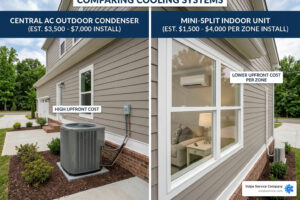
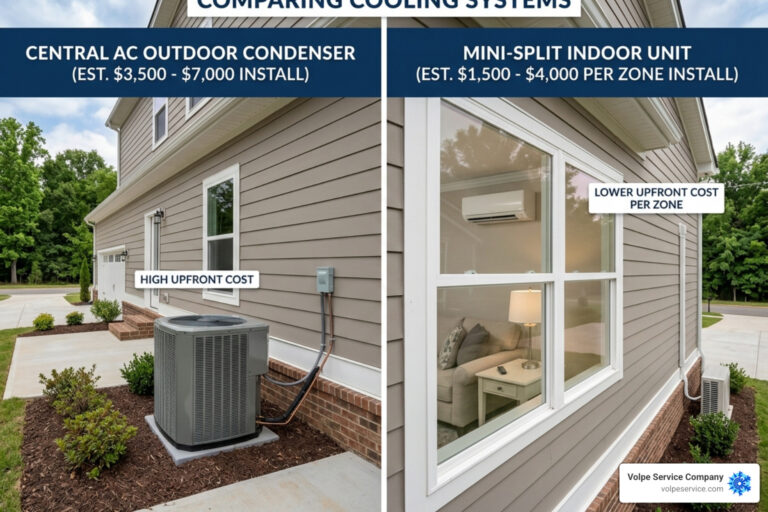
The mini split vs central ac cost comparison isn’t just about which unit costs less to buy. It’s about what you’ll actually spend — upfront, monthly, and over the next 15 to 20 years — based on your home’s specific setup.
Here’s a quick breakdown to answer the core question:
| Factor | Mini Split | Central AC |
|---|---|---|
| Best for homes without ductwork | Yes | No |
| Best for homes with existing ducts | Depends | Yes |
| Energy efficiency (SEER2) | 18–30+ | 14–21 |
| Zoned temperature control | Built-in | Requires add-ons |
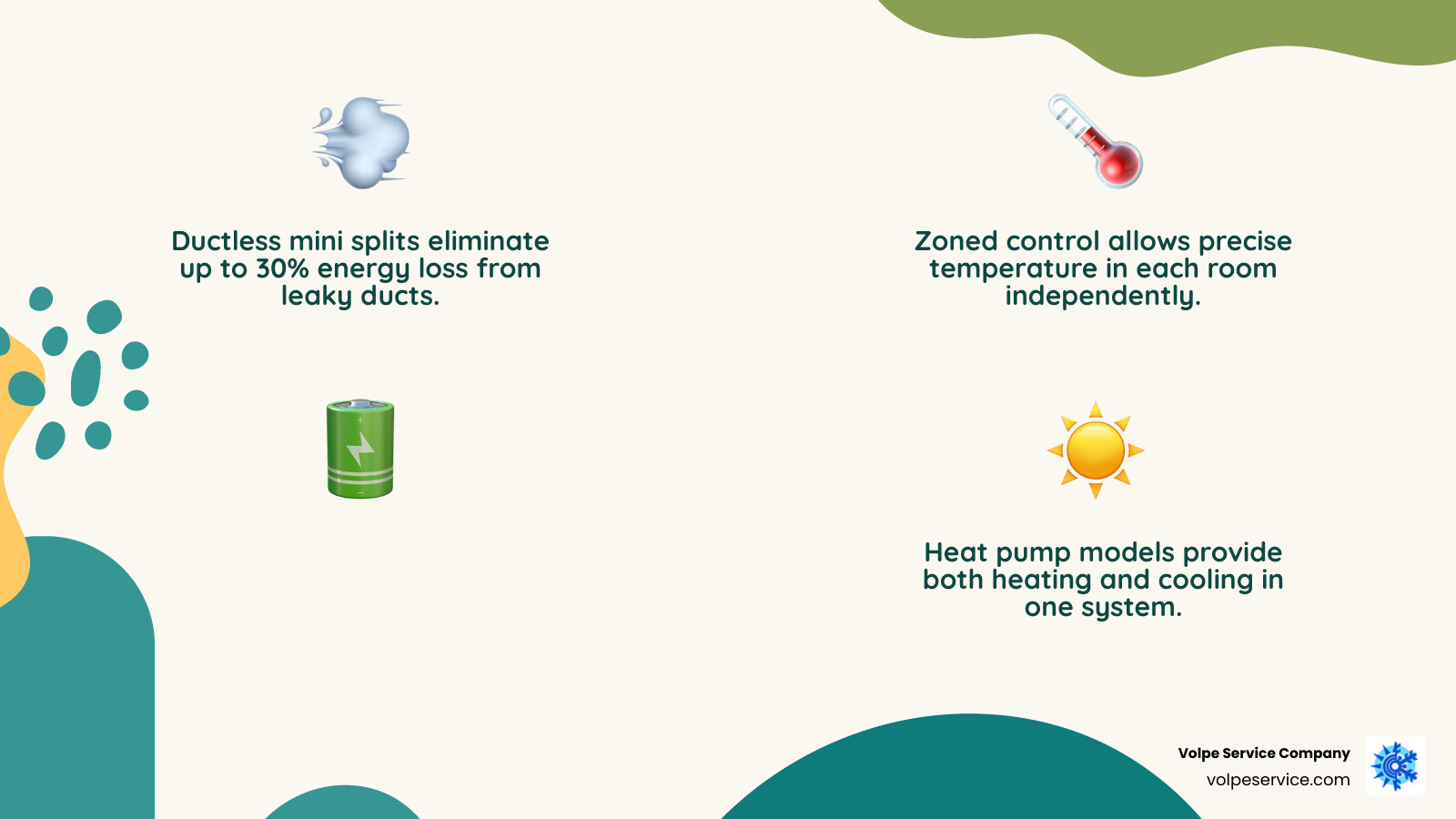
| Duct energy loss | None | Up to 30% |
| Heats and cools in one system | Yes (heat pump) | Cooling only |
| Federal tax credit | Up to $2,000 | Up to $600 |
The short answer: if your New Jersey home already has well-maintained ductwork, central AC is often the more affordable starting point. If it doesn’t — or if you’re cooling an addition, a finished basement, or a problem room — a ductless mini split almost always wins on total value.
But most homeowners stop at the installation quote. That’s where the comparison gets misleading.
Duct systems can silently waste up to 30% of the air they condition before it ever reaches a vent. That waste doesn’t show up on any contractor’s invoice — but it shows up on your monthly utility bill, every single month, for as long as the system runs.
At Volpe Service Company, we’ve helped New Jersey homeowners navigate this decision for over 60 years. The right choice depends on your home’s infrastructure, your comfort goals, and how long you plan to stay. This guide walks through all of it — clearly and without the guesswork.
Analyzing the Mini Split vs Central AC Cost Comparison for 2026
As we move through 2026, the landscape of home cooling in Northern New Jersey has shifted. With updated energy standards and a greater focus on sustainable living in towns like East Hanover and Morristown, the mini split vs central ac cost comparison has become more nuanced than ever.
When we analyze these systems, we look at the “total footprint” of the installation. A central AC system is a major undertaking if you aren’t simply replacing an old unit. It requires a large outdoor condenser and a significant indoor air handler, usually tucked away in an attic or basement. The labor involved is extensive, especially when balancing the airflow across multiple rooms to ensure your upstairs bedrooms aren’t sweltering while your kitchen feels like a walk-in freezer.
On the flip side, ductless systems offer a more modular approach. The Mini Split Installation Process Explained usually involves mounting indoor units directly on the walls or ceilings of the rooms you want to cool. These are connected to an outdoor compressor by a small conduit. Because there are no massive ducts to snake through your floor joists, the labor is often faster, though it requires a high level of technical precision to ensure the refrigerant lines are perfectly sealed.
For those currently using window units or older portable conditioners, Switching Your Home to Central AC might seem like the traditional route, but the 2026 market is leaning heavily toward the flexibility of ductless. In our experience serving areas from Livingston to Summit, the “best” system is the one that minimizes wasted energy. Central AC excels at cooling large, open-concept homes with existing infrastructure, while mini splits are the champions of precision and efficiency in multi-story or older homes.
How Existing Infrastructure Influences Mini Split vs Central AC Cost Comparison
The single biggest “swing factor” in your budget is ductwork. If you live in one of the beautiful historic homes in Chester or Mendham, you already know that these structures weren’t built with modern HVAC in mind.
If your home has no ducts, or if your current ducts are leaky, undersized, or filled with decades of debris, the mini split vs central ac cost comparison tilts heavily in favor of ductless. Installing new ductwork in an existing home is an invasive process. It involves cutting into plaster or drywall, losing closet space to “chases” for the pipes, and significant repair work once the HVAC team leaves.
Ductless systems bypass this entire headache. Our Guide to Ductless Installation highlights how we can bring modern cooling to a home with only a three-inch hole in the exterior wall. This preserves the structural integrity and aesthetic charm of older New Jersey residences while providing a level of comfort that central air often struggles to match in partitioned, older layouts.
Monthly Savings and the Mini Split vs Central AC Cost Comparison
Let’s talk about the “hidden” part of the mini split vs central ac cost comparison: your monthly electric bill. In 2026, energy prices aren’t getting any lower, and efficiency is the only way to keep overhead down.
Central AC is an “all-or-nothing” system. When the thermostat in the hallway hits 74 degrees, the system kicks on and cools the entire house — including the guest room you haven’t stepped in for three days and the formal dining room you only use on holidays. This is a massive source of energy waste.
Mini splits offer built-in zoning. Each indoor unit has its own thermostat. If you spend your day in your home office in Parsippany, you can cool just that room. You aren’t paying to chill the bedrooms upstairs until you’re actually ready to use them. This occupancy-based cooling can reduce monthly bills by up to 40% compared to traditional systems.
Common Mini Split Installations Questions often focus on whether these units can handle the humid New Jersey summers. The answer is a resounding yes; in fact, because they use inverter technology to run at variable speeds, they are often better at dehumidifying your air than a central system that cycles on and off abruptly.
Long-Term Efficiency and Operating Expenses
Efficiency is measured by the SEER2 (Seasonal Energy Efficiency Ratio 2) rating. In 2026, the federal minimums have pushed manufacturers to get more out of every watt of electricity. However, there is still a wide gap between the two technologies.
| System Type | Typical SEER2 Range | Energy Loss Factor |
|---|---|---|
| Standard Central AC | 14 – 17 | High (Duct Leaks) |
| High-Efficiency Central AC | 18 – 21 | Moderate (Duct Insulation) |
| Ductless Mini Split | 20 – 30+ | Zero (Direct Delivery) |
The technology inside a Daikin Ductless system, for example, uses an inverter-driven compressor. Think of it like a dimmer switch for a light versus a standard on/off switch. A central AC unit typically blasts at 100% capacity until the temperature drops, then shuts off. This “stop-and-go” cycle is incredibly hard on the equipment and uses a surge of power every time it starts.
Mini splits, however, slow down or speed up incrementally to maintain a perfect temperature. This prevents the “ice and fire” swings where you’re shivering one minute and sweating the next. Furthermore, most mini splits installed in 2026 are actually heat pumps. This means they don’t just cool your home in July; they provide incredibly efficient electric heating in the fall and spring, often allowing you to keep your furnace turned off until the deep New Jersey winter sets in.
Total Cost of Ownership and Maintenance Requirements
When evaluating the mini split vs central ac cost comparison, you have to look at the “Total Cost of Ownership” (TCO) over 15 years. This includes the initial investment, electricity, and the inevitable repairs.
Central AC systems have a lifespan of roughly 12 to 15 years. Because they rely on a complex network of ducts, you also have to factor in duct cleaning and occasional sealing to keep the system efficient. If a duct in your attic becomes disconnected, your AC will spend the summer trying to cool the great outdoors, driving your bills through the roof.
Mini splits typically last longer — often 15 to 20 years — because they don’t have to work as hard to move air through restrictive pipes. However, they do require a different kind of discipline from the homeowner. You’ll need to rinse the small plastic filters inside each indoor head every few weeks. It’s a simple task that takes five minutes at the kitchen sink, but it’s vital for maintaining airflow.
Professional tune-ups are non-negotiable for both. For our customers seeking Air Conditioner Installation Parsippany NJ, we always recommend an annual service plan. During these visits, we check refrigerant levels, clean the outdoor coils, and ensure the electronics are functioning safely. Our Mini-Split AC Complete Guide provides a deeper dive into how regular care can prevent expensive component failures down the road.
Strategic Scenarios: When to Choose Ductless or Central Air
Every home in Northern New Jersey is unique, and we’ve seen scenarios where both systems shine. Here is how we usually break it down for our clients in West Orange, Madison, and Denville:
The “Central Air Wins” Scenario:
- You already have modern, well-insulated ductwork in good condition.
- You prefer a “hidden” look where you only see small vents in the ceiling or floor.
- You want a single thermostat to control the entire home’s climate.
- You are on a tighter upfront budget and your home’s layout allows for easy equipment replacement.
The “Ductless Mini Split Wins” Scenario:
- You are finishing a basement, attic, or garage and don’t want to overtax your existing HVAC system.
- You live in a historic home where adding ducts would destroy the architectural character.
- You have “problem rooms” (like a sunroom or a bedroom above the garage) that are always the wrong temperature.
- You want the ultimate in energy efficiency and are looking to maximize the 2026 federal tax credits.
We specialize in Customized Ductless Installation, which means we don’t just slap a unit on the wall. We look at the sun exposure of your windows, the insulation in your walls, and your family’s daily habits to design a system that fits. For those in more rural or wooded areas like Mt. Olive, we often find that the heating capability of a mini split is a game-changer for those chilly spring mornings. Whether you need AC Installation Chester NJ or a system for a new addition in Boonton, the strategy is always data-driven.
Frequently Asked Questions about HVAC System Value
Are there tax credits available for high-efficiency heat pumps in 2026?
Yes! Under the Inflation Reduction Act, which remains a major factor in 2026, homeowners can claim a federal tax credit of 30% of the project cost, capped at $2,000 per year, for qualifying heat pump installations. Because most mini splits are heat pumps, they almost always qualify. Standard central AC units that only provide cooling are usually capped at a much lower credit, often around $600. When you factor this into the mini split vs central ac cost comparison, the “more expensive” ductless system often becomes much more competitive.
Which system provides better comfort through zoning?
Ductless mini splits are the undisputed kings of zoning. Each indoor head operates independently. This is perfect for families with different temperature preferences — one person can sleep in a 68-degree bedroom while the rest of the house stays at 74. While you can add zoning to a central AC system using motorized dampers inside the ducts, it is a complex and often expensive modification that can be prone to mechanical issues.
How does ductwork impact the final investment?
Ductwork is often the “hidden monster” of HVAC budgeting. If your home requires a full duct retrofit, the labor and material investment can actually exceed the cost of the AC equipment itself. Furthermore, the Department of Energy estimates that typical duct systems lose 20% to 30% of conditioned air through leaks. This means you are paying for 100% of the cooling but only feeling 70% of it. Mini splits have 0% duct loss because the air is cooled right in the room where you need it.
Conclusion
At Volpe Service Company, we don’t believe in one-size-fits-all cooling. Since 1963, our family-owned business has been built on the idea that New Jersey homeowners deserve honest, data-driven solutions. Whether we are performing a complex multi-zone installation in Morristown or a straightforward replacement in East Hanover, our goal is to ensure your home remains a sanctuary of comfort.
The mini split vs central ac cost comparison isn’t a race to the lowest price tag; it’s a search for the best long-term value. Central air offers simplicity and lower upfront costs for homes with good ducts, while ductless mini splits provide unmatched efficiency, zoning, and longevity for homes looking toward the future.
If you’re ready to stop guessing and start cooling, we’re here to help. Our licensed technicians can evaluate your home’s infrastructure and provide a transparent plan tailored to your needs.
Schedule your consultation for AC installation in Chester, NJ or any of our surrounding service areas today. Let’s get your home’s climate control done right — guaranteed.