
Why Indoor Air Quality Matters in 2026
How to improve indoor air quality at home is one of the most important things you can do for your family’s health — and most homeowners don’t realize how urgent the problem already is.
Here are the most effective ways to improve your home’s air quality:
- Control pollution at the source — stop pollutants before they enter the air (stop smoking indoors, choose low-VOC products, test for radon)
- Improve ventilation — open windows when outdoor air is clean, use exhaust fans while cooking and showering
- Use proper filtration — upgrade to MERV-13 HVAC filters and use HEPA air purifiers in rooms where you spend the most time
- Control humidity — keep indoor relative humidity between 30–50% to prevent mold and dust mites
- Clean regularly — vacuum with a HEPA filter, dust with microfiber cloths, wash bedding weekly in hot water
- Maintain your HVAC system — replace filters on schedule, keep ducts clean, and have your system professionally inspected
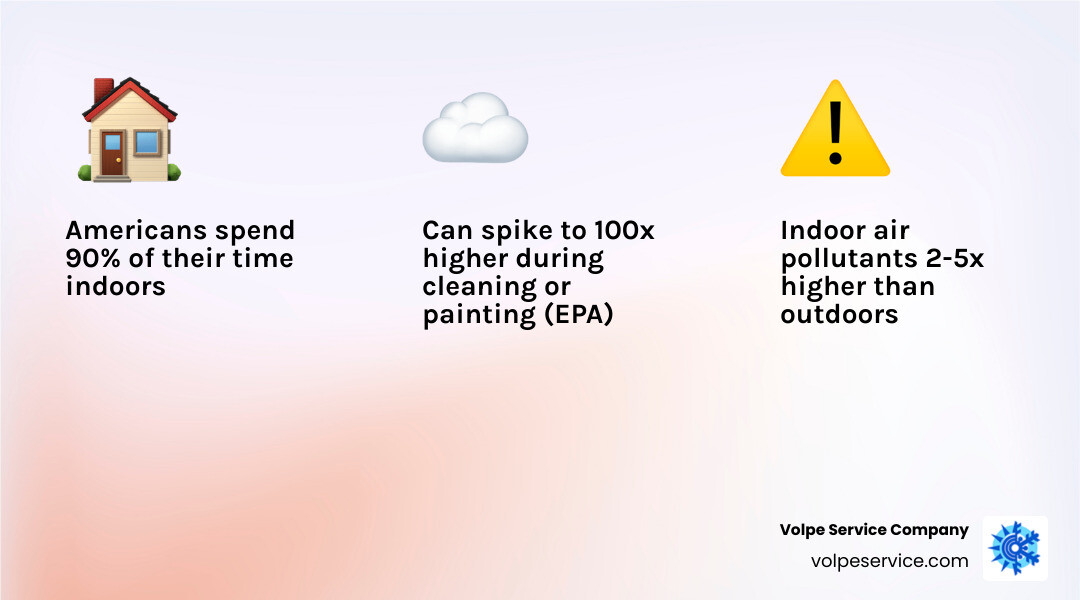
Think about this: Americans spend roughly 90% of their time indoors. Yet the air inside a typical home can contain pollutants at levels 2 to 5 times higher than outside — and during activities like painting or cleaning, that number can spike to 100 times higher, according to the EPA.
That’s not a small problem. Fine particles (PM2.5) are small enough to pass through your lungs directly into your bloodstream, raising the risk of respiratory illness, heart disease, and stroke. Radon — an odorless radioactive gas that seeps up through foundations — is the second leading cause of lung cancer in the United States. And VOCs from everyday products like cleaners, air fresheners, and new furniture keep off-gassing long after you bring them home.
For New Jersey homeowners, the stakes are especially real. Seasonal wildfire smoke, high pollen counts, and tightly sealed winter homes all make indoor air quality a year-round concern — not just a seasonal one.
The good news? Most of the improvements that make the biggest difference are straightforward, and many cost little to nothing to start.
When we talk about the Indoor Air Quality on Children Health, the risks are even higher. Children breathe more air per pound of body weight than adults, meaning they absorb more pollutants. Poor air quality in the home can lead to missed school days, asthma flare-ups, and even impacts on cognitive development. Whether you are in Morristown or Parsippany, protecting the air your family breathes is a foundational step in overall wellness.
The Three Pillars of How to Improve Indoor Air Quality at Home
To truly master your home’s environment, we look at three primary strategies recommended by the EPA: source control, ventilation, and air cleaning. Think of these as your “Air Quality Trifecta.”
Source control is the most effective and cost-efficient method. It involves removing the pollutant or reducing its emissions. Ventilation helps dilute the pollutants that remain by bringing in fresh air. Finally, air cleaning uses technology to capture particles and gases that neither source control nor ventilation could fully eliminate.
By balancing these three, you can find the Top Indoor Air Quality Solutions that work specifically for your New Jersey home’s layout and lifestyle.
Low-Cost Steps on How to Improve Indoor Air Quality at Home Today
You don’t need a massive renovation to start breathing easier this April 2026. Some of the most effective habits are completely free:
- The “No Shoes” Policy: Pollutants like lead dust, pesticides, and pollen “hitch-hike” into your home on the soles of your shoes. Leave them at the door to keep the dirt outside.
- Microfiber Magic: Skip the feather duster, which just moves dust around. Use a damp microfiber cloth to actually trap and remove particles from surfaces.
- Hot Water Wash: Wash your bedding and curtains weekly in water that is at least 130°F. This is the magic number for killing dust mites and removing allergens.
- Fragrance-Free Living: Many “lemon-fresh” or “spring-scented” cleaners contain Volatile Organic Compounds (VOCs). Opt for fragrance-free or natural alternatives like vinegar and baking soda.
- Micro-Ventilation: Even in winter, cracking a window for just 10 minutes a day can significantly reduce the “stale” air buildup in your living spaces.
Eliminating Pollutants at the Source
To make a long-term impact on how to improve indoor air quality at home, you have to look at the heavy hitters.
Radon: This is the second leading cause of lung cancer in the U.S., and it’s especially prevalent in certain parts of Northern New Jersey. Because it’s odorless and colorless, the only way to know it’s there is to test. We recommend every homeowner perform a radon test at least every two years.
VOCs and Formaldehyde: These gases leak out of composite wood furniture, new carpets, and even dry-cleaned clothes. When possible, choose solid wood furniture or buy “floor models” that have already finished most of their off-gassing. If you’re looking for specific help with Indoor Air Quality Parsippany NJ, focusing on these hidden chemicals is a great place to start.
Smoke: Never smoke or vape indoors. Thirdhand smoke — the residue that sticks to walls, carpets, and furniture — can remain toxic for months, releasing harmful chemicals back into the air long after the cigarette is extinguished.
Mastering Home Ventilation for Healthier Living
Many modern HVAC systems in New Jersey homes are designed to recirculate air for energy efficiency, but they don’t always bring in enough fresh outdoor air. This can lead to a buildup of CO2 and indoor pollutants.
Natural Ventilation is as simple as opening windows and doors. To make it more effective, try cross-ventilation: open windows on opposite sides of the house to create a natural breeze that carries pollutants out.
Mechanical Ventilation is your best friend in moisture-heavy areas. Always run your bathroom exhaust fan during and for 20 minutes after a shower to prevent mold. Similarly, use your kitchen range hood every time you cook — even if you aren’t “burning” anything. Gas stoves release nitrogen dioxide and carbon monoxide, while frying releases fine oils and particulates into the air.
For a deeper dive, check out our guides on Home Ventilation for Improved Air Quality and the Importance of Energy Efficient Ventilation. These are essential for keeping your home comfortable without sending your utility bills through the roof.
Protecting Your Home During Poor Outdoor Air Events
There are times when opening the window is the worst thing you can do. In recent years, New Jersey has seen increased “Air Quality Action Days” due to wildfire smoke drifting from the north or high ozone levels in the summer.
When the Air Quality Index (AQI) is high:
- Keep Windows Closed: Seal your home to prevent the “infiltration” of outdoor smoke.
- Recirculate: Set your HVAC system to “recirculate” rather than pulling in outside air.
- Create a Clean Air Refuge: Designate one room (usually a bedroom) where you run a high-quality HEPA air purifier 24/7. This ensures you have at least one space with pristine air.
- Upgrade Your Filter: If your system allows it, use a MERV-13 filter during these events to catch fine smoke particles.
For more specialized advice, see our Ventilation Solutions Healthier Home resource.
Advanced Air Filtration and Cleaning Technologies
If source control and ventilation aren’t enough, it’s time to bring in the technology. When looking at how to improve indoor air quality at home, filtration is your last line of defense.
HEPA Filters: The gold standard. HEPA (High-Efficiency Particulate Air) filters are rated to remove 99.97% of particles as small as 0.3 micrometers. This includes dust, pollen, mold spores, and even some bacteria.
MERV Ratings: Your central HVAC system uses a MERV (Minimum Efficiency Reporting Value) rating. Most standard filters are MERV 1-4, which only protect the equipment from large dust bunnies. For health benefits, we recommend a MERV-13 filter, which is fine enough to capture virus carriers and smoke particles.
Activated Carbon: While HEPA captures particles, it doesn’t stop odors or gases (VOCs). For that, you need a filter with activated carbon. This “adsorbs” the gas molecules, trapping them in the charcoal.
To see how these technologies fit into your home, read our Guide to Optimize Indoor Air Quality.
How to Improve Indoor Air Quality at Home with Professional Maintenance
As of April 2026, the technology behind home comfort has become incredibly precise. However, even the best air purifier or MERV-13 filter is useless if it’s clogged with six months of New Jersey dust.
Professional maintenance goes beyond just changing a filter. It includes:
- Duct Inspection: Leaky ducts can pull dusty air from your attic or crawlspace and blow it directly into your living room.
- System Calibration: Ensuring your AC or furnace is burning fuel cleanly and moving air at the right velocity.
- Sensor Testing: Checking that your smart thermostats and IAQ monitors are providing accurate data.
Regular check-ups are the backbone of Indoor Air Quality Parsippany NJ services, ensuring that your “Air Cleaning Allies” are actually doing their jobs.
Managing Humidity and Preventing Biological Growth
Humidity is the “Goldilocks” of indoor air quality: you don’t want too much, and you don’t want too little. The EPA recommends keeping indoor relative humidity between 30% and 50%.
If it’s too high (above 60%): You’re inviting mold to grow behind your walls and dust mites to thrive in your carpets. High humidity can also lead to that “musty” smell. For help with this, see our article on Dealing with AC Odors and IAQ.
If it’s too low (below 30%): Your skin gets itchy, your nasal passages dry out (making you more susceptible to viruses), and static electricity can even damage your electronics.
| Humidity Level | Health & Home Impact | Action Needed |
|---|---|---|
| Below 30% | Dry skin, nosebleeds, increased virus survival | Use a humidifier / Seal air leaks |
| 30% – 50% | The Ideal Zone | Maintain current settings |
| Above 60% | Mold growth, dust mite explosions, musty odors | Use a dehumidifier / Increase ventilation |
Frequently Asked Questions about Indoor Air Quality
Do houseplants effectively clean indoor air?
While the famous NASA study from the 1980s showed that plants could remove VOCs in a sealed lab, the reality in a New Jersey home is different. You would need roughly 10 to 100 plants per square yard to see a significant reduction in pollutants! While we love plants for their psychological benefits and beauty, they aren’t a substitute for a good HVAC filter. In fact, over-watered plants can actually grow mold in the soil, which decreases air quality for allergy sufferers.
How often should I test for radon and carbon monoxide?
Carbon monoxide (CO) detectors should be tested monthly using the “test” button, and batteries should be replaced every six months (or use 10-year sealed battery units). For radon, the EPA recommends testing every two years, or after any major renovation like sealing a basement or adding an addition. In April 2026, smart CO detectors are now common, which can alert your phone if levels rise while you’re away.
Is professional air quality testing worth it?
If you have unexplained respiratory issues, persistent odors, or are moving into an older home in Livingston or Summit, professional testing is incredibly valuable. While DIY kits exist for radon, professional equipment can provide a “snapshot” of your home’s air, identifying specific VOCs, mold spore counts, and particulate levels that a standard store-bought monitor might miss. This data allows us to create a targeted plan rather than just guessing.
Conclusion
Improving your home’s air isn’t about one single “magic” product; it’s about a commitment to better habits and smart technology. From the simple act of leaving your shoes at the door to the advanced protection of a MERV-13 filtration system, every step you take helps your family breathe easier.
At Volpe Service Company, we’ve been helping our neighbors in East Hanover, Morristown, and across Northern New Jersey since 1963. As a family-owned business, we understand that “comfort” isn’t just about the temperature on the thermostat — it’s about the safety and purity of the air your loved ones breathe every day.
Whether you need a system inspection, a humidity control solution, or expert advice on Indoor Air Quality Parsippany NJ, we are here to provide data-driven solutions and honest, courteous service. Don’t hold your breath — take control of your home’s air today.