

Is Your AC Trying to Tell You Something? Here’s What Those Strange Noises Mean
AC making strange noises what they mean is one of the most common questions New Jersey homeowners ask when their system starts acting up — and for good reason. Modern air conditioners are engineered to run quietly, typically between 25 and 55 decibels, roughly the level of a soft conversation. Some newer indoor units run as low as 19 decibels, quieter than a library. So when your system suddenly sounds like it’s working overtime — banging, hissing, screeching, or rattling — something is almost certainly wrong.
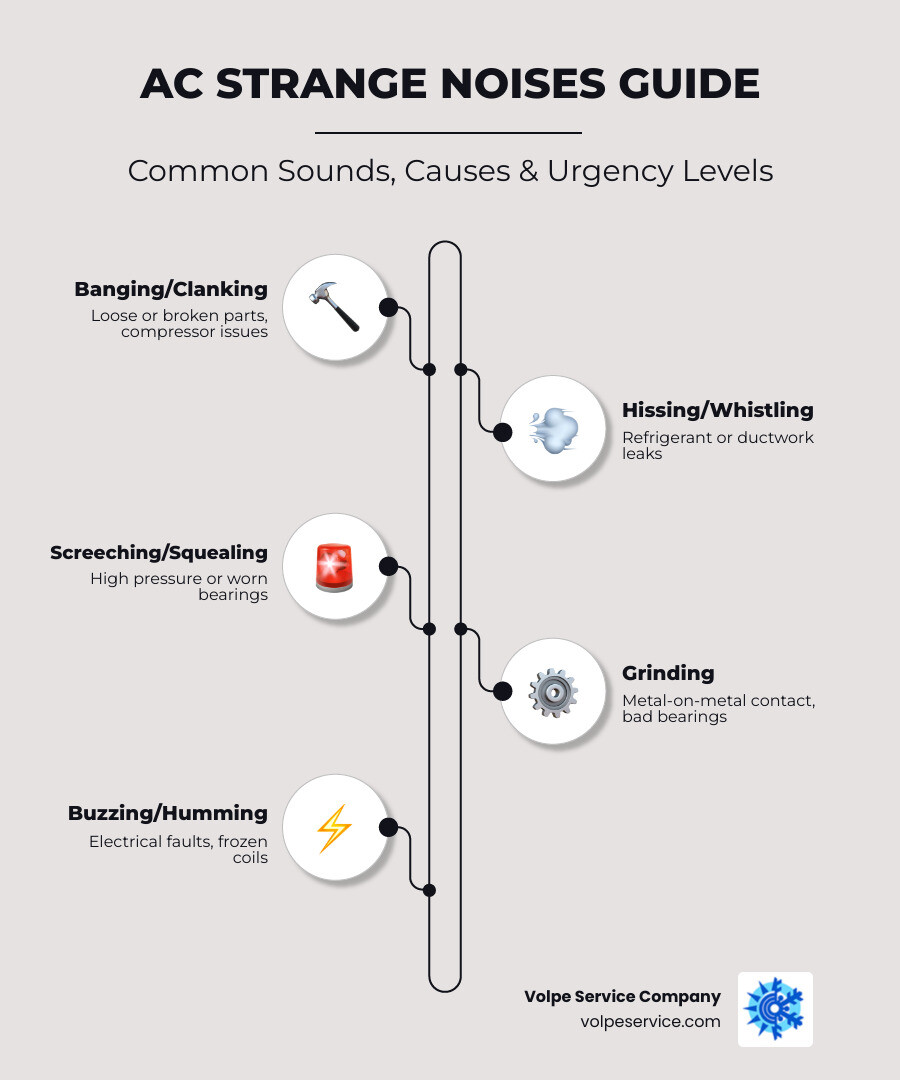
Here’s a quick breakdown of the most common AC noises and what they likely mean:
| Noise | Most Likely Cause | Urgency |
|---|---|---|
| Banging / Clanking | Loose or broken internal part, compressor issue | 🔴 High — turn off immediately |
| Hissing / Whistling | Refrigerant leak or ductwork air leak | 🔴 High — call a pro now |
| Screeching / Squealing | High compressor pressure or worn motor bearings | 🔴 High — shut down fast |
| Grinding | Worn motor bearings, metal-on-metal contact | 🔴 High — stop running the unit |
| Buzzing / Humming | Electrical fault, frozen coils, failing capacitor | 🟠 Moderate — inspect soon |
| Rattling | Loose panels, debris in unit, worn hardware | 🟡 Low-Moderate — check soon |
| Clicking (persistent) | Failing thermostat, bad capacitor, faulty relay | 🟠 Moderate — call a technician |
| Gurgling / Bubbling | Clogged condensate drain or refrigerant issue | 🟠 Moderate — schedule service |
Ignoring these sounds can turn a minor fix into a major breakdown. AC systems can last 15 to 20 years when properly maintained — but that lifespan shrinks fast when warning signs go unaddressed. Think of unusual noises as your system’s way of asking for help before something much more serious goes wrong.
In this guide, we’ll walk through each noise type, explain what’s likely causing it, and tell you exactly when it’s safe to wait and when you need to act right away.
“Why is my AC so loud?” Understanding Normal vs. Problematic Sounds
When your air conditioner is running perfectly, it should fade into the background. Most modern systems operate between 25 and 55 decibels, which is about the volume of a quiet conversation. Some high-efficiency indoor units, like the latest variable-speed models, can drop as low as 19dB—virtually silent to the human ear.
Establishing a “baseline” for your unit is vital. A healthy system typically produces:
- A steady, uniform hum: This is the sound of the indoor blower motor and the outdoor compressor working in harmony.
- A gentle air whoosh: This is simply the sound of treated air moving through your supply vents.
- A single startup click: This is the electrical relay engaging to send power to the system.
However, when these sounds change or become erratic, it’s a sign that internal components are struggling. If you notice a sudden shift in the volume or rhythm of your cooling system, it’s time to investigate 5 common air conditioner sounds you dont want to hear to prevent a full system failure.
High-Urgency Alerts: AC Making Strange Noises What They Mean for Safety
Some noises are more than just annoying; they are emergency signals. If your system is screaming, hissing, or banging, it’s often a sign of high internal pressure or electrical hazards.
High-pitched squealing or screaming is perhaps the most alarming sound. If this lasts for more than 10 to 15 seconds at startup, it usually indicates dangerously high internal pressure within the compressor. Modern systems have safety shut-offs for this, but if yours continues to scream, you must shut it down manually at the thermostat or breaker immediately to prevent the compressor from failing—or worse, exploding.
Other high-urgency sounds include:
- Loud Hissing: This often signals a significant refrigerant leak. Because refrigerant is under high pressure, a crack in the line sounds like a snake or a tea kettle.
- Electrical Arcing (Buzzing): A loud, aggressive buzz can mean electricity is jumping where it shouldn’t, posing a fire hazard.
For these issues, refer to our guide on 3 kinds of air conditioner noises you should take seriously to understand the immediate risks involved.
Identifying the Source: AC Making Strange Noises What They Mean Indoors
When the noise is coming from inside your home—specifically from the air handler or the vents—it usually points to airflow or motor issues.
If you hear a whistling sound from your vents, it’s often the “tea kettle effect.” Your blower motor is trying to pull air through a blockage, usually a filthy air filter. If the filter is clean and the whistling persists, you may have a leak in your ductwork or a closed damper.
A buzzing sound from the indoor unit is frequently caused by frozen evaporator coils. When the coils turn into a block of ice due to low refrigerant or restricted airflow, the system vibrates and hums under the heavy load. If you suspect this, check our detailed article on why your ac is making buzzing sounds for troubleshooting steps.
Outdoor Unit Warnings: AC Making Strange Noises What They Mean for Your Condenser
The outdoor unit (the condenser) is exposed to the elements, making it prone to debris-related noises. If you hear a rattling or clanking from outside, a twig, leaf, or small stone may have fallen through the top grille and is now being struck by the fan blades.
Persistent clicking from the outdoor unit without the system starting usually means the contactor relay or the capacitor is failing. The thermostat is sending the signal, but the outdoor components can’t “kick-start” into gear. For homeowners using heat pumps, certain sounds are unique to the defrost cycle, which you can learn more about in our guide on heat pump strange noises.
“My AC is making a grinding sound.” Mechanical Malfunctions Explained
A grinding sound is almost always a “red flag” for mechanical failure. It typically signifies metal-on-metal contact, which happens when motor bearings lose their lubrication. If you hear this, turn the unit off immediately. Continuing to run a grinding motor can cause the part to seize entirely, potentially burning out the motor and requiring a much more expensive replacement.
Banging and clanking are similarly serious. These sounds usually mean a part has come loose or broken entirely. Common culprits include:
- A loose fan blade: If a blade is bent or loose, it will strike the surrounding housing as it spins.
- Broken compressor mounts: The compressor sits on rubber “isolation feet.” If these perish or the bolts loosen, the compressor will thrash around inside the cabinet, creating a heavy banging sound.
- Unbalanced blower wheel: If the indoor blower becomes caked with dirt or loses a balance clip, it will wobble and clank against its casing.
If your ac unit makes grinding noises, it is rarely a DIY fix and requires a professional to open the sealed components and inspect the bearings or valves.
Airflow and Electrical Issues: Buzzing, Hissing, and Whistling
While mechanical bangs are obvious, airflow and electrical issues are often more subtle but equally damaging.
Buzzing is the “alarm bell” for electrical problems. It can be caused by:
- Loose Wiring: Vibrations over time can loosen electrical connections.
- Failing Capacitor: This part helps start the motor; when it begins to fail, it may emit a low-frequency buzz.
- Contactor Relay Issues: If the switch that engages the compressor is worn, it may chatter or buzz.
Hissing and Whistling are the sounds of escaping air or gas. If you hear a hissing sound like air escaping a tire, it’s almost certainly a refrigerant leak. This is hazardous to the environment and prevents your system from cooling efficiently. Whistling, on the other hand, is usually an airflow restriction. If your air filter looks like a “dust bunny convention,” replace it immediately to see if the sound subsides. For more specific solutions, explore our strange heat pump noises solutions page.
Preventive Care: How Maintenance Silences the System
Regular maintenance is the best way to ensure your AC remains a “silent partner” in your home’s comfort. We recommend a professional tune-up twice a year—once in the spring for your AC and once in the fall for your heating system.
| Condition | Sound Profile | Impact on System |
|---|---|---|
| Well-Maintained | Steady hum, soft whoosh | 15-20 year lifespan, high efficiency |
| Neglected | Rattling, squealing, grinding | Premature failure, high utility bills |
During a seasonal tune-up, our technicians perform critical tasks that prevent noise:
- Lubrication: We apply specialized non-detergent oil to motor bearings to prevent screeching and grinding.
- Coil Cleaning: Removing dirt from evaporator and condenser coils prevents the “buzzing” associated with frozen units.
- Tightening Hardware: We secure loose panels and motor mounts that cause rattling.
- Electrical Inspection: We check capacitors and contactors before they start clicking or buzzing.
Staying ahead of these issues not only keeps your home quiet but also extends the life of your equipment. For those interested in how these sounds translate to the heating season, read about what it means when your heater makes these noises.
Frequently Asked Questions About AC Noises
Is it dangerous to run an AC that is making loud noises?
It depends on the noise, but generally, it is not safe. Banging, grinding, screeching, or loud hissing are “red flag” noises. Running the system with these sounds can cause catastrophic failure, destroy internal components like the compressor, or even lead to electrical fires. If you hear metal-on-metal sounds, turn the system off immediately.
Why does my air conditioner click repeatedly when it tries to turn on?
Repeated clicking is usually an electrical communication issue. Your thermostat is sending a “start” signal, but the electrical contactor or the start capacitor is failing to respond. This prevents the compressor from turning on and can eventually lead to a burned-out motor if the system keeps trying to start unsuccessfully.
Can a dirty air filter cause my AC to make whistling sounds?
Yes, absolutely. A clogged filter restricts the amount of air the blower motor can pull into the system. This creates a high-pressure “whistling” or “whooshing” effect as air is forced through the tiny remaining gaps. It’s the most common cause of whistling and is easily fixed by a simple filter change.
Conclusion: Restoring Peace and Quiet in Your New Jersey Home
Strange AC noises are the “language” of your HVAC system, and they are rarely just a nuisance—they are early warning signs. Whether it’s a loose fan blade in Morristown or a failing capacitor in Summit, catching these audio clues early can be the difference between a simple repair and a full system replacement.
Since 1963, Volpe Service Company has been the trusted name for HVAC solutions in East Hanover, Livingston, and throughout Northern New Jersey. As a family-owned business, we pride ourselves on providing data-driven diagnostics, licensed expertise, and honest pricing. We don’t just fix the noise; we find the root cause to ensure your long-term comfort.
Don’t let a noisy AC ruin your peace of mind. Schedule your professional HVAC inspection today and let our expert team restore the quiet, cool comfort your home deserves.