
Is HVAC Replacement Worth It? What New Jersey Homeowners Need to Know
HVAC replacement return on investment is one of the most practical questions a homeowner can ask before spending thousands on a new system. The short answer: most homeowners recover a meaningful portion of their costs — through lower energy bills, fewer repairs, and a higher home sale price.
Here’s a quick summary of what you can expect:
| ROI Factor | Typical Range |
|---|---|
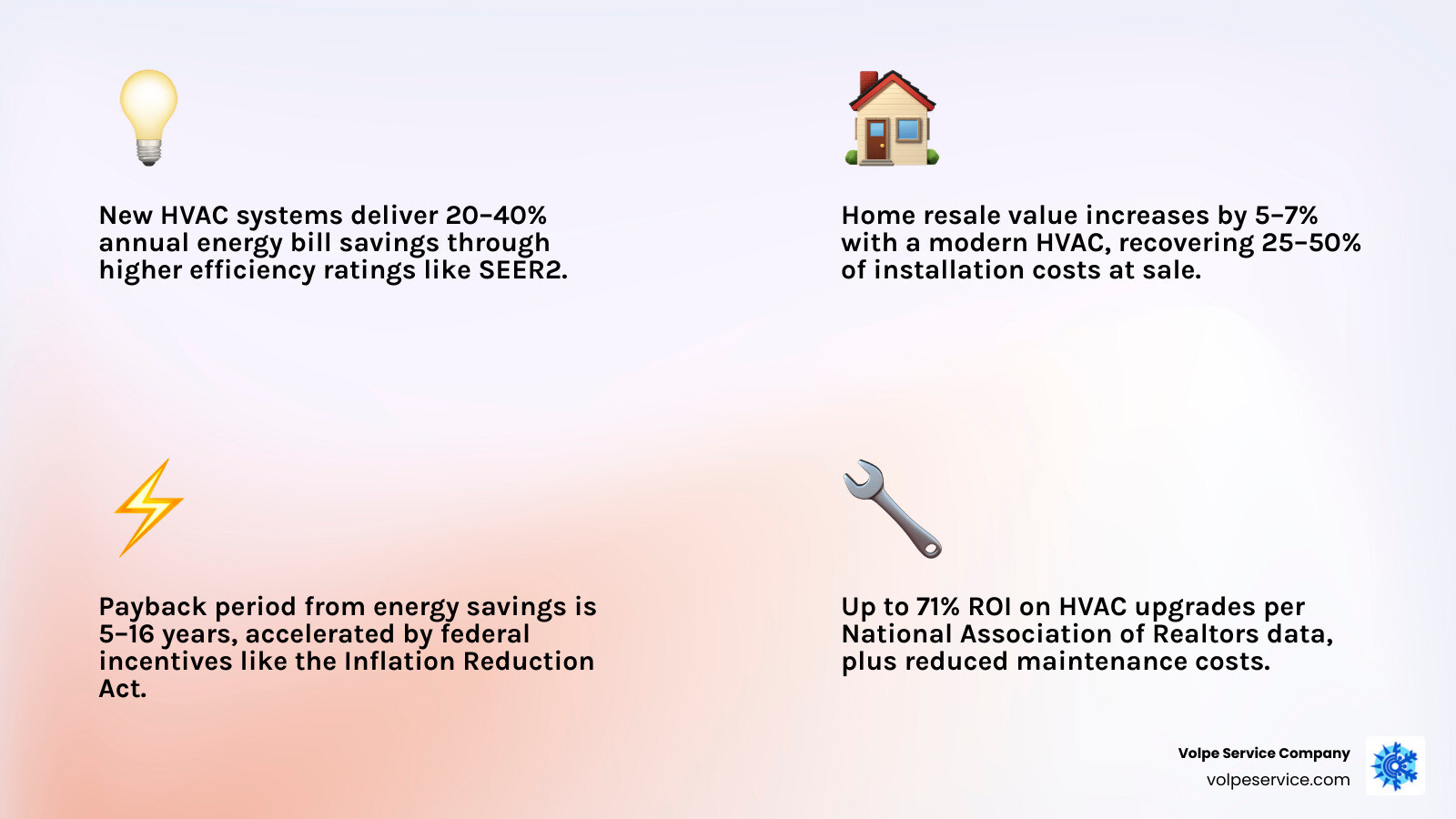
| Energy bill savings (annually) | 20–40% reduction |
| Home resale value increase | 5–7% of home value |
| Cost recovery at sale | 25–50% of system cost |
| Payback period (energy savings) | 5–16 years depending on efficiency and climate |
| NAR-reported ROI on HVAC upgrades | Up to 71% |
If your system is aging, running inefficiently, or failing during New Jersey’s hot summers and cold winters, the math often tilts strongly toward replacement. And in 2026, with energy costs continuing to rise and federal incentives still available through the Inflation Reduction Act, the timing matters more than ever.
That said, the real ROI of replacing your HVAC isn’t just a single number. It depends on your current system’s efficiency, your home’s insulation, local utility rates, and whether you’re planning to sell or stay. This guide walks through all of it — so you can make a confident, informed decision.
The Financial Impact of an HVAC Replacement Return on Investment
When we talk about hvac replacement return on investment, we have to look beyond just the sticker price. At Volpe Service Company, we’ve been helping our neighbors in East Hanover and Morristown navigate these decisions since 1963. We’ve seen that a new system impacts your wallet in four distinct ways: immediate energy savings, long-term maintenance reduction, increased home equity, and operational longevity.
Think of an old HVAC system like a 20-year-old car. It might still get you from point A to point B, but you’re likely visiting the mechanic every other month, and the gas mileage is atrocious. Modern systems are designed with precision engineering that simply didn’t exist two decades ago. By replacing a “clunker” system, you stop the financial “bleeding” caused by emergency service calls and astronomical utility bills.
Furthermore, a new system resets the clock on your home’s most expensive mechanical component. For those planning to move in the near future, the question of Will a new HVAC help sell your home faster? is a resounding yes. Buyers in 2026 are highly educated; they check the age of the condenser and the furnace before they even look at the kitchen cabinets. They want the peace of mind that they won’t be hit with a massive replacement bill three months after moving in.
How Modern Systems Increase Home Resale Value
In the competitive Northern New Jersey real estate market—from Summit to Parsippany—move-in readiness is a massive selling point. A new HVAC system acts as a “value shield.” While cosmetic upgrades like paint or flooring are subjective, a functional, high-efficiency climate control system is a universal win.
According to data from the National Association of Realtors, HVAC upgrades can yield returns as high as 71%. Most appraisers and real estate experts agree that a new system can boost a home’s resale value by 5% to 7%. On a home valued at $500,000, that’s a potential increase of $25,000 to $35,000.
But it’s not just about the appraisal. It’s about marketability. When a buyer sees a brand-new, ENERGY STAR-rated unit, it signals that the home has been well-maintained. It removes a major “objection” during the negotiation phase. Instead of asking for a $10,000 credit because the furnace is 22 years old, the buyer is more likely to submit a strong, clean offer. If you’re looking for ways to boost your property’s worth, there are several 6 HVAC upgrades that will increase your homes value that go beyond just the basic unit, such as smart zoning and improved ductwork.
Key Factors Influencing Your Long-Term Returns
Your specific hvac replacement return on investment isn’t a “one-size-fits-all” calculation. Several variables in our New Jersey climate will dictate how quickly the system pays for itself.
| Factor | Impact on ROI |
|---|---|
| Local Climate | High. NJ’s humid summers and freezing winters mean high runtime, making efficiency critical. |
| Home Insulation | High. A new system in a poorly insulated home is like running a marathon with a weighted vest. |
| System Type | Moderate. Heat pumps often offer higher ROI due to dual heating/cooling capabilities. |
| Ductwork Integrity | Moderate. Leaky ducts can waste up to 30% of your conditioned air. |
In our area, we often discuss whether Is it worth installing a heat pump? for Northern NJ homes. In 2026, the answer is increasingly “yes.” Modern cold-climate heat pumps are incredibly efficient and can often replace both an aging AC and a furnace, simplifying your maintenance and doubling your efficiency gains.
Efficiency Ratings: SEER2, AFUE, and HSPF
To understand your ROI, you need to speak the language of efficiency.
- SEER2 (Seasonal Energy Efficiency Ratio): This measures cooling efficiency. As of 2026, the standards have increased. Moving from an old 10 SEER unit to a 16 or 18 SEER2 unit can slash your cooling costs by nearly 40%.
- AFUE (Annual Fuel Utilization Efficiency): This applies to furnaces. An old furnace might have an AFUE of 80%, meaning 20 cents of every dollar spent on gas literally goes up the chimney. Modern high-efficiency furnaces reach 96% to 98% AFUE.
- HSPF (Heating Seasonal Performance Factor): This measures the heating efficiency of heat pumps. The higher the number, the more heat you get for every kilowatt of electricity used.
Pairing these high ratings with a smart thermostat can add another 10-15% in annual savings by optimizing runtimes based on your actual habits.
Calculating Your Personal HVAC Replacement Return on Investment
To calculate your potential savings, we look at your current utility rates and usage patterns. In New Jersey, where electricity and gas rates can be volatile, efficiency is your best hedge against inflation.
A simple way to look at it is the “Payback Period.” If a new system saves you $800 a year in utilities and $300 a year in avoided repairs, and you received a $1,200 tax credit, you are looking at a very attractive timeline to break even. When you add the 5-7% increase in home value, many of our clients find that the system essentially pays for itself the moment it’s installed.
When to Choose Replacement Over Repair
This is the most common dilemma we hear at Volpe Service Company. Do you put another $800 into a 15-year-old AC, or do you put that money toward a replacement? We use two data-driven “rules of thumb” to help our customers in Livingston and Madison decide.
- The 50% Rule: If the cost of a single repair exceeds 50% of the value of a new system, replacement is almost always the smarter financial move.
- The 5,000 Rule: Multiply the age of the system by the cost of the repair. If the total is more than $5,000, it’s time to retire the unit. For example, a $600 repair on a 10-year-old system equals $6,000. It’s time to replace.
Another critical factor is the R-22 refrigerant phase-out. If your old AC uses R-22 (often called Freon), repairs involving the refrigerant are now prohibitively expensive because it is no longer produced. A single recharge can cost more than a significant portion of a new, eco-friendly system. If you’re on the fence, we recommend checking our guide on Should you repair or replace your air conditioner 5 factors to consider.
Indicators for System Retirement
Beyond the math, your system will often “tell” you when it’s done. Keep an ear and eye out for these 8 telltale signs its time to replace your furnace:
- Frequent repairs: If you have your HVAC company on speed dial, that’s a bad sign.
- Rising energy bills: Even if the weather hasn’t changed, your bills are creeping up.
- Strange noises: Banging, screeching, or rattling.
- Uneven temperatures: Some rooms are ice boxes while others are saunas.
- Excessive dust: Your system is no longer filtering air effectively.
Knowing when to replace AC units is equally important, especially before the first July heatwave hits. We’ve found that proactive replacement is always cheaper than emergency replacement in the middle of a heatwave when schedules are packed and stress is high.
Strategic Upgrades for New Jersey Homeowners
In 2026, New Jersey homeowners have a unique advantage. Between federal programs and local utility incentives, the “net cost” of a new system is lower than it has been in decades.
The Inflation Reduction Act (IRA) continues to offer significant tax credits for high-efficiency HVAC equipment. You can often claim 30% of the project cost, up to $1,200 annually for central systems or even more for heat pumps. Many homeowners ask us, Can you write off a new HVAC system on your taxes? While we aren’t accountants, we can certainly provide the AHRI certificates and documentation you need to claim these credits.
Maximizing Your HVAC Replacement Return on Investment with Tax Credits
To truly maximize your hvac replacement return on investment, you have to be strategic. We often suggest:
- Timing: If you need both a furnace and an AC, sometimes splitting the installation over two tax years can allow you to claim the maximum credit for each component.
- ENERGY STAR: Only specific high-efficiency models qualify for the best rebates. We use a data-driven approach to match you with a unit that hits the “sweet spot” of performance and incentive eligibility.
- Utility Rebates: Companies like PSE&G and JCP&L often offer instant rebates for switching to high-efficiency heat pumps or central air systems. We stay up-to-date on these programs so you don’t have to.
Beyond the Numbers: Comfort and Air Quality Benefits
While this guide focuses on the financial ROI, there is a “lifestyle ROI” that is harder to put a dollar sign on but just as valuable. Modern HVAC systems do more than just change the temperature; they transform the environment of your home.
Older systems are often “all or nothing”—they blast air until the thermostat is satisfied, then shut off, leading to wild temperature swings. Modern variable-speed systems ramp up and down slowly, maintaining a perfectly consistent temperature. They are also significantly better at humidity control. In a New Jersey August, the humidity is often more uncomfortable than the heat. A new AC system acts as a powerful dehumidifier, making 75 degrees feel like 70.
Furthermore, enhanced air quality AC replacement is a major health benefit. Modern systems can accommodate high-MERV filters and UV light purifiers that capture allergens, viruses, and mold spores. For families in Millburn or Montville dealing with seasonal allergies, this improvement in indoor air quality is often the most celebrated part of the upgrade.
Frequently Asked Questions about HVAC ROI
What is the typical return on investment for a new HVAC system?
Most homeowners can expect to recoup between 25% and 50% of the installation cost through increased home value alone. When you factor in energy savings of 20-40% per year and the elimination of repair costs, the total ROI often exceeds 100% over the life of the system.
How much does a new HVAC system increase a home’s resale value?
On average, a new HVAC system increases a home’s resale value by 5% to 7%. In a competitive market, it also helps the home sell faster by removing a major point of negotiation for buyers.
How long does it take for energy savings to pay back the installation?
The payback period typically ranges from 5 to 16 years. This depends on the efficiency of the new unit (SEER2/AFUE ratings), your local utility rates, and how well your home is insulated. With current tax credits and rebates, many homeowners see a “break-even” point much sooner.
Conclusion
At the end of the day, hvac replacement return on investment is about more than just numbers on a spreadsheet. It’s about the peace of mind that comes with knowing your home will be warm in a blizzard and cool in a heatwave, without breaking the bank on utility bills.
Since 1963, Volpe Service Company has been the trusted name for “Climate Control Done Right.” Whether you are in East Hanover, Denville, or Mendham, our team provides data-driven solutions and honest pricing to ensure you get the absolute best return on your home improvement dollar. We don’t just install boxes; we design comfort systems tailored to the unique needs of Northern New Jersey homes.
If your current system is showing its age, don’t wait for it to fail at the worst possible moment. Let us help you calculate your potential savings and find a system that fits your budget and your lifestyle. For more info about HVAC services or to schedule a professional evaluation, give us a call. We’re here to ensure your home remains the sanctuary it’s meant to be.