
Small HVAC Habits That Cost New Jersey Homeowners Big
The hvac maintenance mistakes homeowners make are rarely dramatic — they’re the small, easy-to-overlook habits that quietly chip away at your system’s efficiency, drive up your energy bills, and shorten the life of one of the most expensive pieces of equipment in your home.
Here are the most common HVAC maintenance mistakes homeowners make:
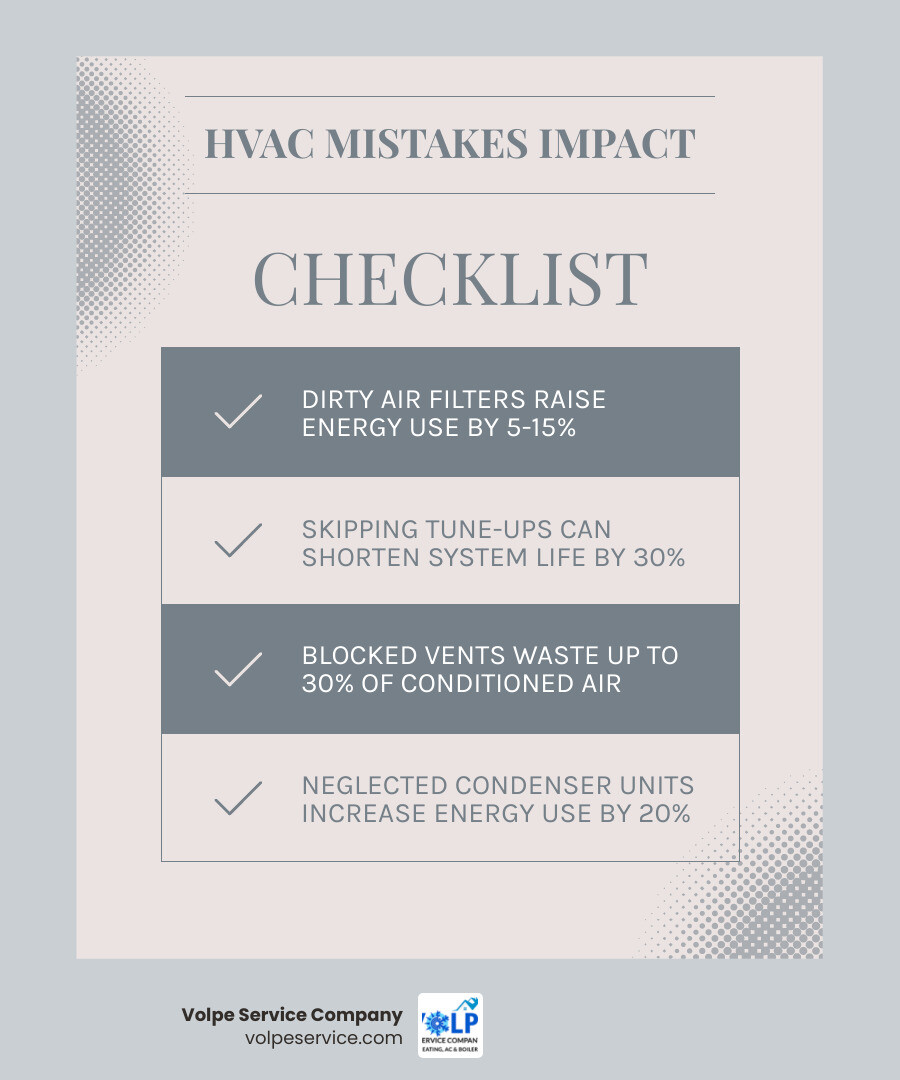
- Not changing air filters regularly — dirty filters restrict airflow and can raise energy use by 5–15%
- Skipping professional seasonal tune-ups — neglected systems can lose up to 30% of their lifespan
- Closing or blocking air vents — creates pressure imbalances that waste up to 30% of conditioned air
- Mismanaging thermostat settings — extreme adjustments don’t heat or cool faster, they just run up bills
- Neglecting the outdoor condenser unit — debris and obstructions can increase energy use by up to 20%
- Attempting complex DIY repairs — risks voiding warranties and can lead to emergency repairs costing 30–50% more
- Installing an incorrectly sized system — too big or too small leads to short cycling, uneven comfort, and premature wear
Most HVAC systems last between 8 and 10 years, but well-maintained units can last significantly longer. The difference often comes down to consistent, preventive care — not expensive repairs after the fact. For New Jersey homeowners dealing with hot summers and cold winters, the stakes are even higher. Your system works hard year-round, and a few overlooked habits can mean the difference between reliable comfort and a breakdown on the worst possible day.
As the English poet Alexander Pope once wrote, “To err is human” — but when it comes to your HVAC system, most errors are entirely preventable.
Common HVAC Maintenance Mistakes Homeowners Make in New Jersey

Living in Northern and Central New Jersey means experiencing the full spectrum of all four seasons. From freezing winter nights in Morristown to humid, sweltering July afternoons in Livingston, our heating and cooling systems are constantly put to the test. Because our local climate demands so much from these systems, preventive care is not just a luxury—it is an absolute necessity to maintain system efficiency.
When homeowners treat their heating and cooling systems with an “out of sight, out of mind” attitude, minor inefficiencies quickly snowball into expensive failures. Understanding how these habits impact your comfort is the first step toward protecting your investment. For a deeper look into the behaviors that can quietly damage your system, check out our guide on 5 Ways You Could Be Damaging Your HVAC System.
How Neglecting Air Filters Leads to HVAC Maintenance Mistakes Homeowners Make
If your HVAC system could speak, its very first request would be for a clean air filter. Neglecting the air filter is one of the most frequent and damaging hvac maintenance mistakes homeowners make.
An air filter’s primary job is to protect the sensitive internal components of your furnace and air conditioner from dust, dirt, and microscopic debris. When a filter becomes completely clogged with gray, carpet-like layers of dust, pet dander, and hair, it creates severe airflow restriction.
Because the system has to work twice as hard to pull air through a blocked filter, your energy consumption can instantly spike by 5% to 15%. Over time, this constant strain overheats the heat exchanger in the winter or freezes the evaporator coil in the summer.
To keep your system running smoothly, follow these best practices for filter care:
- Check the filter monthly: Especially if you live in busy areas like Parsippany or West Orange where pollen and dust can accumulate quickly.
- Observe a 30 to 90 days replacement cycle: Standard 1-inch pleated filters should be replaced every 90 days at a minimum.
- Adjust for pets and allergies: If you have dogs or cats, hair and dander build up rapidly. Move to a 30-to-60-day replacement cycle to protect your indoor air quality.
- Understand MERV ratings: Higher Minimum Efficiency Reporting Value (MERV) ratings mean tighter filtration. However, using a filter with a MERV rating that is too high for your specific residential system can actually restrict airflow as much as a dirty filter.
For more tips on how clean filters keep your air conditioning running efficiently, read about the benefits of Regular AC Maintenance and Cleaning.
Skipping Professional Seasonal Tune-Ups
Another costly error is waiting until your heater or air conditioner breaks down before calling in a professional. Skipping seasonal tune-ups is a gamble that rarely pays off.
An HVAC system is a complex mechanical assembly. Just as you wouldn’t drive a car for 100,000 miles without changing the oil or checking the brakes, you shouldn’t run your comfort system year after year without professional attention. In fact, running an unmaintained HVAC system is equivalent to driving a car 130,000 miles without a single tune-up!
Professional inspections should be scheduled twice a year: once in the spring for your air conditioning and once in the fall for your heating system. Skipping these routine visits can result in up to a 30% shorter system lifespan.
Furthermore, almost all major HVAC manufacturers require proof of annual professional maintenance to keep their equipment warranties valid. If a critical component fails and you cannot prove the system was regularly serviced, you could find yourself paying out of pocket for a replacement.
If you are wondering whether these preventive visits are truly worth your time, discover the answers in our article, Is HVAC Tune-Up Worth It?. To help you plan ahead, we also outline seasonal scheduling recommendations in Don’t Wait for the Smoke: How Often to Schedule Heating and Cooling Tune-Ups.
Airflow and Operational Habits That Damage Your System
Beyond regular maintenance, the way you operate your system daily plays a major role in its overall lifespan. Simple household habits can create unnecessary static pressure and put immense strain on the compressor and blower motor. To prevent these issues, it helps to understand how air moves through your home. Check out our comprehensive list of Hvac System Maintenance Tips to keep your airflow balanced.
Closing or Blocking Air Vents
There is a persistent myth that closing supply vents in unused rooms saves energy by redirecting conditioned air to other parts of the house. In reality, this is one of the most counterproductive hvac maintenance mistakes homeowners make.
Your heating and cooling system was designed to handle a very specific volume of air. When you close vents, you do not stop the system from producing that air; instead, you build up high static pressure inside your ductwork. This pressure imbalance forces the blower motor to work much harder, leading to premature motor failure. Additionally, this excess pressure can cause up to 30% of your conditioned air to leak out of minor seams and gaps in your ductwork, wasting energy and inflating your utility bills.
In the summer, restricted airflow from closed vents can cause the temperature of the evaporator coil to drop below freezing, turning your air conditioner into a block of ice.
| System Metric | Vents Fully Open (Recommended) | Vents Closed/Blocked (Avoid) |
|---|---|---|
| System Pressure | Balanced and stable | High static pressure strain |
| Airflow Efficiency | Maximum distribution | Up to 30% air wasted via duct leaks |
| Risk of Frozen Coils | Extremely low | High risk of evaporator freeze-ups |
| Blower Motor Lifespan | Long-term reliability | Premature motor burnouts |
Keeping all supply and return registers open and ensuring that furniture, drapes, and rugs do not block the air path is essential. To understand why balanced pressure is vital for your home comfort, read about why Regular HVAC Maintenance Is Crucial.
Mismanaging Thermostat Settings and Placement
Your thermostat is the brain of your HVAC system. Unfortunately, many homeowners play what we call “thermostat whack-a-mole”—constantly adjusting the temperature up and down in extreme increments.
If you come home to a hot house in Summit or Madison, setting your thermostat to 60°F will not cool the home any faster. Air conditioners cool at one steady rate; setting an extreme temperature only ensures that the system will run longer, waste energy, and overshoot your desired comfort level.
Thermostat placement is also critical. If your thermostat is installed in direct sunlight, near a drafty window, or close to heat-producing appliances like ovens, it will receive false readings. This causes the system to short cycle or run constantly, driving up energy bills. Upgrading to a smart thermostat and placing it in a neutral, central location can eliminate these issues entirely. For advice on setting up your system for the warmer months, read our Spring AC Start-Up Tips.
Neglecting the Outdoor Condenser Unit
The outdoor condenser unit is responsible for releasing the heat collected from inside your home. Because it sits outside, it is highly vulnerable to debris accumulation. Leaves, grass clippings, twigs, and overgrown shrubs can choke the unit, preventing proper heat transfer and increasing energy use by up to 20%.
Homeowners should maintain a clear 2-foot zone around the entire outdoor unit. Trim back any bushes, weed-whack nearby grass, and regularly clear away fallen leaves.
Another hidden hazard for outdoor units is pet urine. If dogs frequently use the condenser unit as a marking post, the highly acidic urine will corrode the delicate aluminum fins and copper coils over time, leading to costly refrigerant leaks. If you want to know more about how keeping your system clean prevents biological growth and physical damage, read Maintenance Matters: Why Your HVAC System Needs a Spa Day to Prevent Mold.
Technical Errors and the Risks of Self-Servicing
Modern heating and cooling systems are highly sophisticated machines containing complex electrical networks, high-pressure refrigerants, and sensitive gas combustion components. While basic tasks like swapping out an air filter or clearing leaves away from the outdoor unit are perfectly safe, attempting to service the internal mechanics yourself can lead to severe safety hazards and costly property damage. To protect your investment, explore The Ultimate Guide to HVAC Maintenance Plan Benefits.
Why DIY Repairs Are Dangerous HVAC Maintenance Mistakes Homeowners Make
In the age of online video tutorials, it can be tempting to try and fix a malfunctioning air conditioner or furnace on your own. However, DIY repairs are among the most dangerous hvac maintenance mistakes homeowners make.
HVAC systems involve high-voltage electrical components that can cause severe shocks if handled incorrectly. Furthermore, air conditioners rely on chemical refrigerants. Handling refrigerant requires specialized licensing and tools, and releasing it into the atmosphere violates EPA regulations.
Attempting a DIY mechanical fix can also instantly void your manufacturer’s warranty. If a self-repair goes wrong, you may find yourself facing emergency repairs that cost 30% to 50% more than a standard preventive service call. Leaving internal diagnostics and repairs to licensed professionals protects your safety, your wallet, and your peace of mind.
Installing an Improperly Sized HVAC System
When it comes to heating and cooling, bigger is definitely not better. Some homeowners believe that installing an oversized system will cool or heat their home faster. In reality, an oversized system will quickly satisfy the thermostat and shut off, a phenomenon known as short cycling.
Short cycling prevents the system from running long enough to remove humidity from the air, leaving your home feeling damp and clammy. It also causes rapid wear and tear on the compressor, significantly shortening the system’s average 8-to-10-year lifespan.
Conversely, an undersized system will run continuously without ever reaching the desired temperature, leading to soaring utility bills. A professional HVAC contractor must perform a proper Manual J load calculation—taking into account your home’s square footage, insulation, window placement, and local climate—to ensure your new system is perfectly sized.
Frequently Asked Questions About HVAC Care
What warning signs indicate my HVAC system needs professional attention?
You should contact a professional technician immediately if you notice any of the following red flags:
- Strange noises: Grinding, squealing, rattling, or loud banging sounds often point to loose components or failing motor bearings.
- Unusual odors: Musty smells can indicate biological growth inside your ductwork, while burning metallic odors suggest electrical overheating.
- Moisture leaks: Standing water around your indoor furnace or AC unit usually means you have a clogged condensate drain line or a cracked drain pan.
- Inconsistent temperatures: If some rooms in your home are freezing while others are warm, your system is struggling with airflow or sizing issues.
How does regular maintenance extend the lifespan of my heating and cooling system?
Regular maintenance significantly reduces wear and tear on major moving parts. By cleaning dirty coils, lubricating bearings, and tightening electrical connections, technicians prevent the friction and overheating that cause premature system failure. On average, a well-maintained system can enjoy a 3-to-5-year lifespan extension compared to a neglected unit. To see how structured care compares to sporadic repairs, read Membership Plan vs Pay Per Visit: The Ultimate Comparison.
What is the most common HVAC part to fail?
Hands down, the capacitor is the most frequent part to fail in an HVAC system. Capacitors act like temporary batteries, storing up electrical energy to give the compressor and fan motors the high-voltage boost they need to start up. Because they are highly sensitive to extreme summer heat and household electrical surges, they can degrade and fail over time. Fortunately, a technician can easily test and replace a weakening capacitor during a routine seasonal tune-up before it leaves you without cooling on a hot day.
Conclusion
Avoiding the common hvac maintenance mistakes homeowners make is the simplest way to ensure reliable comfort, lower utility bills, and a long-lasting heating and cooling system. From changing your air filters on schedule to keeping your outdoor unit clear of debris, these small habits make a massive difference over time.
Since 1963, Volpe Service Company has been proudly serving homeowners and businesses in East Hanover, NJ, and surrounding communities like Morristown, Livingston, Summit, and West Orange. As a family-owned and operated business, we are committed to providing data-driven solutions, courteous service, constant communication, and honest pricing.
Don’t wait for your system to break down during a heatwave or a winter storm. Schedule professional HVAC service with Volpe Service Company today, and let our experienced team keep your home comfortable all year long!