
Why Undersized HVAC Systems Leave New Jersey Homeowners Hot, Sticky, and Uncomfortable
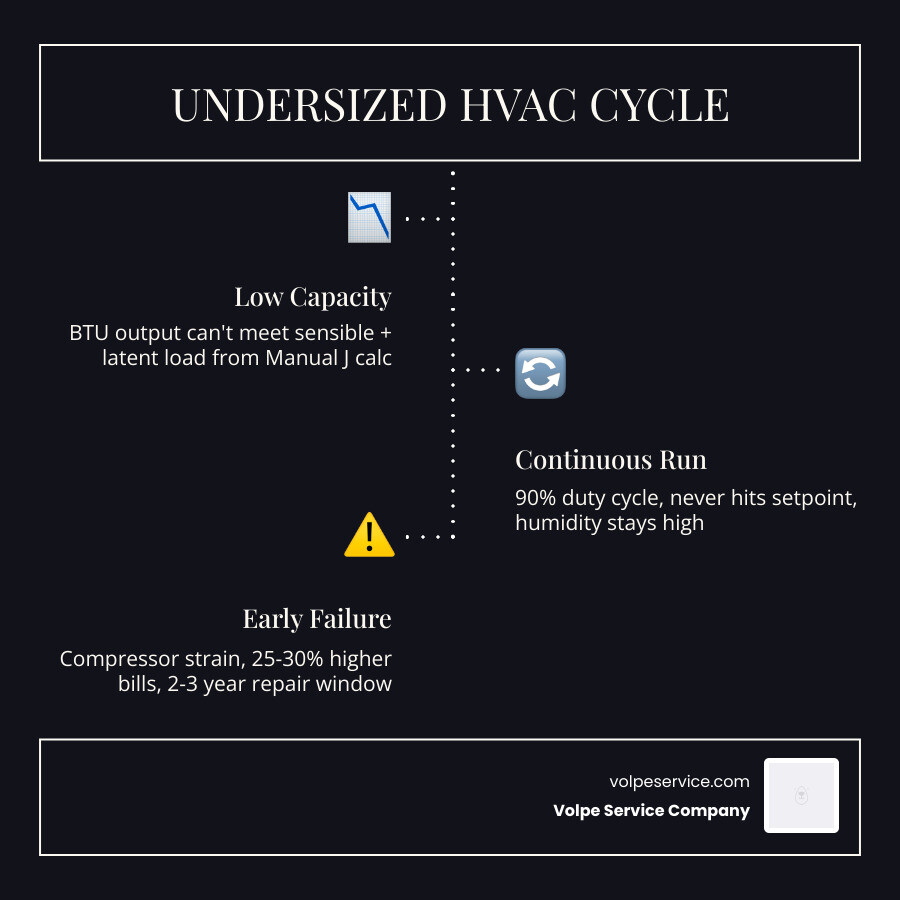
How undersized systems fail to keep you comfortable comes down to one core problem: the equipment simply does not have enough capacity to meet your home’s actual heating or cooling demand. When that gap exists, the system runs constantly, struggles to hit your thermostat target, and can’t pull enough humidity out of the air — leaving every room feeling warmer and stickier than it should.
Here is a quick breakdown of the main ways an undersized system falls short:
- Can’t reach the thermostat setpoint — The system runs non-stop but never fully cools or heats your home to the temperature you set.
- Poor humidity control — Without enough capacity to handle the latent load, indoor humidity stays high, making the air feel clammy and uncomfortable.
- Uneven temperatures — Some rooms, especially upstairs or sun-exposed spaces, stay noticeably warmer than others.
- Higher energy bills — Continuous operation at a near-90% duty cycle can drive utility costs up by 25–30% compared to a correctly sized system.
- Faster equipment wear — Running at full load around the clock puts enormous stress on the compressor, blower motor, and other components, leading to breakdowns far sooner than expected.
If your home in East Hanover, Morristown, Livingston, or anywhere across Northern New Jersey never quite feels comfortable — no matter how low you set the thermostat — an undersized HVAC system may be the reason. This guide walks you through exactly what’s happening inside your system, how to tell if sizing is the real culprit, and what it takes to fix it for good.
The Science Behind How Undersized Systems Fail to Keep You Comfortable
To understand why a small air conditioner or heater leaves you sweating, we have to look at the engineering science of home heating and cooling. Sizing an HVAC system is not a matter of guessing based on square footage alone. In fact, using simple rules of thumb is the number-one reason many homes end up with mismatched equipment.
To get sizing right, professional technicians rely on a Manual J load calculation, a protocol developed by the Air Conditioning Contractors of America (ACCA). This scientific calculation measures the exact amount of heat your home gains in the summer and loses in the winter. It accounts for a wide variety of factors:
- The total square footage and volume of your rooms.
- The R-value of your attic and wall insulation.
- The number, size, and orientation of your windows (for example, west-facing glass lets in massive amounts of afternoon heat).
- The height of your ceilings.
- Local climate design temperatures for Northern New Jersey.
When we calculate these loads, we divide the heat into two distinct categories: sensible load and latent load.
- Sensible load refers to the dry heat you can actually measure with a thermometer. When you want to lower the temperature from 78°F to 72°F, you are dealing with sensible heat.
- Latent load refers to the moisture or humidity suspended in the air.
An HVAC system’s total cooling capacity, measured in British Thermal Units (BTUs) or tons (where one ton of cooling equals 12,000 BTUs per hour), must be carefully balanced to handle both loads. If a system is undersized, it lacks the raw BTU capacity to manage both. It will expend all of its energy trying to lower the dry temperature (sensible load), completely failing to remove the moisture (latent load) from your home. To learn more about how accurate measurements prevent these issues, take a look at Why Correct System Sizing is the Secret to a Happy Home.
Temperature Control: How Undersized Systems Fail to Keep You Comfortable in Extreme Heat
When summer temperatures spike in places like Parsippany, Summit, or West Orange, an undersized air conditioner is pushed to its absolute limit — and quickly falls behind.
An air conditioner is designed to cycle on and off to maintain your desired thermostat setpoint. Under normal, properly sized conditions, a system might run for 30 to 40 minutes during peak afternoon heat before satisfying the thermostat and shutting down.
However, an undersized system will enter a state of continuous operation, running at a 90% to 100% duty cycle. Because the unit’s cooling output is lower than the heat entering through your walls and windows, the system cannot reach your setpoint.
This continuous struggle creates several comfort issues:
- The temperature never drops to your target: Your thermostat might be set to 71°F, but the actual indoor temperature hovers stubbornly at 76°F or 78°F all afternoon.
- Severe temperature swings: As the sun moves across the sky, rooms with heavy exposure will experience sudden spikes in temperature that the weak system cannot counteract.
- The “never-ending” cycle: Because the system never reaches the setpoint, it never shuts off, creating a constant, noisy background hum without delivering the cool relief you expect.
If your system is running non-stop but the air coming from your vents feels weak or barely cool, you might be facing a capacity issue. For a deeper look into these symptoms, read The Cold Hard Truth About Why Your AC Isn’t Cooling Properly.
Humidity and Airflow: How Undersized Systems Fail to Keep You Comfortable During Humid Summers
In Northern New Jersey, our summers aren’t just hot — they are incredibly humid. Managing indoor humidity is just as important for your comfort as lowering the temperature. According to ASHRAE Standard 55, which governs thermal environmental conditions for human occupancy, indoor relative humidity should ideally remain between 30% and 50%, and never exceed 60%.
When humidity rises above 60%, your body’s natural cooling mechanism — sweat evaporation — slows down. This makes a room feel 4 to 6 degrees warmer than the actual thermometer reading.
An air conditioner removes humidity by blowing warm, moist indoor air across a cold evaporator coil. As the air cools, moisture condenses on the coil and drains away. However, an undersized system fails to manage this latent load effectively:
- Clammy, sticky air: Because the unit cannot keep up with the overall heat load, the indoor air remains saturated with moisture. Even if the system manages to slowly lower the temperature a few degrees, you are left with cold, damp, “clammy” air.
- Rising humidity throughout the day: As outdoor humidity climbs, the undersized system loses the battle, allowing moisture levels inside your home to rise steadily.
- Mold and mildew risks: Persistent relative humidity above 60% creates a prime breeding ground for mold spores, mildew, and dust mites, threatening your home’s structural materials and your family’s health.
The Hidden Toll: Energy Bills and Equipment Wear
Many homeowners mistakenly believe that installing a smaller HVAC unit is a smart way to save money on monthly utility bills. The logic seems simple: a smaller motor should consume less power.
In reality, the exact opposite is true. Because an undersized system must run continuously at a 90% or higher duty cycle to try and satisfy the thermostat, it consumes far more total kilowatt-hours of electricity than a properly sized system that cycles normally.
This continuous operation can raise your monthly utility bills by 25% to 30%. Instead of saving money, you end up paying a premium for a home that never actually feels comfortable. Additionally, as the system runs non-stop, its components overheat. This constant thermal stress leads to “efficiency degradation,” meaning the system becomes even less efficient over time, driving your bills even higher. If you are considering upgrading to a modern, high-efficiency system to eliminate these wasted costs, check out our guide on The Real ROI of Replacing Your Central Air.
Accelerated Mechanical Wear and Premature Failure
HVAC equipment is built to handle a specific number of operational hours per year. Under normal conditions, a properly sized air conditioner or heat pump in New Jersey should last 12 to 15 years with regular maintenance.
When a system is undersized, the physical toll on its internal components is devastating:
- Compressor strain: The compressor is the heart of your AC system. Running continuously causes it to overheat, breaking down the lubricating oil inside and leading to mechanical failure.
- Blower motor burnout: The fan motor must run around the clock to circulate air, causing its bearings and electrical windings to wear out prematurely.
- Frozen evaporator coils: Because the system runs non-stop, the temperature of the evaporator coil can drop below freezing, especially if airflow is slightly restricted. Ice will physically build up on the coil, completely blocking airflow and potentially sending liquid refrigerant back to the compressor, which destroys it instantly.
Because of this extreme mechanical stress, undersized systems often require major, expensive repairs within just 2 to 3 years of installation. In contrast, properly sized systems typically operate for 7 to 10 years before requiring any significant component replacements. To understand how to weigh these repair costs against a replacement, see our When to Repair vs. Replace Your HVAC System Complete Guide.
How Home Layout and Climate Zones Amplify Sizing Issues
Your home’s architectural design plays a major role in how severely an undersized system impacts your daily comfort. Sizing issues are rarely felt evenly throughout a house. Instead, they manifest as severe hot and cold spots depending on your layout:
- Vaulted ceilings: High, open ceilings create a massive volume of air that must be conditioned. Because heat naturally rises, an undersized unit will struggle to cool the lower living spaces while warm air pools overhead.
- West-facing windows: Rooms with large windows facing the afternoon sun receive a massive burst of radiant heat. An undersized system cannot deliver enough cooling volume to counteract this localized heat gain.
- Multi-story homes: Upstairs bedrooms are notoriously difficult to keep cool because heat rises from the first floor and enters through the roof. An undersized system will often leave second-story rooms up to 10°F warmer than the main floor.
- Settled insulation: In older homes across Morristown, Madison, or Montville, settled attic insulation with low R-values allows heat to pour into the living spaces, instantly overwhelming a small system.
Our local Northern New Jersey climate is classified as a mixed-humid zone, meaning we experience freezing winters and hot, sticky summers. This seasonal volatility means an undersized system will fail you twice: it won’t keep you cool in July, and it will struggle to keep you warm during a January cold snap, forcing expensive auxiliary heating systems to run constantly.
Diagnosing the Issue: Is It Undersized Equipment or Bad Ductwork?

Before you assume your actual heating or cooling unit is too small, it is critical to perform diagnostic tests. In many cases, the physical equipment is sized correctly, but the delivery system — your ductwork — is failing.
Ductwork problems can easily mimic the symptoms of an undersized system. For instance, leaky or restricted ducts can waste up to 30% of your HVAC system’s efficiency. If cold air is escaping into your attic or crawlspace before it reaches your living rooms, your system will run continuously and fail to reach the setpoint, making a perfectly sized unit perform exactly like an undersized one.
To find the true root cause, a professional technician will perform several key diagnostic steps:
- Total External Static Pressure (TESP) testing: Static pressure is the resistance to airflow within your HVAC system. If your ductwork is too small, poorly routed, or restricted, static pressure spikes. This starves your system of airflow, preventing it from distributing air properly.
- Airflow CFM measurements: A standard system should move between 350 to 400 Cubic Feet per Minute (CFM) per ton of cooling. We use specialized balancing hoods to measure the exact CFM coming out of your registers to ensure your home is getting the correct volume of air.
- Duct temperature gain testing: We measure the temperature of the air leaving the unit versus the air coming out of the registers. If the temperature rises by more than 10% along the way, poor duct insulation or leaks are robbing your system of its capacity.
Understanding these diagnostic details is key to achieving true indoor comfort. For a complete look at maintaining a healthy, efficient system, explore The Ultimate Homeowner Guide to HVAC Happiness.
Undersized vs. Oversized Systems
It is also helpful to compare the symptoms of an undersized system with those of an oversized system. While both cause severe discomfort and high bills, they do so in completely opposite ways:
| Symptom / Feature | Undersized HVAC System | Oversized HVAC System |
|---|---|---|
| Cycle Length | Extremely long, continuous run times (45+ minutes or non-stop) | Very short cycles (turns on for 5–10 minutes, then shuts off) |
| Thermostat Setpoint | Struggles or fails to reach the setpoint on hot/cold days | Reaches the setpoint rapidly, then shuts off |
| Indoor Humidity | High and sticky because the system cannot manage the latent load | High and clammy because the system shuts off before removing moisture |
| Temperature Balance | Severe hot/cold spots, especially in upstairs rooms | Cold rooms close to the air handler; uneven temperatures throughout |
| Energy Bills | High due to continuous, non-stop operation | High due to frequent, power-hungry system startups |
| Equipment Wear | Continuous stress burns out motors and strains the compressor | Frequent on/off cycling damages the compressor and fan motor |
Frequently Asked Questions About HVAC Sizing
How do I know if my current HVAC system is undersized?
The most common signs include a system that runs continuously without ever reaching your thermostat setpoint, a noticeable temperature difference of up to 10°F between rooms (especially upstairs), indoor humidity levels that remain above 55% during summer, and sudden spikes in your energy bills despite normal usage.
Can an undersized system damage my home’s indoor air quality?
Yes. Because an undersized system cannot effectively remove moisture, indoor relative humidity levels often climb above 60%. This excess moisture creates a prime environment for mold growth, mildew, and dust mites. These allergens can trigger respiratory issues, asthma, and allergies for everyone in your household.
What is the best way to determine the correct HVAC size for my home?
The only accurate, scientific method is to have a licensed professional perform a comprehensive Manual J load calculation. This assessment evaluates your home’s layout, window sizes and orientations, insulation levels, ceiling heights, and local climate data to determine the exact BTU capacity your home requires.
Conclusion
At Volpe Service Company, we have been helping our neighbors in East Hanover, Livingston, Morristown, and across Northern New Jersey stay comfortable in their homes since 1963. We know that true comfort isn’t about guessing; it’s about using data-driven solutions and honest, professional workmanship to get the job done right.
If your current system is struggling to keep up with the summer heat or winter cold, don’t keep paying high energy bills for a home that never feels comfortable. Our team of licensed technicians can perform a precise load calculation and ductwork inspection to find the perfect, energy-efficient solution for your home.
Ready to see how much you could save by upgrading to a correctly sized, high-efficiency system? Calculate your potential savings with our SEER Calculator today, or contact us online to schedule your comfort consultation!