

Why Understanding How HVAC Load Calculations Work Could Save Your Home’s Comfort and Energy Bills
How HVAC load calculations work is simpler than it sounds — and knowing the basics can protect you from one of the most common (and costly) mistakes homeowners make: getting the wrong-sized system.
Here’s a quick answer:
How HVAC Load Calculations Work — At a Glance
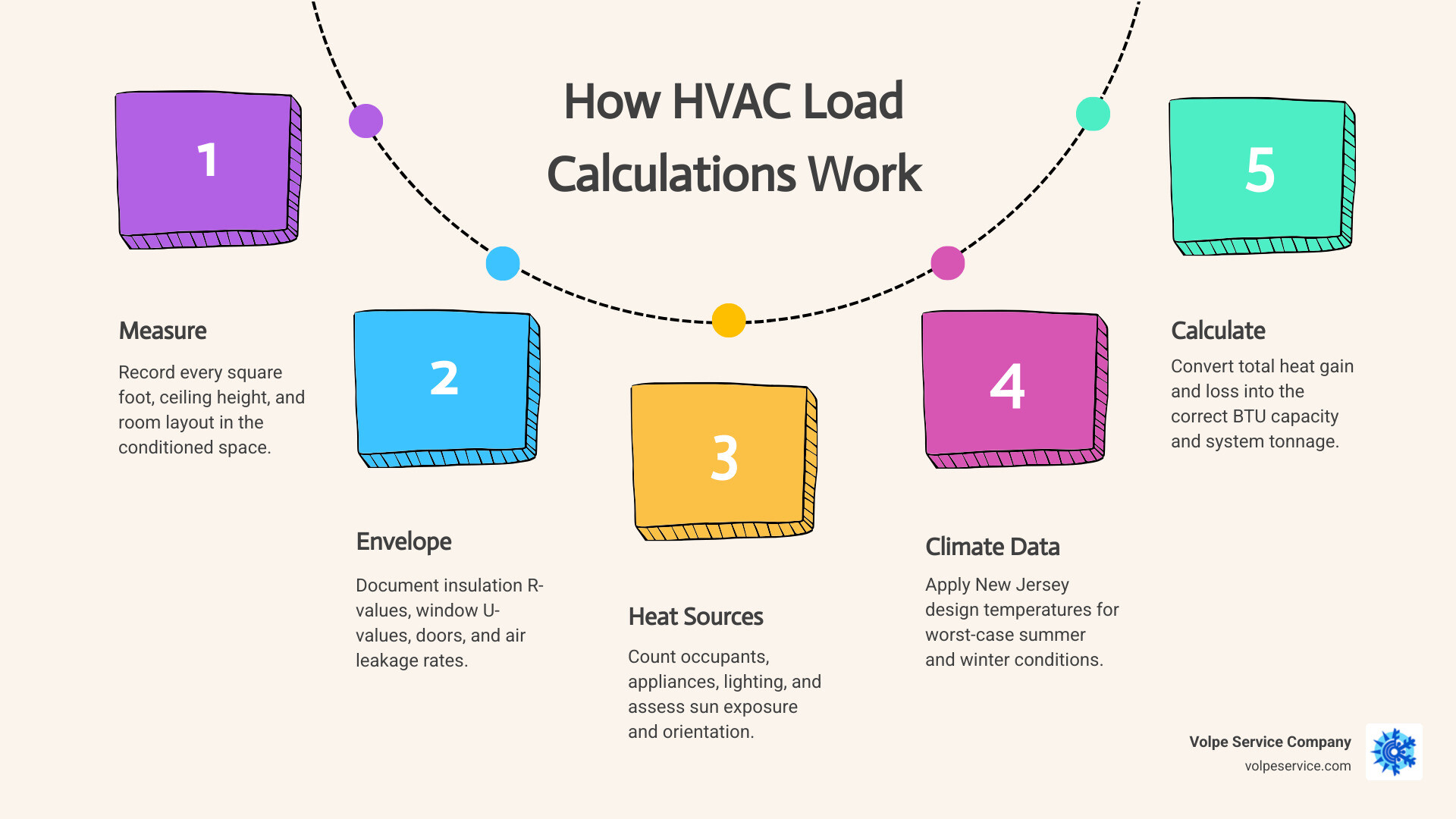
- Measure the space — Square footage, ceiling height, and room layout are recorded for every conditioned area.
- Assess the building envelope — Insulation R-values, window U-values, door construction, and air leakage rates are documented.
- Account for heat sources — Sun exposure, orientation, number of occupants, appliances, and lighting are all factored in.
- Apply local climate data — Outdoor design temperatures specific to your New Jersey location are used to establish worst-case conditions.
- Calculate heat gain and heat loss — Engineers determine how much heat enters in summer and escapes in winter under peak conditions.
- Size the equipment — The total BTU load is converted into the correct system capacity (measured in tons, where 1 ton = 12,000 BTU/h).
When a contractor skips this process and guesses based on square footage alone, you often end up with a system that’s too big or too small — and both outcomes cause real problems. An oversized system short-cycles, leaving your home humid and uncomfortable. An undersized system runs nonstop, driving up energy bills and wearing out components faster.
For New Jersey homeowners dealing with hot, humid summers and cold winters, getting this right isn’t optional — it’s the foundation of a comfortable, efficient home.
Understanding How HVAC Load Calculations Work for Your Home

When we talk about HVAC sizing, we aren’t talking about the physical dimensions of the outdoor unit. We are talking about capacity. In the HVAC world, capacity is measured in BTUs (British Thermal Units) and Tons.
To understand how hvac load calculations work, you first need to know the math of comfort. One “ton” of refrigeration is equal to 12,000 BTUs per hour. This isn’t about weight; it’s a measurement of heat removal. For example, a 3-ton air conditioner can remove 36,000 BTUs of heat from your home every hour.
Another critical figure we look at is CFM (Cubic Feet per Minute). A typical system produces about 400 CFM per ton of air conditioning. If the math is off, the airflow won’t be right, and you’ll end up with rooms that are either freezing or stifling. This is why Why Correct System Sizing is the Secret to a Happy Home is such a vital concept for homeowners in places like Morristown or Summit.
The Science Behind How HVAC Load Calculations Work
At its heart, a load calculation is an analysis of heat gain and heat loss.
- Heat Gain: During a humid July day in East Hanover, heat enters your home through the roof, walls, and windows. It’s also generated inside by your oven, your lights, and even your family members.
- Heat Loss: In the dead of a January winter in Mendham, heat escapes through those same surfaces.
We look at the building envelope—the shell of your home that separates the indoor air from the outdoor elements—to see how well it resists this thermal transfer. If you’ve recently upgraded your windows or added insulation to your attic, your home’s “load” has changed. This means the 4-ton unit that was installed in 2010 might be completely wrong for your home in May 2026. Understanding these shifts is the first step in learning How to Choose the Right Type of AC Unit for Your Home.
Sensible vs. Latent Heat Loads
This is where many “rule of thumb” estimates fail. There are actually two types of heat your AC has to deal with:
- Sensible Heat: This is the heat you can see on a thermometer (dry bulb temperature). It’s the “hotness” of the air.
- Latent Heat: This is the moisture in the air (humidity).
In Northern New Jersey, latent heat is a huge factor. An air conditioner’s job is to lower the temperature and remove moisture. If a system is sized only for sensible heat, it might cool the room down so fast that it doesn’t run long enough to pull the humidity out. You’re left with air that is 72 degrees but feels “clammy” and damp. Proper load calculations ensure the system runs long enough to balance both, preventing common Understanding HVAC Zone Control Problems.
The Manual J Method vs. Square Footage Rules of Thumb
For decades, many contractors used a “rule of thumb” like “one ton for every 500 square feet.” While that might give you a ballpark figure, it’s about as accurate as buying a pair of shoes based on your height instead of your foot size.
The industry standard, developed by the Air Conditioning Contractors of America (ACCA), is the Manual J8 calculation. This is a precision engineering report that looks at the unique DNA of your home. It’s a required step in any professional AC Installation Process Guide.
Why Square Footage Estimates Often Fail
Imagine two 2,000-square-foot homes in Livingston.
- Home A is a brand-new build with high-efficiency spray foam insulation, triple-pane windows, and plenty of shade.
- Home B is a 1920s colonial with original single-pane windows, no wall insulation, and sits in direct sunlight all day.
If you use a square footage rule of thumb, both homes get the same 4-ton unit. But Home A would be massively oversized, leading to short cycling (where the unit turns on and off constantly), while Home B would be undersized, running 24/7 and never reaching the set temperature. This results in excessive wear, higher energy bills, and a much shorter equipment lifespan. This is why Professional AC Installation Benefits always include a data-driven sizing approach.
Key Factors That Influence How HVAC Load Calculations Work
When we perform a Manual J calculation, we aren’t just looking at the floor. We are looking at:
- Insulation R-values: How well do your walls and ceilings resist heat flow?
- Sun Exposure: Which direction does the house face? North-facing rooms stay cooler than those with massive south-facing windows.
- Window U-values: How much heat is conducted through the glass?
- Occupancy Patterns: A home with two retirees has a different heat load than a home with five active kids and two dogs.
- Appliance Heat: Modern electronics and high-end kitchen ranges add significant BTUs to the indoor environment.
- Ceiling Height: A room with 12-foot vaulted ceilings has much more air volume to condition than one with 8-foot ceilings.
- Air Leakage Rates: We use data to determine how much unconditioned outdoor air is “leaking” into your home through gaps and cracks.
Advanced Considerations: Thermal Storage and Radiant Systems
As we move toward more energy-efficient construction in 2026, how hvac load calculations work has become even more sophisticated. We now account for the time-delay effect. This is the idea that building materials, like brick or heavy timber, have “thermal mass.” They soak up heat during the day and release it hours later.
Impact of Building Materials on Peak Loads
The materials used in your home act as a battery for heat. This is why your upstairs might feel warmest at 8:00 PM, even though the sun went down hours ago. Professional software uses the Radiant Time Series (RTS) method to predict exactly when those heat gains will turn into a “cooling load” for your AC.
| Feature | Air-Based Systems (Convective) | Radiant Cooling Systems |
|---|---|---|
| Heat Removal Method | Cools air, which then cools surfaces | Cools surfaces directly to absorb radiant heat |
| Response Time | Fast | Slower (due to thermal mass) |
| Load Conversion | Immediate convective heat gain | Delayed radiant heat gain |
| Humidity Control | Primary function of the coil | Requires separate dehumidification |
Professional Tools and the Importance of the Manual J Report
Gone are the days of scribbling numbers on the back of an envelope. Today, we use advanced tools to ensure your HVAC Services New Jersey are as accurate as possible.
At Volpe Service Company, we lean into data-driven solutions. Many professionals now use LiDAR technology and 3D modeling software (like Wrightsoft or Elite Software) to scan a home’s dimensions. This creates a digital twin of your house, allowing us to simulate how heat moves through every room.
Why Homeowners Should Request a Manual J Report
If you are replacing your HVAC system, you should always ask your contractor for a copy of the Manual J report. Here’s why:
- System Longevity: It proves the system won’t burn itself out by being the wrong size.
- Performance Verification: You can see exactly why a 3-ton unit was chosen over a 4-ton unit.
- Code Compliance: In many New Jersey municipalities, like West Orange or Parsippany, building codes (including IRC Section M1401.3) require these calculations for permits.
- Energy Star Standards: If you’re aiming for high-efficiency rebates, a documented load calculation is often a prerequisite.
Frequently Asked Questions about HVAC Sizing
What happens if my HVAC system is oversized?
It’s a common myth that “bigger is better.” In reality, an oversized system is a nightmare for comfort. It will blast the home with cold air and reach the thermostat setting in five minutes. Because it shuts off so quickly (short cycling), it never has the chance to remove humidity. You end up with “cold and clammy” air, and the constant starting and stopping puts massive strain on the compressor, leading to an early—and expensive—system failure.
How often should a load calculation be performed?
You don’t need one every year, but you absolutely need one if:
- You are replacing your furnace or AC unit.
- You’ve added a room or finished a basement.
- You’ve upgraded your insulation or installed new windows.
- You’ve noticed significant comfort issues (some rooms are always hot, others always cold).
Is a load calculation required for a simple equipment replacement?
Yes. As of May 2026, modern energy codes are very strict. Even if you are just swapping out an old unit for a new one, we must verify that the sizing is correct for the home’s current state. Many homeowners have made their houses tighter and more efficient over the years, meaning the original system size is likely now too large.
Conclusion
Since 1963, Volpe Service Company has been dedicated to “Climate Control Done Right—Guaranteed.” We’ve seen how much a proper load calculation changes the experience of living in a New Jersey home. From the historic streets of Boonton to the modern builds in Montville, every home is a unique puzzle of heat gain and loss.
By using data-driven solutions and honest, transparent communication, we ensure that your family stays comfortable while your energy bills stay manageable. Don’t settle for a “guess-timate” on your next system. Make sure you’re getting the full picture with The Ultimate Homeowner Guide to HVAC Happiness.
Ready to get your home’s sizing right? Here are your next steps:
- Request a room-by-room Manual J report before signing any installation contract.
- Verify your ductwork capacity to ensure it can handle the airflow of a new, high-efficiency system.
- Calculate your potential savings with our SEER tool to see how much a properly sized unit can save you.
If you’re in East Hanover, Madison, or anywhere in our Northern New Jersey service area, let’s make sure your home is sized for success.