
Is Your AC Trying to Tell You Something? Know the Warning Signs Before It’s Too Late
Signs your ac needs repair are easy to miss — until your home feels like a sauna in the middle of a New Jersey summer. A struggling air conditioner rarely fails without warning. It sends signals first: warm air from the vents, strange noises in the night, energy bills that keep climbing for no obvious reason.
The problem is, most homeowners don’t know which signals to take seriously.
Here’s a quick look at the most common signs your AC needs attention:
- Warm or hot air blowing from vents — even when the thermostat is set to cool
- Weak or inconsistent airflow — some rooms cool fine, others feel stuffy
- Unusual noises — grinding, banging, screeching, or rattling
- Strange odors — musty smells (mold), burning smells (electrical issues)
- Frequent on/off cycling — the system starts and stops more than it should
- Water leaks or ice buildup — pooling water or frost on indoor coils
- High humidity indoors — the air feels sticky despite the AC running
- Rising energy bills — no change in usage, but costs keep going up
- Thermostat problems — your home won’t reach the set temperature
- AC won’t turn on at all — a sign of electrical or compressor failure
Catching these early makes a real difference. Most AC problems are far less expensive to fix when they’re identified before they snowball into a full system failure. Ignoring them, on the other hand, can mean bigger repair bills, shorter system lifespan, and — at worst — a complete breakdown on the hottest day of the year.
Whether your system is brand new or pushing 15 years old, knowing what to watch for puts you in control.
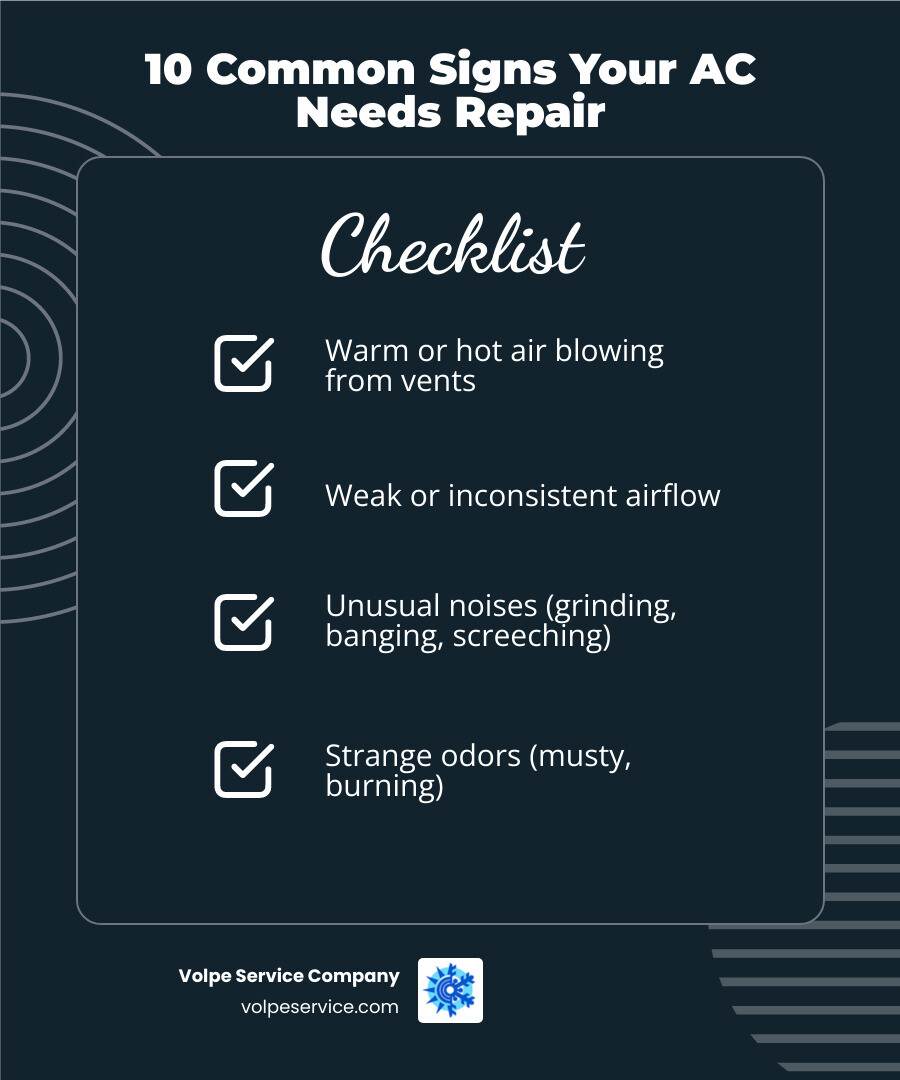
10 Common Signs Your AC Needs Repair
As we settle into April 2026, the cooling season in Northern New Jersey is just around the corner. Ensuring your indoor comfort depends on a system that is reliable and efficient. However, after months of heavy use or even sitting dormant through the winter, your unit might struggle.
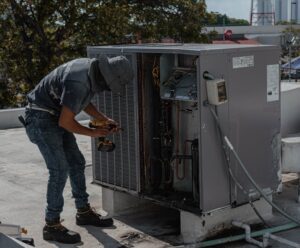
One of the most obvious Signs for AC Repair Service is seeing your outdoor condenser unit choked with debris like leaves, twigs, or grass clippings. This restriction forces the system to work harder, leading to several of the symptoms on our checklist.
- Warm Air: If you feel heat coming from your vents when you’ve requested cool air, your system is failing its primary job.
- Weak Airflow: This often signals that the cool air is being produced but can’t reach your living spaces.
- Frequent Cycling: A healthy AC should have relatively consistent cooling cycles. If it turns on and off every few minutes, it’s “short-cycling.”
- High Humidity: In our part of New Jersey, the AC is responsible for pulling moisture out of the air. If your home feels “sticky,” the AC isn’t doing its job.
- Water Leaks: While some condensation is normal, large puddles around the indoor unit are Signs to Call Our HVAC Technicians immediately.
- Frozen Coils: Seeing frost or ice on your indoor evaporator coils is a major red flag.
- Thermostat Inaccuracies: If one room is freezing while the other is a sauna, your thermostat or ductwork may be compromised.
- Unusual Odors: Smells ranging from “dirty socks” to “burning rubber” require professional investigation.
- Rising Energy Bills: If your utility costs are spiking compared to April of last year, your efficiency has likely plummeted.
- Unusual Noises: Grinding, squealing, or clanking are Signs Your AC Needs Urgent Repair to prevent mechanical destruction.
Why Warm Air and Weak Airflow are Signs Your AC Needs Repair
When your air conditioner starts blowing warm air, it’s often a symptom of a refrigerant leak or a failing compressor. Refrigerant is the lifeblood of your system; it absorbs heat from inside your home and releases it outdoors. If the levels are low due to a leak, there isn’t enough “cooling power” to lower the temperature.
Weak airflow, on the other hand, is usually a mechanical or obstruction issue. We often find that clogged filters are the primary culprit. When a filter is caked with dust, the blower motor has to strain to push air through. Over time, this can lead to blower motor failure.
Another hidden cause of weak airflow is ductwork obstructions or leaks. According to the Department of Energy, up to 20-30% of conditioned air can escape through holes or poorly connected ducts. This means you’re paying to cool your attic or the spaces between your walls instead of your bedroom. Understanding How to Know If Your Air Conditioner Is Broken starts with checking these simple airflow paths.
Unusual Noises and Smells: Critical Signs Your AC Needs Repair
Your AC should run with a steady, predictable hum. If you start hearing sounds that belong in a metal shop, you have a problem. Grinding noises typically point toward worn-out bearings in the motor. Screeching or squealing sounds often indicate a belt that has slipped or is frayed.
Perhaps the most technical “sound” issue involves the capacitor. If you hear a faint clicking or humming but the outdoor fan won’t spin, you may be seeing AC Capacitor Failure Signs. The capacitor acts like a giant battery to jump-start the motor; without it, the system stalls.
Smells are equally telling. An electrical burning odor is a serious safety concern. It often occurs when wiring is shorting out or a motor is overheating. If this happens, you might notice your AC Circuit Breaker Keeps Tripping. Never keep resetting a breaker that won’t stay engaged; this is your home’s way of preventing a fire.
Musty, moldy smells usually point to microbial growth within the ductwork or on the evaporator coils. Because the AC handles so much moisture, any clog in the drain line can create a breeding ground for mold, which then gets blown throughout your home, impacting your indoor air quality.

Repair vs. Replace: Navigating the $5,000 Rule
When you’re faced with a significant repair, the big question is: “Is it worth fixing?” At Volpe Service Company, we like to give our neighbors in East Hanover and Morristown a data-driven way to decide. We use the $5,000 Rule.
To use this rule, multiply the age of your unit by the estimated repair cost. If the total is more than $5,000, it’s usually more cost-effective to replace the unit.
| Factor | Repair | Replace |
|---|---|---|
| System Age | Under 10 years | Over 12-15 years |
| Efficiency | Remains at current SEER | Upgrades to higher SEER2 |
| Refrigerant | Uses R-410A | Moves to modern, eco-friendly options |
| Reliability | May need more repairs soon | Comes with new warranty |
| Initial Cost | Lower | Higher |
The average lifespan of an air conditioner is 10 to 15 years. If your system is approaching that 15-year mark, even a “minor” repair might be throwing good money after bad. Furthermore, if your system still uses R-22 refrigerant (the production of which was banned by the EPA in 2020), repairs involving the refrigerant will be increasingly expensive and difficult.
Modern units offer significantly higher SEER2 (Seasonal Energy Efficiency Ratio) ratings. Upgrading can often pay for itself over several years through reduced monthly energy savings. Knowing the Top Warning Signs How to Tell If Your Air Conditioner Is Broken helps you make this decision before your system dies completely during a July heatwave.
Troubleshooting and Preventing Future AC Failures
Before you pick up the phone, there are a few simple DIY steps every New Jersey homeowner can take. Sometimes, the “repair” is simpler than you think.
- Check the Filter: A dirty filter is the #1 cause of AC issues. Replace it every 1-3 months.
- Thermostat Settings: Ensure it’s set to “Cool” and the temperature is at least 5 degrees below the room temperature.
- Batteries: If your thermostat screen is blank, try fresh batteries.
- Circuit Breakers: Check your electrical panel to see if a breaker has tripped.
- Outdoor Clearance: Ensure there is at least two feet of clear space around your outdoor condenser.
If these steps don’t resolve the issue, you likely have Signs You Need an AC Repair that requires a licensed professional.
The best way to avoid these headaches is through annual maintenance. A seasonal tune-up in the spring allows us to clean the coils, check refrigerant levels, and tighten electrical connections. This prevents the small “wear and tear” issues from becoming “emergency breakdown” issues.
Frequently Asked Questions about AC Repair
How long do air conditioners typically last in New Jersey?
In our region, you can expect a central AC unit to last between 10 and 15 years. Factors like our high summer humidity and, for our customers in areas like Millburn or Summit, the heavy use during heatwaves can impact this. Regular maintenance is the single biggest factor in reaching that 15-year mark.
Why are my energy bills spiking during the summer?
Spiking bills usually indicate reduced efficiency. When coils are dirty or the refrigerant is low, the system has to run for much longer cycles to reach the desired temperature. Mechanical strain on an aging motor also draws more electricity. Lastly, don’t forget the ducts; if they are leaking, you’re losing money into your attic.
Is a leaking AC unit a safety concern?
It can be. If the leak is water, the primary concern is property damage and mold growth. However, if the “leak” is actually refrigerant, it poses a health risk and environmental hazard. Additionally, water leaking onto electrical components can cause short circuits or fire hazards.
Conclusion
Don’t let a struggling air conditioner ruin your summer comfort. By keeping an eye out for these signs your ac needs repair, you can address minor issues before they lead to a total system failure. Whether it’s a strange noise in Livingston or weak airflow in West Orange, catching the problem early saves you time, money, and stress.
Volpe Service Company has been providing data-driven HVAC solutions to Northern New Jersey since 1963. From East Hanover to Parsippany and beyond, our family-owned team is dedicated to honest pricing and courteous service. We don’t just guess; we use our 60+ years of experience to diagnose exactly what your system needs to keep you cool.
Ready to ensure your home stays comfortable all season long? Schedule your professional cooling service today with the experts at Volpe Service Company.