

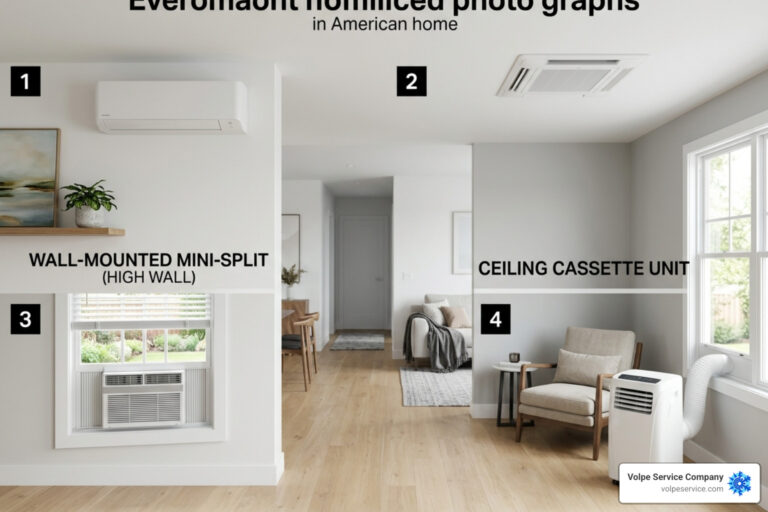
Why Adding Cooling Without Ductwork Options Compared Matters for Older New Jersey Homes
Adding cooling without ductwork options compared is one of the most common challenges facing owners of older homes across Northern New Jersey — and the stakes are real when summer temperatures climb and your 1920s craftsman has never seen a duct in its life.
Here is a quick look at your main options:
| Option | Best For | Efficiency | Disruption Level |
|---|---|---|---|
| Ductless mini-split | Whole-home or multi-room comfort | SEER 16-28+ | Low |
| High-velocity small-duct system | Historic homes needing invisible outlets | SEER 14-18 | Moderate |
| Window AC unit | Single-room, temporary use | EER 10-15 | Very low |
| Through-the-wall (PTAC) unit | Permanent single-room solution | EER up to 15 | Low-moderate |
| Portable AC | Renters or truly temporary needs | EER 8-12 | None |
Traditional central air conditioning depends on ductwork to move cooled air from room to room. But many homes built before the 1960s — and especially the century homes common in towns like Morristown, Montville, and Madison — were never designed with ducts in mind. Adding them now often means cutting through plaster walls, dropping ceilings, or sacrificing closet space. That is a hard sell when you love your home’s original character.
The good news is that modern technology has made duct-free cooling genuinely excellent — not just a compromise. In fact, because traditional duct systems can lose up to 30% of cooling energy through leaks alone, going ductless can actually outperform central air in many real-world situations.
Whether you need to cool a single room or an entire multi-story home, understanding your options — and how they compare on efficiency, comfort, cost, and preservation — is the first step toward making the right call.

Primary Options for Adding Cooling Without Ductwork Options Compared
When we look at adding cooling without ductwork options compared, we generally categorize them into permanent upgrades and temporary fixes. For homeowners in East Hanover or Summit who want a long-term solution that adds value to their property, the focus usually lands on ductless mini-splits and high-velocity systems.
Ductless Mini-Splits
Considered the “gold standard” for older homes, these systems consist of an outdoor condenser connected to one or more indoor air handlers via small refrigerant lines. They are incredibly efficient and offer the flexibility to cool specific rooms or the entire house. If you are just starting your research, our Mini Split AC Complete Guide provides a deep dive into how these systems function.
High-Velocity Small-Duct Systems
These systems use a specialized air handler and flexible, 2-inch insulated tubing. Because the tubing is so small, it can be snaked through walls and ceilings with far less destruction than traditional 10-inch metal ducts. It is a “low-duct” rather than a “no-duct” option.
Single-Room and Temporary Solutions
For those on a tighter timeline or in a rental situation, options like window units, portable ACs, and through-the-wall units (PTACs) provide localized relief. However, these often come with trade-offs in noise, security, and energy waste. When searching for a Mini Split Installation Near Me, many New Jersey residents find that the permanent comfort of a mini-split far outweighs the seasonal headache of lugging window units from the basement.
Evaluating adding cooling without ductwork options compared for historic preservation
In towns like Parsippany and Chester, preserving the architectural integrity of a home is a top priority. Traditional ductwork installation can be “surgical” at best and “demolition-heavy” at worst.
Ductless systems are a favorite for preservation because they only require a 3-inch hole through the exterior wall for the refrigerant line and electrical wiring. This means we can keep your original plaster walls and crown molding intact. For those specifically looking for Ductless Installation Parsippany NJ, the goal is always to provide modern comfort without changing the “soul” of the home.
How adding cooling without ductwork options compared for humidity control
New Jersey summers are famous for their “thick” air. Humidity control is where high-quality systems really shine. While a standard window unit might cool the air, it often leaves the room feeling clammy because it doesn’t run long enough to remove moisture effectively.
Modern systems, such as Daikin Ductless units, use inverter technology. Instead of turning full-on and full-off, the compressor adjusts its speed to maintain a steady temperature. This allows the system to run longer at lower speeds, which is the secret to superior dehumidification and improved indoor air quality. High-velocity systems are also moisture-wicking powerhouses, often removing up to 30% more moisture than conventional systems because their coils run colder.
Comparing Ductless Mini-Splits and High-Velocity Systems
| Feature | Ductless Mini-Split | High-Velocity System |
|---|---|---|
| Aesthetics | Visible indoor wall/ceiling units | Small, 2-inch circular vents |
| Installation | Very low disruption (3-inch hole) | Moderate disruption (snaking tubes) |
| Dehumidification | Excellent (Inverter tech) | Superior (Colder coils) |
| Efficiency | Highest (up to 28+ SEER2) | High (14-18 SEER2) |
| Zoning | Built-in (Room-by-room control) | Possible with dampers |
Choosing between these two often comes down to your visual preference. If you don’t mind a sleek, white unit on the wall (or a recessed ceiling cassette), the mini-split is usually the most efficient and cost-effective path. If you want the system to be nearly invisible, high-velocity is the way to go.
We often receive Mini Split Installations Questions about whether one outdoor unit can handle multiple rooms. The answer is yes! A Customized Ductless Installation can connect one outdoor compressor to as many as eight indoor units, creating a fully zoned cooling network for your whole home.
Maximizing Performance with Proper Sizing and Zoned Cooling
One of the biggest mistakes a homeowner can make is guessing the size of the system they need. In the HVAC world, bigger is not better — it’s actually worse.
An oversized system will “short-cycle,” meaning it turns on, blasts the room with cold air, and shuts off before it has a chance to dehumidify the space. This leads to uneven temperatures and high energy bills. We use a Manual J load calculation to determine the exact cooling needs of each room, taking into account window placement, insulation levels, and local New Jersey climate data.
This precision is vital during the Mini Split Installation Process Explained to our clients. By correctly sizing the system, we ensure you get the maximum benefit of zoned cooling. Zoned cooling allows you to keep the bedroom at 68°F for sleep while keeping the guest room at 74°F, potentially reducing energy consumption by up to 40% compared to a central system. For a full breakdown of what to expect, check out our Guide to Ductless Installation.
Energy Efficiency Ratings and 2026 Federal Incentives
As of April 2026, the standards for energy efficiency have never been higher. You will see terms like SEER2 (Seasonal Energy Efficiency Ratio) and HSPF2 (Heating Seasonal Performance Factor). These are measurements of how much cooling or heating the system provides per watt of electricity used.
Ductless systems consistently lead the pack, often hitting SEER2 ratings of 20 to 28+. Compare that to a window unit, which typically hovers around 10 to 12. The Mini Split Installation Top Benefits include more than just comfort; they include significant long-term savings on your utility bills.
Furthermore, the Section 25C tax credits are a game-changer this year. Homeowners can claim a federal tax credit of 30% of the equipment and installation cost for qualifying heat pumps, up to $2,000 per year. When you factor in these incentives during your Mini Split AC Install, the transition to high-efficiency cooling becomes much more accessible.
Frequently Asked Questions About Ductless Cooling
How quiet are ductless systems compared to window units?
If you’ve ever tried to watch a movie or have a conversation over the roar of a window AC, you’ll appreciate the silence of a mini-split. Indoor units typically operate between 19 and 32 decibels. To put that in perspective, a whisper is about 30 decibels. Because the compressor (the noisy part) is located outside, all you hear indoors is the gentle hum of a small fan.
What maintenance is required for long-term performance?
While these systems are robust, they aren’t “set it and forget it.” To keep yours running for its full 15-20 year lifespan:
- Clean the filters: You should wash the reusable filters every 4-6 weeks during peak season.
- Clear the outdoor unit: Ensure leaves or “New Jersey snow” (cottonwood seeds) aren’t clogging the coils.
- Annual Inspections: A professional tune-up once a year ensures refrigerant levels are correct and drain lines are clear. Following these Mini Split Installation Steps for maintenance will protect your investment.
Can these systems provide heating during New Jersey winters?
Absolutely. Modern mini-split heat pumps are designed for cold climates. Many models can provide effective heating even when outdoor temperatures drop to -5°F or -13°F. Many of our clients in Morristown and Summit use a hybrid setup. They keep their beautiful cast-iron radiators for the “deep freeze” of January but use their mini-splits for cooling in the summer and highly efficient heating during the “shoulder seasons” of spring and autumn.
Conclusion
Adding cooling to a home without ductwork doesn’t have to be a compromise. Whether you choose the nearly invisible vents of a high-velocity system or the ultra-efficient zoning of a ductless mini-split, you are investing in the comfort and longevity of your home.
At Volpe Service Company, we’ve been helping New Jersey families stay comfortable since 1963. From East Hanover to Mendham, our family-owned team uses data-driven solutions to ensure your climate control is done right the first time. We believe in honest pricing, constant communication, and treating your historic home with the respect it deserves.
Ready to reclaim your home from the summer heat? Schedule Expert AC Installation in Chester NJ or any of our surrounding service areas today and let us help you find the perfect ductless solution for your needs.