
Why Choosing Between Central Air vs Mini Split for Northern New Jersey Homes Is a Big Decision
central air vs mini split for northern new jersey homes is one of the most common — and most important — HVAC questions homeowners ask, especially as April 2026 brings another warm season to the region.
Northern New Jersey’s summers are genuinely tough. Average highs hover around 85°F with humidity levels between 65% and 80%, and most years bring 90 or more days where you’ll need active cooling. Add in the region’s cold winters and the fact that a huge number of local homes were built before 1970 — many without any ductwork at all — and it’s clear that picking the right system isn’t just about comfort. It’s about what actually works for your home’s structure, your comfort needs, and the local climate.
Here’s a quick-reference comparison to help you decide:
| Factor | Central Air | Ductless Mini-Split |
|---|---|---|
| Best for | Homes with existing ductwork | Homes without ductwork, additions, older homes |
| Energy efficiency (SEER) | 14–22 | 20–30+ |
| Duct energy loss | 20–30% lost through ducts | None |
| Heating capability | Cooling only (unless heat pump) | Yes — heats and cools year-round |
| Installation disruption | High if no ducts exist | Low — typically 1–2 days per zone |
| Zoning control | Limited (single thermostat) | Room-by-room control |
| System lifespan | 12–15 years | Up to 20 years |
| Federal tax credit (IRA) | Available | Available |
Bottom line: If your Northern NJ home already has ductwork in good condition, central air is often the more straightforward upgrade. If your home lacks ducts — which is common in pre-1970 colonials, cape cods, and split-levels throughout towns like Morristown, Summit, and Mendham — a ductless mini-split system is almost always the smarter, more efficient choice.
Read on for a full breakdown of how each system performs in Northern New Jersey’s specific climate, what installation really involves for older homes, and which system will serve you best long-term.
Understanding Central Air vs Mini Split for Northern New Jersey Homes
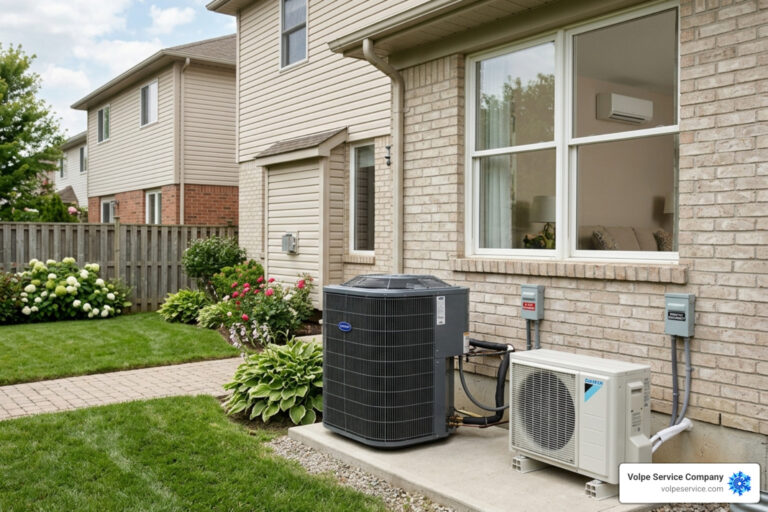
When we talk about central air vs mini split for northern new jersey homes, we are comparing two fundamentally different ways of moving heat. Central air conditioning is the “traditional” choice for many. It relies on a large outdoor condenser and an indoor evaporator coil, usually paired with a furnace. It uses a network of ducts to push chilled air into every room. If you are switching your home to central AC, you are investing in a system that is virtually invisible, with only small vents showing in each room.
On the other hand, mini split AC installation offers a more flexible, “ductless” approach. These systems consist of one outdoor unit connected to one or more indoor air handlers by small refrigerant lines. Because they don’t need bulky ducts, they are a favorite for the century homes found in Boonton and Mountain Lakes.
The aesthetic impact is a major point of comparison. Central air is hidden, while mini-splits involve a sleek unit mounted on the wall or ceiling. However, mini-splits win on noise levels; they are incredibly quiet, often operating at decibel levels lower than a whisper (20–30 dB), whereas central air handlers can be much louder as air rushes through the vents.
How Central Air Systems Work in NJ
A central AC system works by pulling warm air from your home through return ducts, cooling it over a set of evaporator coils, and then blowing the chilled air back through supply ducts. This forced-air distribution is great for achieving a uniform temperature across an entire floor. If you have a newer home in Parsippany or a colonial that was retrofitted with ducts decades ago, air conditioning installation in Parsippany, NJ for a central system is often the most practical path forward.
The Mechanics of Ductless Mini-Split Systems
Mini-splits use advanced inverter-driven compressors. Unlike traditional AC units that are either “all on” or “all off,” an inverter compressor can speed up or slow down to match the exact cooling needs of the room. This provides incredible room-by-room control. If you have a home office in Madison that gets sun all afternoon but a bedroom that stays cool, you can adjust each unit independently. For those in need of ductless HVAC services in Parsippany, NJ, this means no more “hot spots” or fighting over a single thermostat.
Energy Efficiency and Performance in the Garden State
Efficiency is where the debate over central air vs mini split for northern new jersey homes gets interesting. In 2026, we look at SEER2 (Seasonal Energy Efficiency Ratio) and HSPF2 (Heating Seasonal Performance Factor) ratings to judge performance.
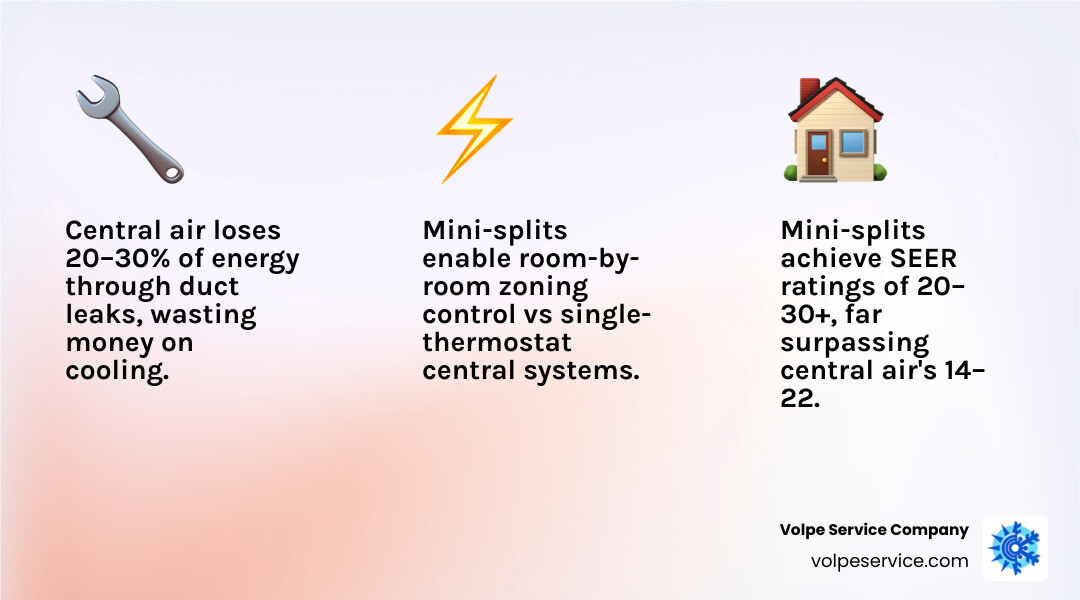
One of the top benefits of mini split installation is the elimination of duct loss. According to Energy Star, the average central HVAC system wastes about 30% of its energy through leaks, holes, and poor connections in the ductwork. Since mini-splits don’t use ducts, 100% of the conditioned air stays in your living space.
| Metric | Central AC | Ductless Mini-Split |
|---|---|---|
| SEER2 Rating | 14 – 22 | 20 – 30+ |
| Energy Loss | 20% – 30% (Ducts) | 0% |
| Lifespan | 12 – 15 Years | ~20 Years |
| Heating | Optional (Heat Pump) | Standard (Most Models) |
Efficiency of Central Air vs Mini Split for Northern New Jersey Homes
If you are trying to choose the right type of AC unit for your home, consider your energy bills. Mini-splits typically achieve SEER ratings between 20 and 30+, while even high-efficiency central units usually top out around 22. This higher efficiency, combined with the ability to turn off units in unoccupied rooms, can lead to significant improvements in energy efficiency during those humid July weeks in Livingston and Summit.
Heating Capabilities and 2026 Rebates
Modern mini-splits are almost always heat pumps, meaning they can provide high-efficiency heating even when Northern NJ temperatures drop well below freezing. Some units maintain full heating capacity down to -22°F.
This dual-functionality makes them eligible for significant incentives. Under the Inflation Reduction Act, homeowners may qualify for federal tax credits for high-efficiency heat pumps. Additionally, local utilities like PSE&G offer rebates that can further offset the initial installation. Central AC units also qualify for credits, though the available incentives may vary in amount.
Installation Considerations for Historic and Older Properties
Northern New Jersey is famous for its historic architecture, from 19th-century Victorians in Morristown to mid-century moderns in Montville. These homes often present a challenge: they were built to be “breathable” and use radiators for heat, meaning there is no ductwork.
If you are looking at AC replacement in Parsippany, NJ for a home without ducts, the choice becomes clear. Installing new ductwork in a finished century home can be invasive, requiring us to cut into plaster walls, drop ceilings, or sacrifice closet space.
Choosing Central Air vs Mini Split for Northern New Jersey Homes with No Ductwork
For homes without existing infrastructure, ductless systems are a godsend. Installation is non-invasive; we only need to drill a small three-inch hole through the exterior wall to connect the indoor and outdoor units. This preserves the architectural integrity of your home.
However, if your home has a large, unfinished attic, we can sometimes install a central air handler there and run ducts down into the second-floor rooms. This is a common “hybrid” solution we provide through our HVAC services in New Jersey. But for multi-story homes or additions like a finished basement or a new sunroom in Chester, the mini-split remains the most flexible option.
Maintenance Requirements and Reliability
Both systems require a bit of love to reach their full lifespan.
- Central Air: Requires monthly filter changes, annual professional inspections, and duct cleaning every 3 to 5 years.
- Mini-Splits: Require you to wash the reusable filters every 4 to 6 weeks and have a professional deep-clean the coils once a year to prevent mold and dust buildup.
When you are deciding should you repair or replace your air conditioner, keep longevity in mind. A well-maintained mini-split can last up to 20 years, while a central AC unit typically needs replacement after 12 to 15 years due to the heavy load on the compressor and the wear and tear on the duct system.
Frequently Asked Questions about NJ Cooling Systems
Which system is better for older homes in Morristown or Summit?
For historic preservation, mini-splits are usually superior. They avoid the need for massive renovations to install ducts. However, if your Morristown home already has a forced-air heating system, upgrading to a high-efficiency central AC unit is often the simpler and more direct upfront choice. We always look at the specific “bones” of the house before making a recommendation.
Can a mini-split system effectively heat a home during a Northern NJ winter?
Absolutely. Modern “cold-climate” heat pumps are designed specifically for regions like ours. They use inverter technology to extract heat from the outside air even when it’s freezing. While many NJ homeowners keep their existing boilers or furnaces as a backup for the absolute coldest nights, a mini-split can handle the bulk of the heating season very efficiently.
How long do these systems typically last with proper maintenance?
Central AC systems generally last 12 to 15 years. The ductwork can last longer, but it often needs sealing or repair over time. Ductless mini-split systems are built for the long haul, often reaching the 20-year mark if the filters are kept clean and the outdoor unit is kept clear of snow and debris.
Conclusion
Choosing between central air vs mini split for northern new jersey homes doesn’t have to be a headache. At Volpe Service Company, we’ve been helping our neighbors in East Hanover, Morristown, and across Northern NJ find their perfect comfort balance since 1963.
As a family-owned and operated business, we don’t believe in “one size fits all” HVAC. We use data-driven solutions to analyze your home’s layout, insulation, and your family’s specific needs. Whether you need a high-tech zoned mini-split system for a Mendham estate or a reliable AC installation in Chester, NJ for a traditional colonial, we are committed to professional workmanship and courteous service.
Ready to upgrade your home’s comfort for the 2026 season? Contact us today to schedule a consultation and see why we’ve been Northern New Jersey’s trusted HVAC partner for over 60 years.