
What You Need to Know About Federal Tax Credits for Heat Pump and Boiler Upgrades
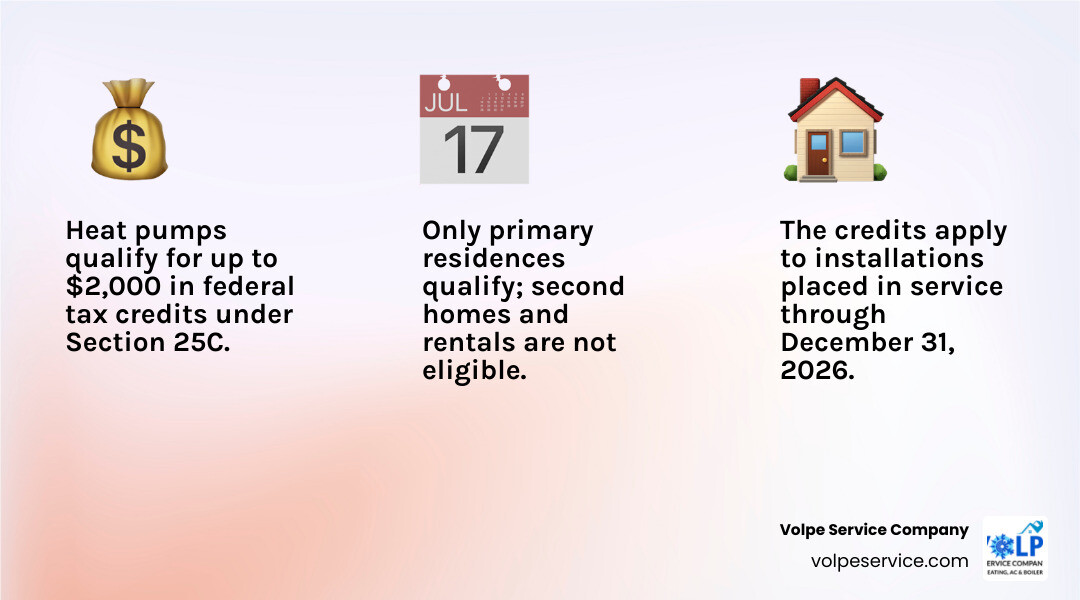
Federal tax credits for heat pump and boiler upgrades are still available for qualifying installations completed by December 31, 2026 — and they can put real money back in your pocket. Under Section 25C of the tax code, homeowners can claim 30% of the cost of eligible equipment, up to set annual limits depending on what they install.
Here is a quick summary of what is available:
| Upgrade Type | Credit Rate | Annual Maximum |
|---|---|---|
| Heat pumps and heat pump water heaters | 30% of cost | $2,000 |
| Gas or oil boilers and furnaces | 30% of cost | $600 (within $1,200 cap) |
| Combined annual maximum | – | $3,200 |
Key facts at a glance:
- The credit is nonrefundable — it reduces taxes you owe, but you cannot receive more back than your tax bill
- There is no lifetime limit — you can claim eligible credits every year through the end of 2026
- Equipment must be installed in your existing primary residence in the United States
- Rebates and utility incentives reduce the qualified expenses you can use to calculate the credit
- You claim it by filing IRS Form 5695 with your federal tax return for the year of installation
For New Jersey homeowners considering a heat pump or boiler upgrade, understanding these credits before you buy can make a meaningful difference in your total cost. The credits were expanded under the Inflation Reduction Act of 2022 and apply to qualified improvements placed in service from January 1, 2023 through December 31, 2026. Whether you are replacing an aging boiler or switching to a modern heat pump system, getting the details right from the start helps you avoid leaving money on the table.
How Federal Tax Credits for Heat Pump and Boiler Upgrades Work in 2026

If you are planning to upgrade your home’s heating and cooling system this year, you are in a prime position to take advantage of federal tax incentives. The Energy Efficient Home Improvement Credit, governed by Section 25C of the Internal Revenue Code, provides a substantial financial cushion for homeowners who transition to high-efficiency systems.
Unlike a tax deduction, which simply reduces your taxable income, a tax credit is a dollar-for-dollar reduction of your actual tax liability. If you owe the federal government money at the end of the year, this credit directly wipes away a portion of that debt.
Under these rules, you can claim a credit equal to 30% of the total qualified purchase and installation costs of eligible energy-efficient home improvements. However, the IRS does not write blank checks; the credit is subject to strict annual caps depending on the type of equipment you install.
Because these credits are nonrefundable, they can only reduce your tax liability to zero. Any excess credit cannot be carried forward to future tax years. If you are wondering how this fits into your overall tax planning, you can learn more about the rules in our detailed guide on Can You Write Off a New HVAC System on Your Taxes?.
Annual Limits for Federal Tax Credits for Heat Pump and Boiler Upgrades
To make the most of these incentives, you have to understand how the IRS categorizes different upgrades. The federal government divides energy-efficient improvements into distinct “buckets,” each with its own annual cap.
The two primary buckets that apply to HVAC upgrades are:
- The Heat Pump Bucket ($2,000 Cap): This category includes electric or natural gas heat pumps and heat pump water heaters. You can claim 30% of the cost, up to a maximum of $2,000 per year.
- The General Energy Property Bucket ($1,200 Cap): This category covers conventional heating and cooling equipment, such as natural gas, propane, or oil boilers and furnaces, as well as central air conditioners and building envelope improvements (insulation, doors, and windows). Within this $1,200 aggregate limit, hot water boilers and furnaces are individually capped at $600.
The IRS allows you to combine these buckets up to an overall maximum annual credit of $3,200. This means you could install a high-efficiency heat pump and a qualified boiler in the same calendar year and claim credits from both categories, provided you do not exceed the combined cap.
| Category | Individual Equipment Limit | Combined Category Limit |
|---|---|---|
| Heat Pumps & Heat Pump Water Heaters | 30% of cost, up to $2,000 | $2,000 per year |
| Boilers, Furnaces, & Central AC | 30% of cost, up to $600 per unit | $1,200 per year (including insulation/windows) |
| Overall Annual Maximum Credit | – | $3,200 per year |
Who Qualifies for Federal Tax Credits for Heat Pump and Boiler Upgrades?
Eligibility for the Section 25C tax credit depends heavily on who owns the property, how the property is used, and the type of home being upgraded.
- Primary Residences: To qualify for the majority of these credits, the equipment must be installed in an existing home located in the United States that serves as your principal residence. New construction homes do not qualify for the Section 25C credit.
- Renters: If you rent your home, you can still claim credits for certain portable or tenant-installed residential energy property, such as qualified heat pumps or stoves. However, renters cannot claim credits for building envelope components (like insulation or exterior doors) that are permanently integrated into a building they do not own.
- Second Homes and Rental Properties: You cannot claim the Section 25C credit for property that you do not use as a residence. Landlords who upgrade rental properties are ineligible for this credit. However, if you own a second home that you use personally as a residence (and do not rent out to others), you may claim credits for qualifying energy property, though you cannot claim building envelope improvements on that second home.
If you are weighing the long-term value of transitioning to this technology, you might ask yourself: Is It Worth Installing a Heat Pump?. The combination of lower monthly utility bills and upfront federal tax savings makes it an incredibly compelling option for homeowners throughout Northern New Jersey.
Technical Efficiency Standards for Qualifying Equipment
Simply buying a “new” heat pump or boiler does not guarantee you will qualify for the tax credit. The federal government uses these incentives to drive the adoption of highly efficient technology, which means the equipment you select must meet rigorous performance standards.
To verify eligibility, the IRS relies on standards set by the Consortium for Energy Efficiency (CEE) and the ENERGY STAR program. Before signing any contract, it is vital to confirm that your chosen model is listed in the database of qualifying products. For a broader look at modern heating options, check out our guide on Is It Worth Getting a New Combi Boiler Now?.
Heat Pump Efficiency Requirements
For heat pumps installed in 2026, the equipment must meet or exceed the highest efficiency tier (excluding the advanced tier) established by the CEE that was in effect at the beginning of the calendar year.
These standards vary based on whether the system is a ducted split system, a ductless mini-split, or a packaged unit. Key metrics to look for include:
- SEER2 (Seasonal Energy Efficiency Ratio 2): Measures cooling efficiency.
- EER2 (Energy Efficiency Ratio 2): Measures cooling efficiency under peak outdoor temperatures.
- HSPF2 (Heating Seasonal Performance Factor 2): Measures heating efficiency over a typical heating season.
Additionally, for split-system heat pumps, the IRS requires that both the outdoor condenser and the indoor air handler be installed together as a matched system. Upgrading only one half of an older split system will disqualify the project from receiving the credit.
As heating technology continues to improve, many local families are discovering how well these systems handle our local winters. You can read more about why these systems are so effective in our article on Why New Jersey Homeowners Are Warming Up to Modern Heat Pumps.
Boiler Efficiency Requirements
If you prefer hydronic heating, upgrading to a high-efficiency boiler is an excellent way to improve comfort while securing a $600 tax credit. To qualify, conventional hot water boilers must meet the following criteria:
- Natural Gas or Propane Boilers: Must be ENERGY STAR certified and achieve an Annual Fuel Utilization Efficiency (AFUE) rating of 95% or higher.
- Oil Boilers: Must meet alternative efficiency criteria, specifically operating at an AFUE of 90% or higher, and must be certified by the manufacturer to run on fuel blends containing at least 20% biodiesel, renewable diesel, or second-generation biofuel.
Because our communities in Morris, Essex, and Union counties feature many historic homes with traditional radiator or baseboard heating systems, replacing an old, inefficient boiler is often the most practical path to comfort. For a complete look at your options, read through our Boiler Replacement Service Complete Guide.
How to Claim Your Tax Credits and Required Documentation
Claiming your tax credit requires careful documentation. If you are audited, the IRS will expect you to produce specific records proving that your upgraded system met all federal guidelines in the year it was placed in service.
To claim the credit on your federal income tax return, you must complete IRS Form 5695 (Residential Energy Credits) and submit it along with your standard Form 1040.
For installations completed in 2025 and 2026, the IRS has implemented stricter anti-fraud measures. You must ensure your documentation includes:
- The Manufacturer’s Certification Statement: A signed document from the manufacturer certifying that the specific model number qualifies for the Section 25C credit.
- The Qualified Manufacturer Identification Number (QMID) or PIN: A unique product identifier that must be entered directly onto Form 5695.
- An Itemized Invoice: Your invoice must clearly break down the cost of the equipment versus the labor. While labor costs for installing residential energy property (like heat pumps and boilers) are eligible for the credit, labor costs for building envelope components (like insulation) are not.
Working with an experienced, professional team ensures that your installation is completed correctly and that you receive all the necessary paperwork to file your claim smoothly. Learn more about what to expect during your project by reading about Expert Heat Pump Installation Benefits.
The Impact of Rebates and Utility Incentives
When calculating your tax credit, you must pay close attention to how other financial incentives impact your “qualified expenses.” The IRS requires you to subtract any state rebates, utility subsidies, or federal grants from the total project cost before you calculate your 30% tax credit.
For example, if a heat pump installation costs $8,000, and you receive a $1,500 instant rebate from your local New Jersey utility company, your qualified expense for tax purposes is $6,500. Your 30% tax credit would be calculated as 30% of $6,500 ($1,950), rather than 30% of the original $8,000.
This rule applies to:
- Utility Rebates: Instant or mail-in rebates offered by electric or gas utilities.
- State Rebate Programs: Funding from state energy offices, including programs funded by the Inflation Reduction Act like the HOMES (Home Energy Performance-Based, Whole-House Rebates) program and the HEAR (High-Efficiency Electric Home Rebate Act) program.
Navigating these stacked incentives can be tricky, but it is the best way to drive down your out-of-pocket costs. For more information on system maintenance and operations, check out our Heat Pump Services Guide.
Strategic Planning to Maximize Your Energy Savings
Because the Section 25C tax credit has an annual limit but no lifetime limit, smart homeowners can maximize their savings by spreading their energy efficiency projects over multiple tax years.
If you try to do everything at once—installing a heat pump, upgrading your boiler, adding insulation, and sealing your air ducts—you will quickly blast past the $3,200 annual cap, leaving valuable tax savings on the table.
Instead, consider a multi-year strategy:
- Year 1: Schedule a professional home energy audit (eligible for a 30% credit up to $150). Use the audit results to air-seal and insulate your attic (eligible for a 30% credit up to $1,200).
- Year 2: Upgrade your primary heating and cooling system to a high-efficiency heat pump (eligible for a 30% credit up to $2,000). If your electrical panel needs an upgrade to support the new heat pump, this electrical work can also qualify for a credit of up to $600.
- Year 3: Replace an aging hot water boiler with an ENERGY STAR certified model (eligible for a 30% credit up to $600).
By sequencing your projects, you can claim thousands of dollars in federal credits over several years while systematically reducing your home’s energy consumption. If you are starting with a boiler upgrade, you can learn about the long-term rewards in our article on Modern Boiler Installation Benefits.
Frequently Asked Questions About HVAC Tax Credits
Can I claim the credit for a second home?
Yes, but with limitations. You can claim the Section 25C credit for qualifying residential energy property (such as heat pumps, heat pump water heaters, and boilers) installed in a second home, as long as you personally use that home as a residence. However, you cannot claim credits for building envelope components—such as insulation, exterior doors, or windows—on a second home. Rental properties that you own but do not live in are completely ineligible for these credits.
What is the deadline for 2026 installations?
To claim the credit on your 2026 tax return, the qualifying equipment must be fully installed and placed in service on or before December 31, 2026. The IRS defines “placed in service” as the date the installation is complete and the equipment is ready for regular use. Simply signing a contract or paying a deposit in 2026 is not sufficient if the physical installation does not take place until 2027.
Are these tax credits refundable?
No, the Section 25C tax credit is strictly nonrefundable. This means it can reduce your tax liability to zero, but any remaining credit cannot be refunded to you as a check, nor can it be carried forward to offset your taxes in future years. It is highly recommended to consult with a certified tax professional to understand how your specific tax liability matches up with your planned home improvements.
Conclusion
Upgrading your home’s heating and cooling systems is a significant investment, but federal tax credits make high-efficiency technology more accessible than ever. By carefully selecting equipment that meets CEE and ENERGY STAR standards, keeping detailed installation records, and planning your upgrades strategically, you can secure up to $3,200 in tax savings every year.
At Volpe Service Company, we have been helping New Jersey families stay comfortable in their homes since 1963. Our team of licensed, highly trained technicians provides data-driven solutions, honest pricing, and clear communication throughout every project. We serve homeowners across Northern and Central New Jersey, including East Hanover, Livingston, Morristown, Summit, West Orange, Madison, Millburn, Denville, Parsippany, Montville, Boonton, Mountain Lakes, Chester, Mendham, and Mt. Olive.
Ready to plan your energy-efficient upgrade? Contact us today to schedule a consultation with our local comfort specialists at our Parsippany HVAC Service Page and take the first step toward a more efficient, comfortable home.