

Why Getting the Right Size HVAC for Northern New Jersey Homes Is More Complex Than You Think
Getting the right size HVAC for Northern New Jersey homes is one of the most important decisions you’ll make as a homeowner — and one of the most commonly mishandled. Northern New Jersey sits in ASHRAE Climate Zone 4A, a mixed-humid zone that throws both extremes at your system: winters that routinely drop to the mid-20s°F and summers that combine heat with heavy humidity. That dual demand means a system that’s even slightly off in size can leave you uncomfortable, paying higher energy bills, and facing early equipment failure.
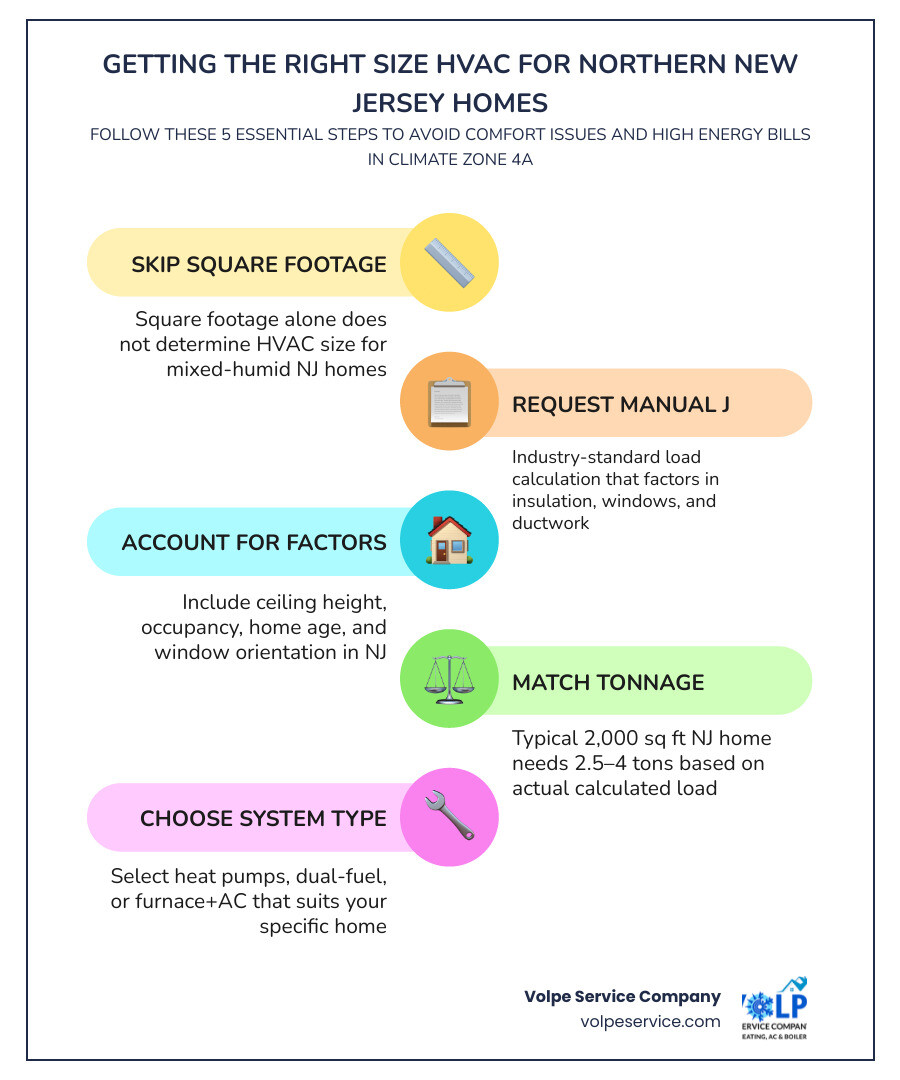
Here’s a quick-reference guide to getting the sizing right:
| Step | What to Do |
|---|---|
| 1. Skip the square footage rule | Square footage alone does not determine the right HVAC size |
| 2. Request a Manual J calculation | This is the industry-standard load calculation method |
| 3. Account for home-specific factors | Insulation, windows, ductwork, ceiling height, and occupancy all matter |
| 4. Match tonnage to your actual load | A typical 2,000 sq ft NJ home needs roughly 2.5–4 tons depending on condition |
| 5. Choose the right system type | Heat pumps, dual-fuel, or furnace+AC — each suits different homes |
| 6. Verify with commissioning data | Ask for airflow, static pressure, and humidity readings after install |
The stakes are real. An oversized system short-cycles, leaving your home feeling clammy even when the temperature drops. An undersized one runs nonstop and still can’t keep up on the hottest or coldest days. And because North Jersey labor rates run 15–20% above the state average — largely due to proximity to the NYC labor market and the region’s older housing stock — a sizing mistake costs more here than almost anywhere else in the state.
This guide walks you through every factor that goes into a proper HVAC sizing decision, from Manual J calculations to duct design, equipment ratings, and available rebates in New Jersey.
Explore more about getting the right size hvac for northern new jersey homes:
Why Getting the Right Size HVAC for Northern New Jersey Homes Matters
In Northern New Jersey, our weather is nothing short of a seasonal rollercoaster. We experience freezing winter lows that put our heating systems to the ultimate test, followed by muggy, heavy summer humidity that makes air conditioning a absolute necessity. Because we live in Climate Zone 4A, our homes require systems capable of handling both heavy heating demands and intense dehumidification.
When you invest in a new comfort system, the goal isn’t just to find a unit that fits in your basement or utility closet. The goal is to match the heating and cooling output of the equipment to the unique thermal footprint of your house. To understand why this balance is so delicate, it helps to read about Why Correct System Sizing Is the Secret to a Happy Home.
The Risks of an Oversized System
There is a common myth in the home improvement world that “bigger is always better.” When it comes to heating and air conditioning, however, an oversized system is a recipe for ongoing frustration.
When an air conditioner or furnace is too large for the space it serves, it satisfies the thermostat setting almost instantly. It blasts cold or hot air into the home, reaches the target temperature within minutes, and shuts down. This phenomenon is known as “short cycling.”
While a quick cooling or heating burst might sound convenient, it creates several severe problems:
- High Humidity: An air conditioner does two jobs: it lowers the temperature and it removes moisture from the air. Removing moisture takes time. Because an oversized unit only runs for five to ten minutes at a time, it never runs long enough to pull humidity out of the air. This leaves your home feeling damp, sticky, and clammy.
- Uneven Temperatures: Short cycles don’t allow air to circulate properly. You will likely end up with hot and cold spots throughout your house, where some rooms feel like iceboxes while others remain stuffy.
- Accelerated Wear and Tear: The most stressful part of an HVAC system’s operation is the startup cycle. When a system turns on and off constantly, its components experience rapid wear, leading to premature breakdowns and a significantly shorter overall lifespan.
If you suspect your current system might be too large, you can learn more by reading about Why AC Unit Needs Professional Sizing.
Here are some of the most common signs that your home comfort system is improperly sized:
- The system turns on and off every few minutes (short cycling).
- Indoor humidity levels remain uncomfortably high during the summer.
- Your energy bills are rising with no clear explanation.
- Certain rooms are always drafty or warmer than the rest of the house.
- The air feels heavy, stale, or drafts are highly noticeable.
The Risks of an Undersized System
On the other end of the spectrum, an undersized system presents its own set of exhausting challenges. If your heating or cooling system lacks the capacity to meet your home’s thermal load, it will run continuously in a desperate attempt to reach the temperature set on your thermostat.
During a freezing winter night in Morristown or a scorching, humid July afternoon in Livingston, an undersized system will operate non-stop. This constant operation leads to:
- Poor Comfort: The system simply cannot keep up with extreme outdoor temperatures, leaving your family shivering in the winter or sweating in the summer.
- High Utility Bills: Because the system never takes a break, your electricity or gas consumption skyrockets.
- Premature System Failure: Running 24/7 places immense strain on the compressor, blower motor, and other critical parts, drastically shortening the lifespan of your investment.
Manual J Load Calculations vs. Square Footage Rules of Thumb
Historically, many contractors relied on simple square footage “rules of thumb” to size systems. You might hear someone say, “You need one ton of cooling for every 500 square feet.” While this makes for quick math, it is a highly inaccurate and outdated way of doing business.
The only correct, scientifically backed method to determine required heating and cooling capacity is a Manual J Load Calculation. Developed by the Air Conditioning Contractors of America (ACCA), a Manual J calculation evaluates the exact heat gain (in summer) and heat loss (in winter) of a specific structure. To get a complete breakdown of this process, check out Everything You Need to Know About HVAC Load Calculations.
Why Square Footage Sizing Fails for Getting the Right Size HVAC for Northern New Jersey Homes
To see why square footage rules of thumb fail so spectacularly, consider two homes of identical size in Essex or Morris County.
The first is a beautiful, historic home built in Boonton during the early 1900s, featuring plaster walls, single-pane wood windows, minimal insulation, and drafty balloon-frame construction. The second is a newly constructed, tightly sealed home in West Orange built with modern insulation, double-pane low-E windows, and energy-efficient building materials.
If you size both systems strictly by square footage, they will receive the exact same HVAC equipment. The result? The historic home’s system will be hopelessly undersized, unable to combat the heavy heat loss through the drafty walls and windows. Meanwhile, the modern home’s system will be drastically oversized, short-cycling constantly because the tight building envelope retains conditioned air so well.
Understanding these local nuances is critical, which is why we recommend checking out Everything You Need to Know About HVAC Tips for Morris County and Essex County Homeowners.
Key Factors in a Professional Load Calculation
When a professional performs a true load calculation, they look at your home as a complete, interconnected system.
A comprehensive Manual J calculation takes into account:
- Ceiling Height and Layout: Homes with vaulted ceilings or open-concept floor plans contain a much larger volume of air to condition than homes with standard eight-foot ceilings.
- Insulation Levels: The R-value of the insulation in your attic, walls, and crawlspaces dictates how quickly heat enters or escapes your living spaces.
- Window Type and Orientation: The size, glass type (single, double, or triple-pane), and direction your windows face (south- and west-facing windows let in massive amounts of solar heat in the summer) play a huge role in cooling loads.
- Ductwork Location and Condition: Ductwork running through an unconditioned attic or crawlspace faces much harsher thermal conditions than ductwork located within the conditioned living space.
- Occupancy and Appliances: The number of people living in the home and the types of appliances in use generate internal heat that must be accounted for during the cooling season.
Understanding HVAC Ratings and Equipment Options
Once a professional load calculation determines the exact British Thermal Units (BTUs) or “tons” of capacity your home requires, the next step is choosing the right type of equipment and understanding how efficiency ratings impact your long-term comfort.
For cooling, capacity is measured in tons (where one ton equals 12,000 BTUs per hour of heat removal). For heating, systems are rated directly in BTUs. To help navigate these choices, take a look at our guide on How to Choose the Right Type of AC Unit for Your Home.
To understand how modern efficiency standards compare, review the primary ratings below:
| Rating | What It Measures | Why It Matters |
|---|---|---|
| SEER2 (Seasonal Energy Efficiency Ratio) | Cooling efficiency over an entire season | Higher SEER2 ratings mean lower electricity usage during hot summer months. |
| HSPF2 (Heating Seasonal Performance Factor) | Heating efficiency of a heat pump | Essential for evaluating how efficiently a heat pump will warm your home in winter. |
| AFUE (Annual Fuel Utilization Efficiency) | Gas furnace combustion efficiency | Measures what percentage of fuel is converted directly into heat for your home versus what is lost up the chimney. |
Selecting Systems for Getting the Right Size HVAC for Northern New Jersey Homes
Homeowners in our area are no longer limited to the traditional gas furnace and standard central air conditioner combination. Modern technology offers highly versatile options designed to handle our unique climate:
- Cold-Climate Heat Pumps: Unlike older heat pumps that struggled when temperatures dropped below freezing, modern cold-climate inverter heat pumps operate highly efficiently even in sub-zero weather.
- Dual-Fuel Systems: These systems pair an electric heat pump with a high-efficiency gas furnace. The heat pump handles heating duties during mild spring and autumn days, while the gas furnace kicks in automatically when the winter cold snaps arrive.
- Ductless Mini-Splits: Perfect for homes with drafty radiator heating or those lacking space for traditional ductwork, ductless systems offer highly zoned, whisper-quiet comfort.
To learn more about matching these modern systems to our specific local weather patterns, read The Ultimate Guide to Best HVAC Setup for Northeast New Jersey Weather.
Special Sizing Considerations for Century Homes
Northern New Jersey is famous for its gorgeous historic architecture. From classic Victorians in Morristown to colonial-style properties in Mendham, century homes represent a significant portion of our local housing stock. However, these homes present unique challenges when getting the right size hvac for northern new jersey homes.
Plaster walls, balloon-frame construction, and a lack of original wall insulation mean these homes have incredibly high heat loss in the winter. Furthermore, installing traditional, bulky ductwork can destroy beautiful historic plasterwork and architectural details.
In these scenarios, high-velocity small-duct systems or multi-zone ductless mini-splits are often the perfect fit. Sizing these systems requires specialized expertise to ensure the historic integrity of the home is preserved while still achieving modern comfort standards. You can read more about these specialized solutions in The Best HVAC Options for Northern New Jersey Century Homes.
The Critical Role of Ductwork and Airflow
You can buy the most advanced, perfectly sized heating and cooling system on the market, but if it is connected to a poorly designed, leaky duct system, it will never perform up to its rated capacity. Your ductwork is the circulatory system of your home comfort setup.
If your ducts are restricted, undersized, or plagued by leaks, your new system will struggle to distribute air evenly. This can trick the thermostat, cause the system to work harder than necessary, and lead to premature component failure.
Duct Sealing and Airflow Optimization
According to industry data, the typical home loses 20% to 30% of its conditioned air through leaks, loose connections, and unsealed joints in the ductwork before that air ever reaches the registers. This represents a massive waste of energy and directly impacts system sizing.
If a technician performs a load calculation without inspecting the ductwork, they might install a system that is technically sized correctly for the house but fails to deliver comfort because the airflow is escaping into the attic or basement. Ensuring proper duct sealing, insulation, and static pressure testing is an essential part of any professional installation.
Frequently Asked Questions About Sizing NJ Home HVAC Systems
How many BTUs or tons does a typical North Jersey home need?
There is no single answer to this question because every home’s thermal envelope is unique. However, as a general point of reference, a standard 2,000-square-foot home in our climate zone with decent insulation and sealed ductwork typically requires a system ranging from 2.5 to 3.5 tons of cooling capacity. Older, less-insulated homes of the same size may require closer to 3.5 or 4 tons. A professional Manual J load calculation is the only way to know the exact capacity your specific home requires.
Are there New Jersey utility rebates for installing properly sized systems?
Yes! The New Jersey Clean Energy Program (NJCEP), along with local major utilities like JCP&L and PSE&G, offer substantial rebates and incentives for homeowners who upgrade to high-efficiency, properly sized heating and cooling equipment. Many of these programs require proof of a professional load calculation and certified AHRI matching to qualify, making professional installation even more advantageous.
How can I verify my contractor is calculating the correct size?
Always ask your contractor for a copy of the Manual J Load Calculation report. A reputable, professional HVAC company will gladly walk you through the report, showing you the exact inputs they used for your home’s insulation, windows, and layout. If a contractor estimates your system size over the phone or simply looks at your old unit and says, “We’ll just install the same size,” consider it a major warning sign.
Conclusion
Getting the right size HVAC for Northern New Jersey homes is a precise science that directly impacts your family’s daily comfort, indoor air quality, and monthly utility bills. By skipping outdated rules of thumb and insisting on a professional Manual J load calculation, you protect your home investment and ensure your new system operates at peak efficiency for decades to come.
At Volpe Service Company, we have been providing data-driven, honest, and professional heating and cooling solutions to our neighbors in East Hanover, Morristown, Livingston, Boonton, and surrounding communities since 1963. We take pride in our transparent communication, courteous technicians, and dedication to doing things right the first time.
If you are ready to upgrade your home’s comfort, consider reading about 6 HVAC Upgrades That Will Increase Your Home’s Value. You can also use our SEER Calculator to estimate your potential savings with a properly sized, high-efficiency system. Contact us today to schedule your professional home comfort consultation!