

The Simple Answer to When to Change Your HVAC Air Filter
Knowing when to change your HVAC air filter is one of the most impactful — and most overlooked — parts of home maintenance. A clogged filter forces your system to work harder, drives up energy bills, and can quietly damage components like your blower motor over time. According to the U.S. Department of Energy, replacing a dirty filter alone can improve system efficiency by 5–15%.
Here is a quick-reference guide based on your home’s situation:
| Home Profile | Recommended Filter Change Interval |
|---|---|
| Single occupant, no pets, no allergies | Every 90 days |
| Average family of four, no pets | Every 60–90 days |
| One pet in the home | Every 60 days |
| Multiple pets or allergy/asthma sufferers | Every 20–45 days |
| 1-inch fiberglass filter (any home) | Every 30 days |
| 4–5-inch media filter | Every 6–12 months |
| Vacation home or rarely used system | Every 6–12 months (inspect for mold) |
| Home under active renovation | Every 2–4 weeks |
Most disposable filters last anywhere from one to twelve months depending on filter type, thickness, and what is happening inside your home. But in a busy New Jersey household — especially during peak summer cooling or winter heating seasons — your filter can load up far faster than the package suggests.
The bottom line: check your filter every 30 days regardless of its rated lifespan, and replace it as soon as it looks gray or you can no longer see light through it when held up to a window.
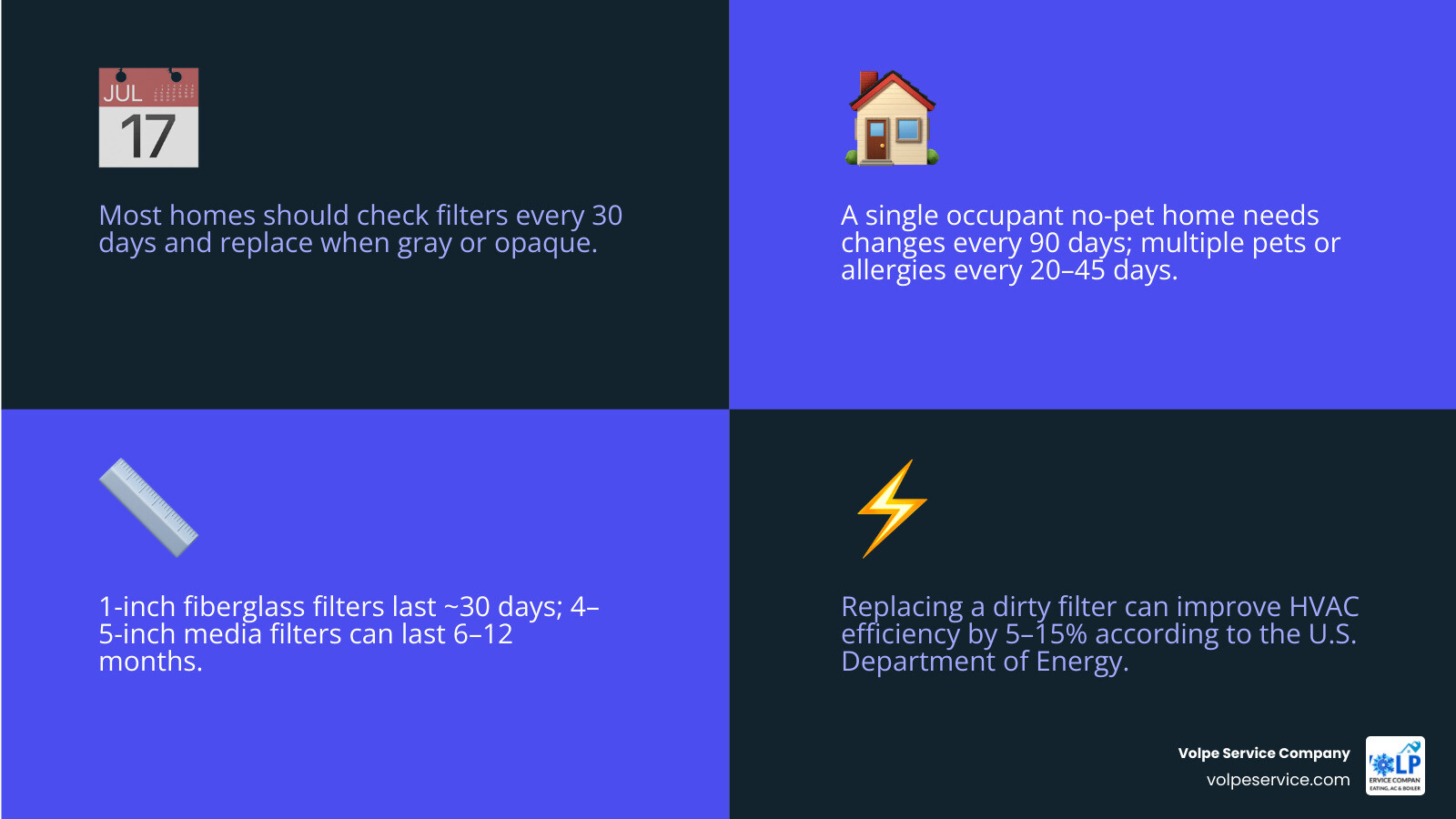
Quick look at when to change your hvac air filter:
Key Factors That Determine When to Change Your HVAC Air Filter
While the baseline recommendations in our chart are a great starting point, calendars don’t breathe—people and homes do. A wide range of variables dictates how quickly your filter becomes saturated with airborne particles. Rather than relying blindly on a manufacturer’s 90-day label, understanding How Often to Change Your HVAC Air Filter requires assessing your household size, your system’s overall runtime, and unique environmental factors.
If you live in a quiet, single-occupant home in Summit or Mountain Lakes, your filter will naturally last longer than a bustling household in Parsippany with kids running in and out of the yard. Similarly, environmental factors like nearby construction, dusty gravel driveways, or pollen seasons can clog a filter in a fraction of the normal time.
How Pets and Allergies Impact When to Change Your HVAC Air Filter
If you have furry family members, your air filter is working double-time. Pet dander, shedding hair, and outdoor debris brought in on paws quickly accumulate in your return vents. In fact, if you start noticing “dust bunnies” organizing a small coup in the corners of your hardwood floors, it is a safe bet that your air filter is already completely full.
For households with multiple pets, we recommend checking your filter every 20 to 45 days. Ignoring this can have serious consequences for your indoor air quality. Around 28 million Americans have asthma—roughly one in twelve people—making proper air filtration a key health factor. When a filter becomes overloaded, it can no longer capture fine particulates, allowing pet dander and dust to bypass the filter entirely and recirculate through your rooms. To understand how this cycle impacts your family’s health, you can read The Complete Guide to How Your HVAC Affects Indoor Air Quality.
How Home Size and Usage Affect When to Change Your HVAC Air Filter
The physical size of your home and how you run your HVAC system play massive roles in filter longevity.
- Air Volume & Home Size: Smaller homes in communities like West Orange or Madison actually often require more frequent filter changes than sprawling estates. Why? Smaller homes have less overall air volume, meaning the total volume of air in the home passes through the filter more times per day, concentrating the dust and debris in a smaller surface area.
- Continuous Fan Setting: If you set your thermostat’s fan to “On” rather than “Auto,” your system runs continuously, even when it isn’t actively heating or cooling. While this provides constant air filtration and keeps temperatures balanced, it also means your filter is trapping dust 24/7. This continuous runtime will require you to change your filter roughly twice as often.
- Peak Seasons vs. Shoulder Seasons: During mild New Jersey spring and autumn weeks, your HVAC system barely runs, meaning your filter is barely working. However, during the peak of summer or the freezing depths of winter, your system might run 12 to 18 hours a day.
To dive deeper into how these elements interact with your specific layout, check out our detailed breakdown on How Often Should You Change the AC Filter in Your House?.
Comparing HVAC Filter Types, Thickness, and MERV Ratings
When shopping for a replacement filter, you will quickly notice an overwhelming variety of options. Filters differ by material, thickness, and their MERV (Minimum Efficiency Reporting Value) rating.
Choosing the wrong type can either leave your air dusty or, conversely, restrict airflow so severely that your system suffocates. To help you navigate these choices safely, we have compiled a guide on Don’t Let Your HVAC Choke: The Best Air Filters for Every Home.
Here is how the most common residential filters stack up:
| Filter Type | Common Thickness | MERV Rating Range | Average Lifespan | Best Used For |
|---|---|---|---|---|
| Fiberglass Panel | 1-inch | MERV 1–4 | 30 days | Basic system protection; does not improve indoor air quality. |
| Standard Pleated | 1-inch | MERV 8–11 | 60–90 days | The residential sweet spot; captures dust, pollen, and pet dander. |
| High-Efficiency Pleated | 1–2-inch | MERV 11–13 | 30–90 days | Allergy and asthma sufferers; requires a system capable of handling higher static pressure. |
| Deep Media Filter | 4–5-inch | MERV 11–16 | 6–12 months | Homes with dedicated media cabinets; excellent filtration with low airflow resistance. |
| True HEPA | Varies | MERV 17–20 | 12+ months | Hospital-grade; not suitable for standard residential HVAC systems without specialized bypass setups. |
Signs and Consequences of a Clogged HVAC Filter
How can you tell if your filter needs replacing without constantly pulling it out of the wall? Your home and system will start giving you clues.
Keep an eye out for these common warning signs:
- Visible Dust Near Vents: If you notice a fine layer of gray dust settling on surfaces near your supply registers shortly after cleaning, your filter may be saturated and bypassing dust.
- Reduced Airflow: If the air blowing out of your vents feels weaker than usual, a clogged filter is the prime suspect.
- Musty Odors: A filter loaded with organic matter, dust, and pet hair can trap moisture and begin to smell musty.
- Rising Utility Bills: When your system has to work twice as hard to pull air through a dirty filter, it consumes significantly more electricity.
If you ignore these signs, the consequences can be incredibly costly. More than half of the average U.S. household’s annual energy consumption goes to space heating and air conditioning. A restricted filter causes a severe pressure drop. This lack of airflow can cause your air conditioner’s evaporator coils to freeze over, turning your indoor unit into a block of ice.
Additionally, your blower motor will have to work under extreme stress, which can lead to premature motor failure or complete system breakdown. For more local insights on what to look out for, read our guide on Signs Your Air Filter Needs Changing in NJ.
Step-by-Step Guide to Proper AC Filter Maintenance
Replacing your air filter is a quick, five-minute task that any homeowner can handle. However, doing it incorrectly can let dirt bypass the filter or damage your system.
Follow these professional steps for a clean, secure swap:
- Power Down the System: Always turn off your HVAC system at the thermostat before removing the old filter. This prevents the fan from kicking on while the filter is out, which would suck loose dust and debris directly into your unprotected coils.
- Locate and Remove the Old Filter: Slide the filter out of its slot. Immediately place it into a trash bag to prevent dust from shaking loose into your living space.
- Inspect the Filter Slot: Use a damp rag to wipe away any residual dust or debris inside the filter housing or return grill.
- Confirm the Size: Double-check the printed dimensions on the side of the filter to ensure a perfect fit.
- Check the Airflow Arrow: Look at your new filter. You will see an arrow printed on the cardboard frame indicating the correct airflow direction. This arrow must point toward the blower motor (away from the return duct). Installing a filter backwards can cause it to collapse or severely restrict airflow.
- Slide the New Filter In: Ensure the filter sits completely flush with no gaps around the frame. Any gap, even a quarter of an inch, allows air (and dust) to bypass the filter.
- Log the Date: Write the current date on the edge of the filter frame with a permanent marker so you always know exactly when it was installed.
- Power Back Up: Turn your thermostat back to your desired setting and listen for any strange whistling sounds, which could indicate a loose fit or air bypass.
By mastering Proper AC Filter Maintenance, you protect your equipment from unnecessary wear. However, while changing your filter is a crucial DIY task, it is only one part of keeping your system healthy. To ensure your entire system is running at peak efficiency, understand the Regular HVAC Maintenance Services Importance.
Frequently Asked Questions About HVAC Filter Replacement
Building consistent filter-changing habits can be tough. We often recommend “habit stacking”—pairing your monthly filter check with an existing routine, like paying your monthly utility bill or testing your smoke detectors. You can also use smart thermostat alerts that track actual system runtime hours rather than just calendar days. For more tips on keeping your home healthy, check out our Guide to Optimize Indoor Air Quality.
Can a dirty air filter make you sick?
Indirectly, yes. While an air filter itself doesn’t create illnesses, a completely saturated filter will stop trapping indoor allergens like dust mites, pollen, pet dander, and mold spores. Once the filter is full, these particles bypass the media and continuously recirculate through your home, which can trigger severe allergic reactions, asthma attacks, and respiratory irritation. Additionally, if a dirty filter is exposed to high humidity, mold growth can develop on the dust loaded onto the filter fibers, spreading mold spores throughout your ductwork.
Is a higher MERV rating always better for residential homes?
No. While higher MERV ratings indicate a filter’s ability to trap smaller, microscopic particles, they also create more static pressure resistance. Think of it like breathing through a thick winter scarf versus a thin cotton mask. If you put a MERV 13 or higher filter into an older or undersized HVAC system, the blower motor might struggle to push air through it, leading to restricted airflow, frozen coils, and system strain. For most standard residential systems, a MERV 8 to MERV 11 filter is the ideal sweet spot.
How do I know if my air filter is the right size?
Your filter size is printed directly on the cardboard frame of your existing filter (e.g., 20x25x1). It is important to note the difference between “nominal size” (the rounded numbers printed on the box) and “actual size” (the precise physical measurements of the filter). Always buy the exact nominal size listed on your system’s filter door or previous filter. If you use a filter that is even slightly too small, air will easily bypass the filter frame, rendering the filter useless.
Conclusion
Determining when to change your HVAC air filter is one of the easiest, most cost-effective ways to protect your home’s comfort, keep your energy bills low, and safeguard your family’s health. While standard calendar rules of thumb are helpful, pay close attention to your household’s unique needs—whether that means adjusting for pets, managing allergies, or stepping up your checks during peak New Jersey summer and winter months.
At Volpe Service Company, we have been helping our neighbors in East Hanover, Livingston, Morristown, and the surrounding communities keep their homes comfortable and efficient since 1963. Our family-owned, data-driven approach ensures your heating and cooling systems are always running exactly as they should.
If you want to ensure your system is fully prepared for the upcoming season, Schedule professional HVAC maintenance with Volpe Service Company today!