
The Three Pillars of Indoor Air Quality (IAQ)
When we talk about improving the air in your home, we focus on three core strategies. Think of these as the “Three Pillars” of a healthy home environment. Your HVAC system plays a starring role in each one.
- Source Control: This is the most effective way to improve air quality. It involves removing or reducing individual sources of pollution. For example, sealing materials that contain asbestos or adjusting a gas stove to decrease emissions. While your HVAC doesn’t always “control” the source, it helps manage the byproduct.
- Ventilation: This is all about dilution. By bringing in fresh outdoor air, you dilute the concentration of indoor pollutants. Many modern New Jersey homes are built so tightly for energy efficiency that they trap pollutants inside. Ventilation Solutions for a Healthier Home are essential to ensure that “stale” air is regularly swapped for fresh air.
- Filtration: This is your system’s active defense. As air cycles through your ductwork, the filter acts as a net, catching particles before they reach your lungs.
By balancing these three strategies, you can significantly reduce the “dust bunny paradise” effect and create a much healthier living space.
How Your HVAC Affects Indoor Air Quality

It is a common misconception that an HVAC system only heats and cools. In reality, it is the “respiratory system” of your home. How your HVAC affects indoor air quality depends largely on how it moves and cleans the air.
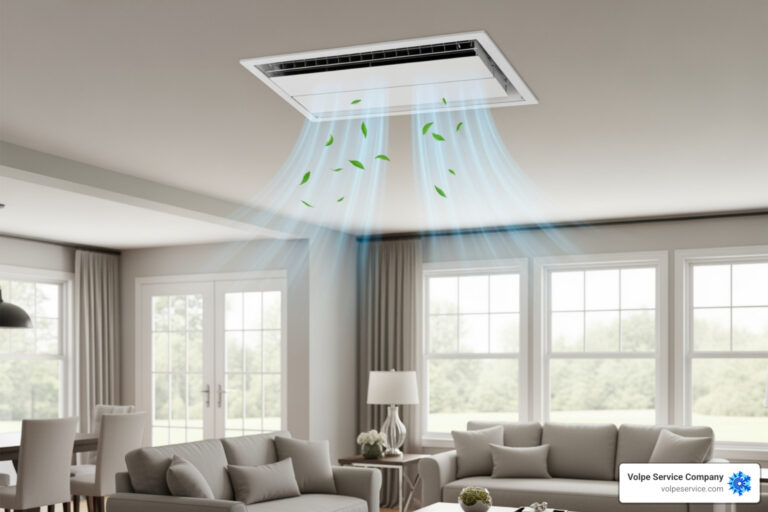
When your system is running, the blower motor pulls air from your rooms through return vents, pushes it through a filter, conditions it (heats or cools), and sends it back out. This constant air circulation is a double-edged sword. If your system is clean and equipped with a high-quality filter, it acts as a whole-home air purifier. However, if the system is neglected, it can become a vehicle for spreading pollutants.
Improved IAQ isn’t just about smelling fresh; it has measurable benefits. Research shows that better air quality can enhance cognitive performance by up to 61%. Furthermore, a well-maintained system provides “thermal stress reduction,” helping people with chronic respiratory or heart conditions avoid the physical strain caused by extreme temperature fluctuations. If you are considering an Enhanced Air Quality AC Replacement, you are investing in both comfort and long-term health.
How your HVAC affects indoor air quality through ventilation
Most standard residential HVAC systems do not naturally bring in a lot of fresh outdoor air. They mostly recirculate the air already inside. This is why mechanical ventilation is so important in places like Parsippany or Morristown, where we keep our windows shut for half the year.
- Energy Recovery Ventilators (ERV): These are fantastic for our New Jersey climate. An ERV pulls in fresh air and exhausts stale air, but it also transfers heat and moisture between the two streams. This means in the summer, the incoming hot, humid air is pre-cooled and dehumidified by the outgoing air.
- Heat Recovery Ventilators (HRV): Similar to an ERV, an HRV transfers heat but not moisture. These are often used in very airtight homes to ensure a steady supply of oxygen and the removal of carbon dioxide and VOCs.
Proper Home Ventilation for Improved Air Quality ensures that pollutants like radon or cleaning chemical fumes don’t just sit and linger in your living room.
How your HVAC affects indoor air quality via filtration
Filtration is often the first thing homeowners think of regarding air quality. The effectiveness of your filter is measured by its MERV (Minimum Efficiency Reporting Value) rating, which ranges from 1 to 16 for residential systems.
- Low MERV (1-4): These are usually basic fiberglass filters. Their primary job is to protect the equipment from large dust bunnies, not to protect your health. They catch less than 20% of large particles.
- Medium MERV (8-11): These are “people protectors.” They can trap pet dander, dust mites, and even some mold spores.
- High MERV (13-16) & HEPA: These are Top Indoor Air Quality Solutions for families with severe allergies or asthma. HEPA filtration systems can eliminate more than 99% of allergens and pollutants, including tiny bacteria and smoke particles.
Managing Humidity and Pollutants for Healthier Living
Humidity is the silent partner of indoor air quality. If the air is too damp, you get mold and dust mites. If it’s too dry, you get itchy skin, bloody noses, and cracked furniture.
| Humidity Level | Impact on Health and Home |
|---|---|
| Below 30% | Dry skin, respiratory irritation, increased viruses, wood shrinkage. |
| 30% – 50% | The “Goldilocks” Zone. Ideal for comfort and health. |
| Above 60% | Mold growth, dust mite proliferation, “musty” odors, condensation. |
In New Jersey, we face high humidity in the summer and bone-dry air in the winter. Your HVAC system manages this through the evaporator coil (which pulls moisture out of the air while cooling) and integrated humidifiers. Keeping your humidity in that 30-50% range is vital. Don’t Hold Your Breath While Improving Your Home Air; instead, use a hygrometer to monitor these levels and ensure your system is draining properly to prevent “Dirty Sock Syndrome” — that musty smell caused by bacterial growth on damp coils.

Maintenance and Filter Optimization for NJ Homeowners
The best HVAC system in the world won’t help your air quality if it isn’t maintained. Maintenance is the “secret” to long-term IAQ.
- Filter Change Frequency: We recommend checking your filter every 30 days. While some high-efficiency 4-inch media filters can last 6 months, standard 1-inch filters usually need replacing every 30 to 90 days. If you have pets or live near a busy road in West Orange or Livingston, you’ll likely need to change them more often.
- Coil Cleaning: Your AC’s evaporator coil is dark and damp — a perfect breeding ground for mold. Annual professional cleaning prevents these spores from being blown into your home.
- Blower Motor & Static Pressure: If your filter is too thick or clogged, it creates “pressure drop.” This forces the blower motor to work harder, which can lead to motor burnout and reduced airflow, leaving pollutants to settle in your home.
Following a Guide to Optimize Indoor Air Quality through regular tune-ups ensures your system actually cleans the air rather than just moving dust around. This is especially critical for Indoor Air Quality on Children’s Health, as kids breathe more air per pound of body weight than adults do.
Integrated IAQ Technologies and Upgrades
If you want to move beyond basic filtration, there are several “active” technologies we can integrate directly into your existing HVAC system.
- UV-C Germicidal Lamps: Installed near the evaporator coil, these lights scramble the DNA of mold, bacteria, and viruses, rendering them harmless.
- Reme Halo: This is a popular whole-home air purifier that is 99.9% effective against various viruses. It can even help neutralize germs from a sneeze within three feet!
- Bi-Polar Ionization: This technology releases ions that cause sub-micron particles (like smoke and viruses) to clump together. Once they are larger, your HVAC filter can actually catch them.
- Activated Carbon Filters: If you struggle with odors from cooking, pets, or VOCs from new furniture, carbon filters are excellent at neutralizing gaseous pollutants that standard filters miss.
Frequently Asked Questions about HVAC and IAQ
Can my air conditioning system actually make me sick?
Yes, it can, but usually only if it’s neglected. Can Air Conditioning Make You Sick? is a common concern. If mold grows on the coils or if the drain pan is clogged and standing water accumulates, the system can blow mold spores and bacteria into your home. Regular maintenance and high-quality filters prevent this.
What is the best MERV rating for residential use in 2026?
For most New Jersey homes in 2026, a MERV 11 to MERV 13 filter is the sweet spot. It provides excellent protection against pollen, mold, and even some bacteria and smoke (important during wildfire seasons) without being so restrictive that it damages your blower motor. Always check with a professional to see what your specific system can handle.
Do houseplants help my HVAC system clean the air?
While we love a good indoor jungle, houseplants do not remove significant quantities of pollutants in a real-world home environment. You would need hundreds of plants in a single room to match the cleaning power of one good HVAC filter. Furthermore, over-watering plants can actually increase indoor humidity and lead to microorganism growth in the soil, potentially hurting your IAQ.
Conclusion
At Volpe Service Company, we’ve been helping our neighbors in East Hanover, Parsippany, and across Northern New Jersey breathe easier since 1963. We know that how your HVAC affects indoor air quality is a matter of both comfort and health. Whether you need a data-driven IAQ assessment or a high-efficiency system upgrade, our family-owned team is here to provide honest pricing and expert service.
If you’re concerned about the air in your home, don’t wait for allergy season to hit. Explore our specialized services for Indoor Air Quality Parsippany NJ and let us help you turn your HVAC system into a powerful tool for a healthier life.