

The Simple Answer to How Often You Should Change Your HVAC Air Filter
Knowing how often should you change your HVAC air filter is one of the easiest ways to protect your system, lower your energy bills, and keep the air in your New Jersey home cleaner. Yet according to recent data, 29% of Americans admit they never change their filter at all — and most of the rest aren’t doing it on the right schedule.
Here’s a quick answer based on filter type and household conditions:
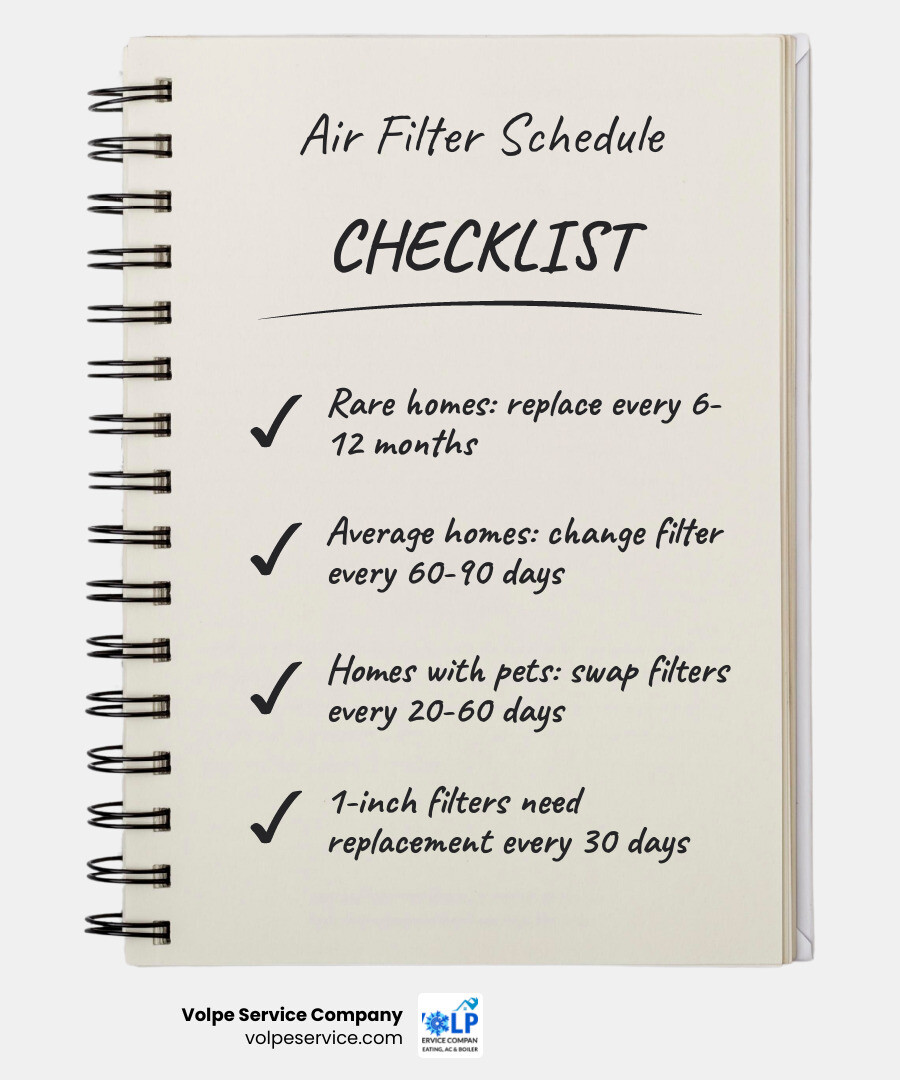
| Household Situation | Recommended Replacement Frequency |
|---|---|
| Vacation home or rarely occupied | Every 6-12 months |
| Single occupant, no pets, no allergies | Every 90 days |
| Average household (2-4 people) | Every 60-90 days |
| One pet in the home | Every 60 days |
| Multiple pets or allergy sufferers | Every 20-45 days |
| 1-inch fiberglass filter (any home) | Every 30 days |
| 4-5 inch media filter | Every 6-12 months |
The rest of this guide covers everything behind those numbers — filter types, MERV ratings, warning signs, and what goes wrong when you wait too long.
Most homeowners don’t think about their air filter until something breaks — the energy bill spikes, rooms stop heating evenly, or the system quits on the hottest day of the summer. By then, a simple $20 fix has turned into a much bigger problem. Staying ahead of your filter schedule is one of the lowest-effort, highest-return maintenance habits you can build.
How Often Should You Change Your HVAC Air Filter?
The standard rule of thumb for average situations is to change your air filter every four months, or with the turn of the seasons. However, “average” rarely describes a busy New Jersey household. If you are trying to figure out How Often Should You Change the AC Filter in Your House?, the baseline answer depends largely on the physical thickness of the filter you use.
Most homes utilize standard 1-inch disposable filters. These thin filters have very little surface area, meaning they quickly fill up with dust and debris. If you are using a standard 1-inch pleated filter, you should aim to replace it every 30 to 90 days. Basic 1-inch fiberglass filters (the green or blue spun-glass variety) have even less capacity and must be swapped out every 30 days or less.
On the other end of the spectrum are 4-inch and 5-inch deep-pleated media filters. Because these filters are folded like an accordion, they have a massive amount of surface area stretched out inside a thicker frame. This design allows them to trap significantly more dust before restricting your system’s airflow. For a thicker 4-inch or 5-inch media filter, a replacement schedule of every 6 to 12 months is usually sufficient.
To keep your system running smoothly, practicing Proper AC Filter Maintenance means coordinating your replacements with how hard your HVAC system is working. During mild spring and autumn months in towns like Livingston or Madison, your heating and cooling systems run infrequently, meaning the filter collects dust much slower. However, during freezing New Jersey winters or humid July heatwaves, your system runs almost continuously, requiring much more frequent filter checks.
| Filter Thickness | Budget/Fiberglass Lifespan | Pleated Filter Lifespan | High-Efficiency Media Lifespan |
|---|---|---|---|
| 1 Inch | 30 days or less | 30 to 90 days | N/A |
| 2 Inches | N/A | 60 to 90 days | 3 to 4 months |
| 4 Inches | N/A | N/A | 6 to 9 months |
| 5 Inches | N/A | N/A | 9 to 12 months |
Understanding How Often Should You Change Your HVAC Air Filter with Pets
If you have a dog, cat, or any other furry family member, your filter schedule needs an immediate adjustment. Pets are wonderful companions, but they are also constant sources of fur, dander, and outdoor debris. Pet dander can increase the overall particulate load in your indoor air by 40% or more, which means your filter will clog much faster than the manufacturer’s packaging predicts.
When pet hair and dander float through the air, they are pulled directly into your return vents. A single dog or cat can easily cut a filter’s lifespan in half, requiring a replacement every 60 days. If you share your home with multiple pets—or long-haired breeds that shed heavily—you should perform a visual check every 30 days. Under heavy pet loads, 1-inch filters often need to be changed every 20 to 45 days to prevent severe airflow restriction and keep dander from recirculating back into your living spaces.
How Often Should You Change Your HVAC Air Filter for Allergy Sufferers
For those living with asthma, severe seasonal allergies, or respiratory conditions, the air filter is the first line of defense against airborne triggers. During the peak pollen seasons in New Jersey, microscopic spores enter your home every time a door opens. Dust mites, mold spores, and fine dust also settle into carpets and furniture, eventually getting pulled into the HVAC system.
If anyone in your household suffers from allergies, we recommend changing your filter every 20 to 45 days. Keeping a fresh, high-efficiency filter in place ensures that these microscopic irritants are trapped rather than blown back out through your supply registers. For a deeper look at managing your home’s air during high-pollen months, consult The Essential Spring Air Filter Replacement Guide for Fresh Air to keep your indoor air as clean and symptom-free as possible.
Key Factors and Filter Types That Impact Your Replacement Schedule
Beyond pets and allergies, several other household variables dictate how often you need to replace your filter:
- Home Size: Larger homes move a massive volume of air. Because the HVAC system must cycle more cubic feet of air to maintain comfortable temperatures, the filter collects dust at a faster rate. Conversely, very small homes or apartments have smaller HVAC units with smaller filters, which can also clog quickly if the space has limited return vents.
- Occupancy Levels: A home with a large family, active children, and constant foot traffic naturally kicks up more dust, lint, and outdoor dirt than a quiet home occupied by a single retiree.
- Thermostat Fan Settings: If you run your thermostat fan on the “ON” setting (continuous circulation) rather than “AUTO” (only running during a heating or cooling cycle), your system is filtering air 24/7. This provides cleaner air, but it also means you will need to replace your filter about twice as often.
- Local Air Quality: Nearby construction, living on a dirt road, or seasonal wildfire smoke will rapidly saturate your air filter, requiring immediate inspection and replacement.
The material of your filter also plays a massive role in performance and longevity. To help you navigate the options, check out Don’t Let Your HVAC Choke: The Best Air Filters for Every Home. Let’s break down the primary filter categories below:
- Fiberglass Filters: These are the inexpensive, flat filters designed primarily to protect the internal components of your furnace or air handler from large dust bunnies. They do very little to improve indoor air quality and must be replaced every 30 days.
- Pleated Filters: Made from polyester or cotton blends, these filters feature folded pleats that trap smaller particles like pollen, mold spores, and pet dander. They are highly efficient, widely available, and typically last between 30 to 90 days.
- HEPA Filters: High-Efficiency Particulate Air filters are the gold standard, capturing 99.97% of particles as small as 0.3 microns (including bacteria and smoke). However, true HEPA filters are rarely compatible with standard residential HVAC systems because their dense material restricts airflow too much, which can damage standard blower motors.
- Washable Filters: While environmentally friendly, washable or electrostatic filters require meticulous monthly cleaning. They must be completely dry before reinstallation, as putting a damp filter back into your system creates a perfect breeding ground for mold and mildew.
OEM vs. Aftermarket Air Filters
When shopping for replacement filters, you will inevitably choose between OEM (Original Equipment Manufacturer) filters—which carry the brand name of your HVAC system, such as Carrier, Lennox, or Trane—and aftermarket filters made by third-party manufacturers.
The primary difference lies in the dimensions and pricing. When buying filters, you will notice two sets of dimensions: the nominal size (the rounded-up numbers printed in bold on the frame, like 20x25x1) and the actual dimensions (the precise measurements down to the fraction of an inch). Aftermarket filters are designed to match these actual dimensions perfectly at a more budget-friendly price point.
As long as the actual dimensions and the MERV rating of the aftermarket filter match your system’s specifications, they will perform identically to OEM filters. Choosing high-quality aftermarket filters is an excellent way to maintain your system without paying a brand-name premium.
How to Visually Check and Replace Your HVAC Filter
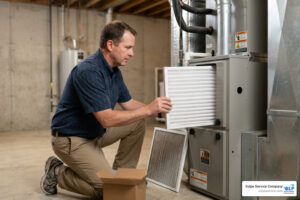
Rather than relying strictly on the calendar, the best way to determine if your filter is spent is to perform a simple visual inspection. This quick test ensures you don’t discard a perfectly good filter too early, or leave a clogged one in place for too long.
- The Light Test: Turn off your HVAC system, slide the filter out, and hold it up to a bright light source (like a window or a flashlight). If light easily passes through the filter fibers, it still has life left. If the filter is dark, gray, caked in dust, and completely blocks the light, it is clogged and must be replaced immediately.
- Check the Arrow: Every HVAC filter has an “Airflow” arrow printed on its cardboard frame. This arrow must point in the direction that air travels through your system—which is always toward the furnace, blower motor, or air handler cabinet, and away from the return duct.
- Power Down First: Always turn off your thermostat or shut off the system’s power switch before pulling out the filter. Removing a filter while the blower fan is running can pull loose dust, hair, and debris directly into the sensitive internal machinery of your unit.
Incorporating these visual checks into your routine is a core component of preserving your equipment. To understand how these small steps fit into the bigger picture of system care, read about the Regular HVAC Maintenance Services Importance.
What Happens If You Don’t Change Your Air Filter Regularly?
Leaving a dirty air filter in your HVAC system does far more than just reduce your indoor air quality. It triggers a damaging chain reaction throughout your entire heating and cooling system.
When a filter becomes choked with dust, it acts as a barrier, severely restricting the volume of air entering your system. This restriction forces your blower motor to work twice as hard to pull air through, consuming significantly more electricity. According to the U.S. Department of Energy, swapping out a dirty filter for a clean one can instantly improve your system’s energy efficiency by 5% to 15%.
Over time, this restricted airflow leads to severe system strain and mechanical failures:
- Frozen Evaporator Coils: In the summer, your air conditioner relies on a steady stream of warm indoor air passing over the cold evaporator coils to absorb heat. If a clogged filter blocks that warm air, the refrigerant inside the coils gets too cold, causing condensation to freeze solid. This ice completely blocks airflow and can eventually destroy your expensive compressor.
- Blower Motor Burnout: When forced to fight against a clogged filter, the fan motor overheats. This continuous strain shortens the motor’s lifespan and can lead to a premature, costly burnout.
- Uneven Heating and Cooling: If your system cannot push enough air through the vents, you will notice some rooms feel like iceboxes while others remain stuffy and warm.
- Short-Cycling: To protect itself from overheating due to restricted airflow, your furnace or AC may shut down prematurely, only to turn back on a few minutes later. This constant starting and stopping wears out electrical components rapidly.
- Mold and Mildew Growth: If a dirty filter gets damp from nearby condensation, mold spores can grow on the organic dust fibers. The system will then distribute these spores directly into your home’s breathing air.
To avoid these costly headaches, understanding why Regular HVAC Maintenance is Crucial is vital for every homeowner. Neglecting this simple chore can lead to severe HVAC Filter Blockage Issues that shorten the lifespan of your entire system.
Frequently Asked Questions About HVAC Air Filters
Can I wash and reuse a standard disposable air filter?
No. Standard disposable filters are made of paper, cardboard, and synthetic fibers that are not water-resistant. Attempting to wash them will destroy their physical structure, render them useless, and potentially cause them to collapse into your blower fan. Furthermore, trapping moisture inside a disposable filter creates a severe risk of mold growth, which will ruin your indoor air quality. Only wash filters that are explicitly labeled as washable or reusable by the manufacturer.
Does a higher MERV rating always mean a better filter?
Not necessarily. MERV (Minimum Efficiency Reporting Value) ratings range from 1 to 16 for residential systems. While a higher MERV rating (such as MERV 13) traps much smaller particles than a MERV 8 filter, it also creates more resistance to airflow. If your HVAC system’s blower motor is not designed to handle high static pressure, installing a high-MERV filter can restrict airflow so severely that it mimics a clogged filter, leading to frozen coils and system strain. For most standard residential systems, a MERV 8 to 11 filter offers the perfect balance of filtration and airflow.
How do I know if my filter is installed in the correct direction?
Look for the printed arrows on the outer cardboard frame of the filter. These arrows indicate the direction of the airflow. The arrow must always point toward the blower motor or furnace cabinet. If your filter is located in a wall or ceiling return register, the arrow should point into the wall or ceiling (toward the ductwork). Installing a filter backward reduces its structural integrity and efficiency, as the wire backing is designed to support the filter medium against the force of the incoming air.
Conclusion
Changing your HVAC air filter on a regular schedule is the easiest, most cost-effective way to protect your home’s comfort, save money on energy bills, and keep your indoor air fresh. While the 90-day rule is a great starting point, remember to adjust your schedule based on your pets, seasonal allergies, and how often your system runs.
While keeping up with your filter changes is a fantastic DIY habit, it is only one part of keeping your heating and cooling systems running efficiently. To truly protect your investment and prevent unexpected breakdowns, professional care is essential. Learn how a structured service plan can save you money and stress by reading The Ultimate Guide to HVAC Maintenance Plan Benefits.
Since 1963, Volpe Service Company has proudly served East Hanover, NJ, and surrounding communities like Morristown, Livingston, and Parsippany with honest pricing, data-driven solutions, and courteous service. Schedule professional maintenance with Volpe Service Company today to keep your home’s comfort system running perfectly all year long!