

Is a Mini Split Better Than Central Air? A Quick Central AC vs Ductless Mini Split Comparison
A central ac vs ductless mini split comparison comes down to a few key factors: your home’s existing ductwork, how many rooms you need to cool, and your energy efficiency goals.
Quick Comparison: Central AC vs Ductless Mini Split
| Feature | Central AC | Ductless Mini Split |
|---|---|---|
| Requires ductwork | Yes | No |
| SEER2 efficiency range | 15–21+ | 18–42 |
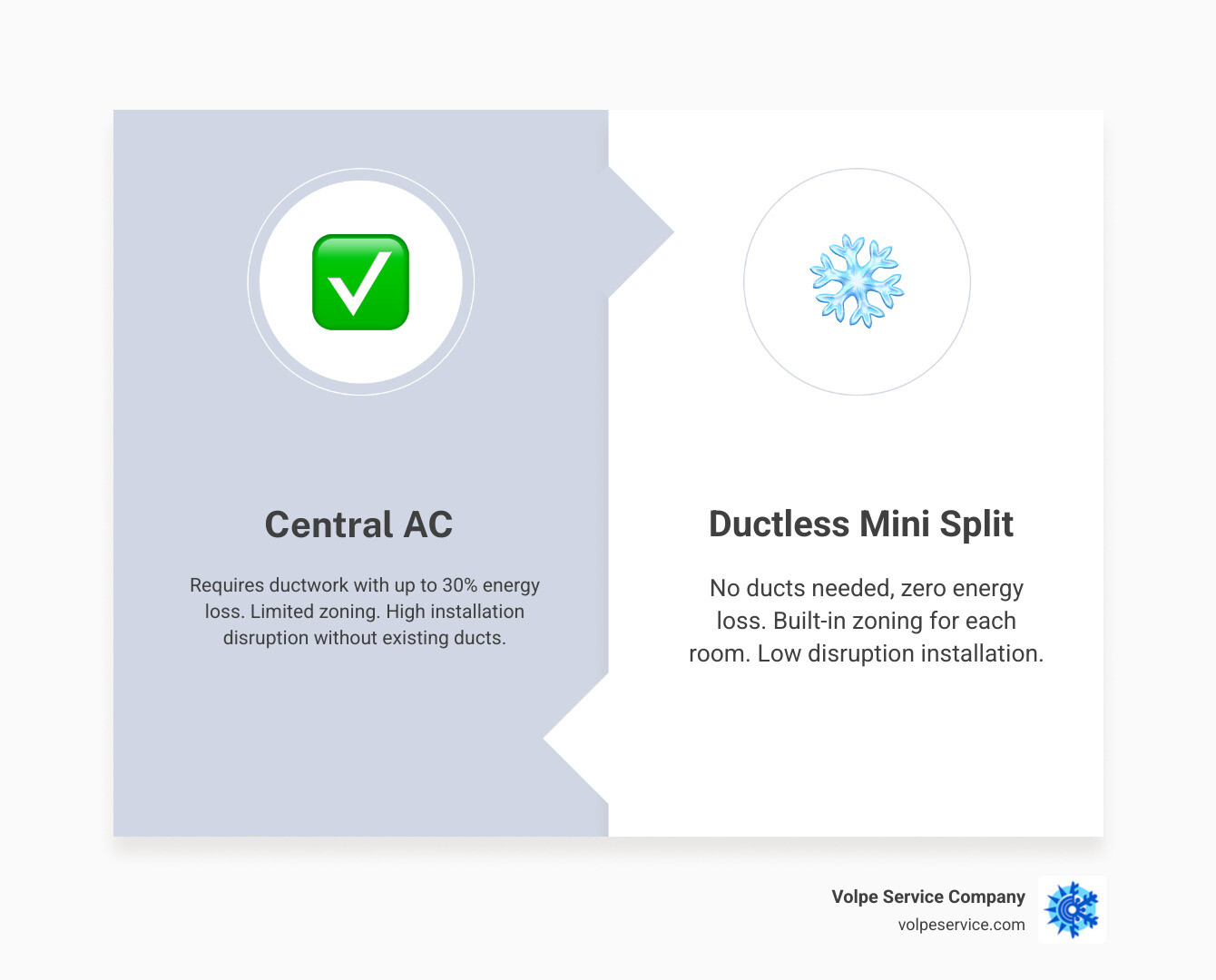
| Energy loss from ducts | Up to 30% | None |
| Zoned temperature control | Limited (add-on) | Built-in |
| Best for | Homes with existing ducts | Older homes, additions, problem rooms |
| Heating capability | Paired with furnace | Built-in heat pump |
| Typical lifespan | 15–20 years | 15–25 years |
| Installation disruption | High (if no ducts exist) | Low |
For most New Jersey homeowners, the right answer depends on one simple question: do you already have ductwork in good shape? If yes, central AC is often the most practical choice. If not — or if you’re dealing with a room addition, older home, or stubborn hot spots — a ductless mini split is likely the smarter, more efficient option.
Choosing the wrong system doesn’t just affect comfort. It affects your energy bill every single month. According to the U.S. Department of Energy, typical duct systems lose 25% to 30% of cooling energy through leaks, poor insulation, or thermal bypass. That’s a significant and ongoing cost that rarely shows up in a contractor’s sales pitch.
Whether you’re replacing an aging system in Morristown, finishing a basement in Livingston, or trying to get that one room in your East Hanover home to finally cool down — understanding the real differences between these two systems will help you make a confident decision.
Understanding the Mechanics: How Central AC and Ductless Systems Work
At their core, both systems operate on the same scientific principle: heat transfer. They don’t actually “create” cold; they remove heat from your indoor air and dump it outside. This is achieved through a refrigerant cycle involving an outdoor condenser unit and indoor evaporator coils. However, how that cooled air reaches your living space is where the two technologies diverge.
In a central system, a large indoor air handler pushes cooled air through a network of hidden channels. In a ductless setup, the refrigerant travels through small tubes directly to individual units mounted on your walls or ceilings. If you want to dive deeper into the specifics of the hardware, check out our Mini Split AC Complete Guide.
The Traditional Central Air Approach
Central air conditioning has been the gold standard for New Jersey homes built since the 1970s. It relies on a “forced air” system. Your home has a series of supply vents that blow cold air into rooms and return registers that suck warm air back to the unit to be cooled again.
This system is typically controlled by a single thermostat, meaning the unit treats your entire house as one big zone. While this provides uniform cooling, it can be wasteful if you spend most of your day in just one or two rooms. For those considering a full system overhaul, Switching Your Home to Central AC is a major project that works best when your home’s “bones” are already designed for it.
The Ductless Mini-Split Method
A ductless mini-split system consists of an outdoor compressor connected to one or more indoor “heads” via slim refrigerant lines. These lines only require a small, three-inch hole in your exterior wall, making the installation far less invasive than tearing into drywall to run ducts.
Because each indoor head has its own thermostat or remote, you gain independent control over every room. Furthermore, modern mini-splits utilize inverter technology. Instead of the “all-on or all-off” operation of older central units, these systems ramp their speed up and down like a dimmer switch, maintaining a perfectly steady temperature without the energy spikes.
Central AC vs Ductless Mini Split Comparison: Efficiency and SEER2 Ratings
Efficiency is measured by SEER2 (Seasonal Energy Efficiency Ratio 2), a standard updated in 2023 and strictly enforced as we move through April 2026. Higher numbers mean more cooling for every dollar spent on electricity. When we look at a central ac vs ductless mini split comparison, the ductless units often pull ahead in raw numbers.
Top-tier ductless mini-splits can achieve staggering ratings between 33 and 42 SEER2. In contrast, even high-efficiency central AC systems usually top out around 20 to 26 SEER2. To understand why these numbers matter for your wallet, explore the Mini Split Installation Top Benefits.
Eliminating Energy Waste from Ductwork
The biggest “hidden” disadvantage of central air is the ductwork itself. Thermal bypass and leaky joints are silent budget killers. Statistics show that typical duct systems lose 25% to 30% of their cooling energy before it ever reaches your bedroom.
If your ducts are located in a scorching hot attic in Parsippany or a damp crawlspace in Summit, that loss can be even higher. Ductless systems deliver air directly into the room, meaning 100% of the cooling you pay for actually stays in the living space.
Maximizing Performance with Inverter Technology
Central AC units often operate at a single speed. They blast cold air until the thermostat is satisfied, then shut off. This leads to temperature swings and high humidity.
Ductless systems use variable-speed inverter-driven compressors. They run at “part-load” for longer periods, which is actually more efficient and does a much better job of removing New Jersey’s summer humidity. By avoiding the constant “stop and start” cycle, these systems reduce wear and tear and prevent the energy spikes that happen every time a traditional motor kicks on.
Installation and Home Layout: Which System Fits Your New Jersey Property?
Your home’s layout is often the ultimate tie-breaker. If you live in a modern home in Mt. Olive with existing, well-insulated ducts, replacing your central unit is straightforward. But for many of our clients in historic areas, the choice is more nuanced. You can learn more about the steps involved in our AC Installation Process Guide.
Retrofitting Older Homes in East Hanover and Morristown
Many beautiful homes in Morristown and East Hanover were built before central air was a standard feature. Retrofitting these properties with ductwork often means sacrificing closet space or building “soffits” (bulky boxes) along the ceiling to hide pipes. It’s invasive, expensive, and can ruin the aesthetic of plaster walls.
Ductless systems are the perfect solution for these properties. Their compact design and minimal disruption allow us to bring modern comfort to a 100-year-old home in a single day. For residents in the area, our Ductless Installation Parsippany NJ service specializes in these types of sensitive retrofits.
Cooling New Additions and Problem Rooms
Do you have a sunroom in Chester that feels like an oven in July? Or a garage conversion in Mendham that stays chilly? Extending ductwork to a new addition is often a logistical nightmare and can put too much strain on your existing central unit.
A single-zone mini-split can provide targeted comfort to these “problem rooms” without affecting the rest of the house. We often see this in Mini Split Installation Process Explained, where a homeowner keeps their central air for the main house but adds a ductless unit for a finished basement or attic suite.
Comfort and Customization: Zoning, Noise, and Air Quality
Comfort is about more than just temperature; it’s about sound and air purity. In a central ac vs ductless mini split comparison, both systems have unique strengths regarding how they handle the environment inside your home.
Achieving True Zoned Comfort
The “Great Air Debate” often centers on control. With central air, if the baby’s room is too cold but the kitchen is too hot, there isn’t much you can do. A Customized Ductless Installation changes that.
Each indoor head acts as its own zone. You can keep your home office at a crisp 68 degrees while leaving the guest wing at 75 to save energy. This level of personalized control is built-in with ductless technology, whereas adding zoning to a central system requires expensive motorized dampers and complex control panels.
Air Quality and Filtration Differences
Central AC systems are excellent for “whole-home air scrubbing.” Because they pull air from every room through a central filter, you can install high-end HEPA filters or UV purifiers that clean the air for the entire house.
However, ductwork itself can become a source of dust and allergens if not cleaned. Mini-splits avoid this entirely. They use reusable mesh filters that you can easily rinse in your sink every few weeks. For localized filtration in a bedroom or nursery, mini-splits provide exceptionally clean air without the risk of duct-borne pollutants. Our Ductless HVAC Services Parsippany NJ can help you maintain these filters for peak performance.
Long-Term Performance: Maintenance and System Lifespan
Both systems are a significant investment, and you want them to last. With proper care, you can expect 15 to 20 years of service from either. Some premium mini-split brands like Daikin or Mitsubishi can even push past the 25-year mark.
To keep your system running, follow these Mini Split Installation Steps for maintenance:
- Central AC: Change filters every 1–3 months, keep the outdoor unit clear of leaves, and have the ducts inspected for leaks every few years.
- Ductless Mini-Split: Rinse indoor filters every 2–4 weeks and ensure the drain line is clear.
- Both: Schedule an annual professional tune-up to check refrigerant levels and electrical connections.
Durability and Expected Service Life
As of 2026, the industry is transitioning away from R-410A refrigerant toward lower-GWP (Global Warming Potential) alternatives like R-32. This makes it more important than ever to choose a system that is compatible with future service standards. Both central and ductless systems are evolving, but ductless units often feature more advanced diagnostic technology that helps technicians identify issues before they lead to a total system failure.
Professional Care for Northern NJ Homeowners
At Volpe Service Company, we’ve been serving New Jersey since 1963. We don’t believe in “one-size-fits-all” cooling. Our licensed technicians use data-driven diagnostics to determine which system actually fits your home’s thermal load. Whether you need a spring tune-up in Denville or an emergency repair in Boonton, honest pricing and constant communication are our hallmarks.
Frequently Asked Questions about Central AC vs Ductless Mini Split Comparison
Which system is more energy efficient in a central ac vs ductless mini split comparison?
In almost every head-to-head matchup, the ductless mini-split wins on raw efficiency. Between the higher SEER2 ratings (up to 42) and the elimination of the 30% energy loss caused by leaky ducts, mini-splits can reduce your cooling costs by 30% or more. However, if you have a very large, open-concept home with existing high-quality ducts, a high-efficiency central AC can still be a very competitive option. For more details, see our Mini Split Installations Questions page.
Can I use both systems in a hybrid central ac vs ductless mini split comparison?
Absolutely! This is a very popular approach in Northern New Jersey. Many homeowners keep their central AC to handle the main living areas but use a Mini Split AC Install for a new sunroom, a finished third floor, or a master suite that the central system struggles to reach. This “hybrid” approach gives you the best of both worlds.
How do the systems compare in terms of noise and aesthetics?
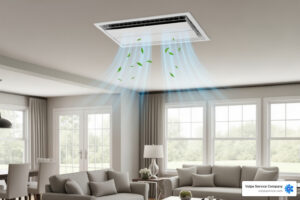
Central AC is virtually invisible inside the home, with only small vents on the floor or ceiling. However, the outdoor unit can be quite loud when it kicks on. Ductless mini-splits require an indoor head on the wall, which some find obtrusive, though modern “ceiling cassette” models are very discreet. In terms of noise, mini-splits are the clear winner indoors; most units operate at 19 to 26 decibels, which is literally quieter than a whisper.
Conclusion
Choosing between central air and a ductless mini-split isn’t about finding the “best” technology—it’s about finding the right fit for your specific New Jersey home. If you have functional ductwork and want a “set it and forget it” whole-home solution, central AC is a tried-and-true choice. But if you want the ultimate in energy efficiency, room-by-room control, and a system that can handle the unique challenges of older homes or additions, ductless is the future.
At Volpe Service Company, we’ve spent over 60 years perfecting home comfort in communities like Madison, Millburn, and Montville. We take a data-driven approach to every inspection and installation, ensuring you get a system that’s sized perfectly for your needs and your budget.
Ready to upgrade your comfort? Contact us today for expert AC installation in Chester, NJ and let our family-owned team help you find the perfect cooling solution for your home.