


Is Your HVAC System Hiding Mold? Here’s What to Look For
The signs of mold in your HVAC system are not always obvious — but catching them early can protect both your health and your home. Here are the most common warning signs to watch for:
- Persistent musty or earthy smell when your heating or cooling turns on
- Visible black, green, or brown spots around vents, registers, or the air handler
- Dark dust or black streaks appearing around ceiling or wall registers
- Worsening allergy or asthma symptoms indoors, including sneezing, watery eyes, or congestion
- Unexplained fatigue or headaches that improve when you leave the house
- Condensation or moisture around ducts, vents, or the air handler unit
- Reduced airflow from supply vents
If you recognize any of these, your HVAC system may be circulating mold spores throughout your home right now.
Americans spend roughly 90% of their time indoors — and when mold takes hold inside an HVAC system, it has a direct pathway into every room you breathe in. What makes this especially concerning is how fast it happens: mold can begin growing in as little as 48 hours once moisture is present. For homeowners across Northern and Central New Jersey, where summer humidity routinely climbs above 60%, HVAC systems face a constant battle against the exact conditions mold loves most.
This guide breaks down every major sign, cause, and solution so you know exactly what you’re dealing with and when to call in a professional.
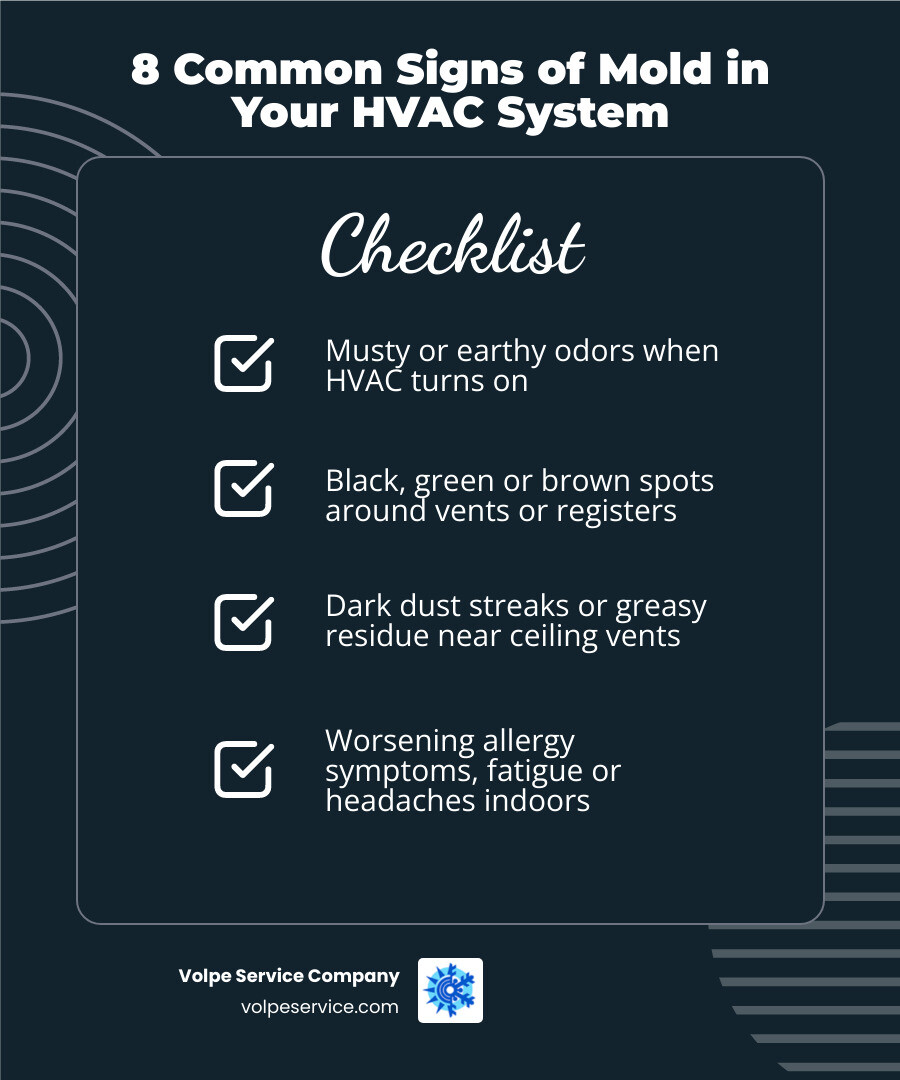
Common Signs of Mold in Your HVAC System
Identifying signs of mold in your HVAC system requires a mix of sensory awareness and visual inspection. Because your ductwork is largely hidden behind walls and ceilings, mold often thrives in the dark before you ever see a single spot. However, the system usually leaves “fingerprints” that indicate a problem is brewing.
One of the most frequent visual cues we see in New Jersey homes is the appearance of dark dust or “smudging” around the edges of ceiling registers. While this is sometimes just common household dust, if it appears greasy, damp, or difficult to wipe away, it may actually be mold colonies feeding on the dust trapped in the vent. Maintenance Matters: Why Your HVAC System Needs a Spa Day to Prevent Mold because a clean system provides no “food” for these spores to grow on.
Persistent Musty or Earthy Odors
Have you ever noticed a “tangy” or earthy smell the moment your air conditioner kicks on? This is often the first and most reliable sign of a biological issue. Mold releases Microbial Volatile Organic Compounds (mVOCs) as it grows. These gases have a distinct, damp odor that many homeowners describe as smelling like wet socks or a basement that hasn’t been aired out in years.
If the smell is strongest when the air is blowing, the source is likely inside the air handler or the ductwork itself. This often points to a clogged condensate drain or a dirty evaporator coil where moisture has been allowed to sit. Ensuring Regular AC Maintenance and Cleaning is the best way to clear out these odors before they become a permanent fixture in your home.
Visible Signs of Mold in Your HVAC System Around Vents
While odors are a great early warning, visible growth is a “code red” situation. Look for black spots, fuzzy textures, or green and white patches on your vent covers. If you remove a vent cover and see discoloration on the backside, it’s a strong indicator that the mold is systemic and traveling through your ducts.
The evaporator coils are another hotspot. Because these coils are designed to be cold and wet, they are the perfect breeding ground. Following AC Coil Cleaning Maintenance Tips can prevent these colonies from blocking airflow and spreading spores into the air stream.
Unexplained Health and Allergy Symptoms
Sometimes, your body knows there is mold before your eyes do. If family members experience frequent sneezing, watery eyes, or persistent headaches that seem to vanish when they leave the house for a few hours, your indoor air quality may be compromised.
Mold spores are potent allergens. For those with existing respiratory conditions, the constant circulation of these particles can lead to increased asthma flare-ups or chronic fatigue. Don’t Hold Your Breath While Improving Your Home Air — if your health is taking a hit, it’s time to look at the system that breathes for your home.
Why Mold Develops in Air Conditioners and Ductwork
Mold is a simple organism with three basic needs: moisture, food, and a dark place to hide. Unfortunately, an HVAC system can provide all three if it isn’t properly maintained.
| Feature | Common Household Dust | Active Mold Growth |
|---|---|---|
| Texture | Dry, flaky, easily wiped away | Damp, fuzzy, or slimy; stains the surface |
| Color | Gray or light brown | Black, dark green, bright white, or orange |
| Odor | Neutral or slightly “musty” when old | Strong, pungent, earthy, or “wet dog” smell |
| Growth | Accumulates slowly over time | Can spread and double in size within 48-72 hours |
The primary culprit is condensation. When cold air travels through ducts located in a warm attic or crawlspace, moisture can form on the inside or outside of the ductwork. If the insulation is poor or the unit is oversized, it won’t remove enough humidity from the air, leaving the system “sweaty.” This excess moisture is why Home Ventilation for Improved Air Quality is so vital in New Jersey’s humid climate.
Humidity Levels and Moisture Accumulation
In towns like Parsippany and Morristown, summer humidity is a major factor. If your indoor humidity levels stay above 60%, you are essentially inviting mold to move in. Standing water in drip pans or a blocked condensate line creates a literal swamp inside your unit. Our team focuses on a Guide to Optimize Indoor Air Quality by ensuring your system manages moisture effectively, keeping your home in the ideal 30-50% humidity range.
Dust and Organic Debris as Food Sources
Mold cannot grow on bare metal alone; it needs organic “food.” In an HVAC system, that food is the dust that bypasses your filters. This dust is made up of dead skin cells, pet dander, and pollen. When this organic matter settles on a damp evaporator coil or inside a moist duct, the mold has everything it needs to feast. This is why Regular HVAC Maintenance is Crucial; by keeping the system clean, you remove the food source and starve the mold before it can colonize.
Health Risks Associated with HVAC Mold Exposure
When mold grows in your air ducts, it isn’t just a localized problem. Every time the blower fan kicks on, it acts as a delivery system, blasting microscopic spores into your living room, kitchen, and bedrooms.
Exposure to these spores is linked to a variety of respiratory issues. While many people only experience mild “allergy-like” symptoms, more sensitive individuals — such as children, the elderly, or those with compromised immune systems — can face more severe risks. These include:
- Severe asthma attacks triggered by airborne irritants.
- Shortness of breath and coughing.
- Chronic sinus infections.
- Long-term lung inflammation.
If you are concerned about the air in your home, especially in areas like Indoor Air Quality in Parsippany, NJ, it is important to address the source rather than just treating the symptoms.
Long-term Indoor Air Quality Impacts
Systemic contamination is the biggest threat. Once mold takes hold in the main air plenum or the insulation lining of your ducts, it can be incredibly difficult to remove without professional intervention. This leads to a cycle where the mold is constantly “re-seeding” your home, even after you’ve cleaned the visible surfaces. Implementing Ventilation Solutions for a Healthier Home helps by ensuring stale, contaminated air is replaced with fresh, filtered air, reducing the concentration of spores.
Professional Maintenance and Prevention Strategies
At Volpe Service Company, we believe the best way to handle mold is to ensure it never gets the chance to start. Prevention is a multi-layered approach that involves modern technology and old-fashioned elbow grease.
One of the most effective Top Indoor Air Quality Solutions we offer is the installation of UV-C germicidal lights. These lights are installed inside the air handler, where they shine directly on the evaporator coil. The UV-C radiation disrupts the DNA of mold spores, bacteria, and viruses, killing them before they can grow. Coupled with whole-home dehumidifiers, these systems create an environment where mold simply cannot survive.
How to Prevent Signs of Mold in Your HVAC System Long-Term
To keep your home mold-free year-round, follow these best practices:
- Change Filters Regularly: Use high-efficiency pleated filters (MERV 8 to 13) and replace them every 1-3 months.
- Schedule Seasonal Inspections: Have a professional check your drain lines and coils at least twice a year.
- Seal Your Ducts: Leaky ducts can pull in humid air from attics or crawlspaces, leading to condensation.
- Maintain Humidity: Keep your home below 50% humidity using your AC or a dedicated dehumidifier.
- Keep Vents Clear: Ensure furniture or rugs aren’t blocking airflow, which can cause moisture to build up in the ducts.
Consistency is key, which is why Regular AC Maintenance and Cleaning is the foundation of a healthy home.
When to Seek Professional Remediation in New Jersey
The EPA generally suggests that if a moldy area is less than 10 square feet (roughly a 3×3 foot patch), you might be able to handle it yourself on hard surfaces. However, when mold is inside your HVAC system, the rules change.
Because the system is interconnected, “cleaning” one vent can often just spread the spores further. You should call Volpe Service Company for a professional assessment if:
- You see visible mold inside the ductwork or on the coils.
- The musty smell persists despite a filter change.
- You have recurring health issues that align with the HVAC runtime.
- You have experienced a recent water leak or flood near your HVAC unit.
For residents seeking expert help with Indoor Air Quality in Parsippany, NJ, our data-driven diagnostics can pinpoint the exact source of moisture and contamination.
Frequently Asked Questions
Can I clean mold out of my air ducts myself?
We generally advise against DIY duct cleaning for mold. While you can certainly wipe down the metal vent covers (registers) with a mixture of water and vinegar, the mold inside the ducts often requires specialized HEPA-filtered vacuums and high-powered air compressors to remove without contaminating the rest of your house. Furthermore, if your ducts are lined with fiberglass insulation (porous material) and that insulation gets moldy, it usually cannot be cleaned and must be replaced.
How quickly can mold grow in an AC unit?
Mold is incredibly fast. Under the right conditions — stagnant air, high humidity, and a food source like dust — mold colonies can begin to form in as little as 24 to 48 hours. This is why it is critical to address any water leaks or “sweating” vents immediately.
What is the most common type of mold found in HVAC systems?
The most frequent visitors are Cladosporium, which often appears as green or black spots on registers, and Aspergillus, which can be gray or white. While “toxic black mold” (Stachybotrys chartarum) is less common in HVAC systems because it requires very high moisture levels for a long period, it can still occur in cases of significant water damage.
Conclusion
Recognizing the signs of mold in your HVAC system is the first step toward a healthier, more comfortable home. Whether it’s a nagging musty smell or those mysterious black spots on your vents, these signs are your system’s way of asking for help.
Since 1963, Volpe Service Company has been the trusted name for climate control across Northern New Jersey. From East Hanover to Parsippany and beyond, our family-owned team uses data-driven solutions to diagnose air quality issues and fix them right the first time. We understand the unique challenges our local climate poses, and we’re dedicated to keeping your air clean and your family safe.
If you’re concerned about the air you’re breathing, don’t wait for the problem to grow. For expert help with Indoor Air Quality in Parsippany, NJ and the surrounding areas, contact us today. Let’s make sure your home’s “lungs” are as clean as they can be.