

Why Air Quality Inside Your Northern New Jersey Home Matters More Than You Think
If you’ve been searching for air quality solutions for Northern New Jersey homes, here’s a quick answer before we dive in:
Top Air Quality Solutions for Northern NJ Homes
| Solution | Best For |
|---|---|
| MERV 11–13 media filters | Dust, pollen, pet dander, mold spores |
| HEPA whole-house filtration | Severe allergies, asthma, fine particles |
| UV germicidal lights | Mold, bacteria, and viruses on HVAC coils |
| Bipolar ionization (iWave, REME HALO) | VOCs, odors, airborne pathogens |
| Whole-house dehumidifier | Summer humidity, mold prevention |
| Whole-house humidifier | Dry winter air, respiratory comfort |
| Radon testing and mitigation | NJ-specific elevated radon risk zones |
| Professional IAQ assessment | Identifying hidden pollutants before choosing a system |
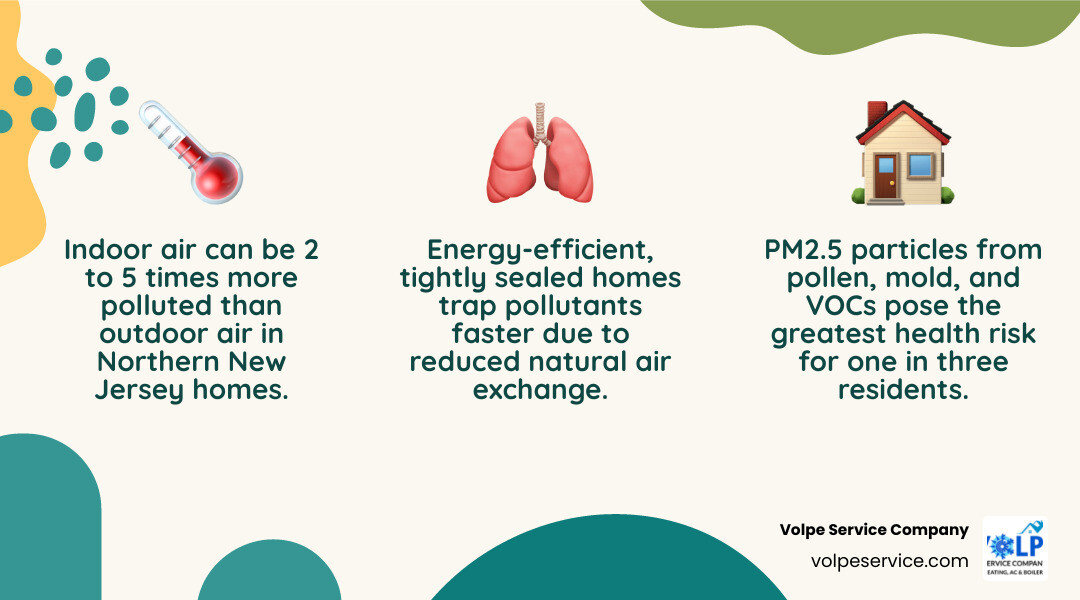
Most homeowners are surprised to learn that the air inside their home can be 2 to 5 times more polluted than the air outside. And since Americans spend roughly 90% of their time indoors, the quality of that air has a real impact on how your family feels every single day.
Northern New Jersey adds its own layer of complexity. The region’s humid summers, cold winters, and active pollen seasons create conditions that trap and cycle pollutants through your home’s HVAC system. Tightly sealed, energy-efficient homes — whether older homes with updated insulation or newer builds — have less natural air exchange, which means pollutants build up faster. Fine particles smaller than 2.5 micrometers (PM2.5) pose the greatest risk, and roughly one in three Americans is at elevated risk from PM2.5 exposure.
Whether you’re dealing with persistent allergy symptoms, musty odors when the heat kicks on, or just a home that never quite feels fresh, this guide walks you through every major solution available — from filter upgrades and UV lights to whole-house dehumidifiers and professional air quality testing.
Understanding Indoor Air Pollutants in Northern New Jersey
To clean the air in your home effectively, we first have to know exactly what we are fighting. Our beautiful corner of New Jersey — from the historic streets of Morristown to the leafy neighborhoods of Summit and Livingston — plays host to a unique mix of indoor air pollutants.
- Pollen and Outdoor Allergens: Our local trees, weeds, and grasses put on a massive pollen show from early spring right through the autumn. When you open your doors, step inside, or let your dog out, these microscopic invaders hitch a ride into your living spaces and settle deep into your carpets and upholstery.
- Dust and Pet Dander: Skin flakes, pet hair, dust mite debris, and insect remnants circulate through your ducts constantly. Every time your heating or cooling system kicks on, it can kick up these settled particles, keeping them suspended in the air.
- Mold Spores: Because Northern New Jersey experiences high seasonal humidity, mold is a persistent threat. Mold loves dark, damp spaces like basements, crawlspaces, and even the wet evaporator coils inside your air conditioning system.
- Volatile Organic Compounds (VOCs): These are chemical gases emitted by everyday household items. Your new furniture, fresh paint, chemical cleaners, aerosol sprays, and even some scented candles release VOCs. In modern, tightly sealed homes, these gases have nowhere to go and can accumulate to unhealthy levels.
- Radon Risk: New Jersey has several areas with elevated radon risk due to the state’s natural geological formations. Radon is a colorless, odorless, radioactive gas that seeps up from the soil into basements and foundations. Testing for radon is a critical part of ensuring your home’s long-term safety.
- Carbon Monoxide (CO): This tasteless, odorless, and colorless gas is a byproduct of incomplete combustion. Any gas-burning appliance — your furnace, water heater, stove, or fireplace — can leak carbon monoxide if it is cracked, improperly vented, or poorly maintained. Keeping your combustion appliances professionally serviced is your first line of defense.
To learn more about keeping these contaminants at bay, check out our comprehensive Guide to Optimize Indoor Air Quality. It is also vital to understand how these invisible threats impact the youngest members of your family; you can read about the impact of Indoor Air Quality on Children Health to see why taking action is so important.
Seasonal Climate Impacts on NJ Home Air
Our local climate in Northern New Jersey keeps us on our toes. We get a front-row seat to all four seasons, which is wonderful for scenery but incredibly challenging for your indoor air.
During our hot, sticky summers, the outdoor humidity often climbs above 70%. When this heavy, moist air makes its way inside, it creates the perfect breeding ground for mold and dust mites. If your air conditioner isn’t sized perfectly or is struggling to keep up, it won’t dehumidify your air properly. You can read more about why this happens in our article on Why an AC System Might Make Your Home Feel Humid.
In contrast, our winters are freezing and dry. To keep heating bills manageable, we seal up our homes tight. While this keeps the heat in, it also traps stale air, cooking odors, pet dander, and chemical vapors inside with us. The air recirculates through your furnace up to seven times a day, concentrating the pollutants.
Here is a quick breakdown of our seasonal air quality triggers:
- Spring (March – May): Heavy tree pollen, mold spores from thawing soil, and damp basement moisture.
- Summer (June – August): High humidity, grass pollen, smog, and mold growth on AC coils. This is also when you might notice 6 Signs That Your Air Conditioner Could Be Making You Sick.
- Autumn (September – November): Weed pollen, mold from falling leaves, and the initial buildup of dust as we close our windows.
- Winter (December – February): Extremely low humidity, pet dander accumulation, fireplace soot, and trapped VOCs from tight home sealing.
Signs Your Home Has Poor Air Quality
How do you know if your home in West Orange, Madison, or Denville has an indoor air quality problem? Your house (and your body) will usually tell you. Pay close attention to these common warning signs:
- Persistent Allergy or Cold Symptoms: If you or your family members suffer from constant sneezing, runny noses, itchy eyes, or dry throats that magically disappear when you leave the house for a few hours, your indoor air is likely the culprit.
- Rapid Dust Accumulation: If you find yourself dusting your tables, shelves, and television screens every few days only to see a thick gray layer return almost immediately, your standard HVAC filter is likely letting fine particles slip right through.
- Musty, Stale, or Lingering Odors: If cooking odors from last night hang around until noon, or if you smell a damp, musty odor whenever your heating or cooling system starts running, you are likely dealing with stagnant air and potential mold growth. For tips on tracking down and resolving these smells, read our guide on Dealing with AC Odors and IAQ.
- Uneven Humidity Levels: If your skin feels itchy and dry in the winter, or if your indoor air feels heavy, sticky, and clammy in the summer, your home’s humidity is out of balance.
- Frequent Headaches or Fatigue: Breathing in high levels of VOCs, carbon dioxide, or microscopic dust can leave you feeling sluggish, tired, and headachy in your own living room. If you are wondering about the direct connection between your cooling system and your physical comfort, check out our post on Can Air Conditioning Make You Sick.
Whole-House Air Quality Solutions for Northern New Jersey Homes
While portable, single-room air purifiers have their place, they can only clean the air in a small radius around them. To protect your entire home, a whole-house system integrated directly into your central HVAC ductwork is the gold standard.

These systems treat all the air circulating through your home every time your system’s fan runs. There are two primary approaches to whole-house air treatment: passive filtration and active purification.
- Passive Filtration: This is the traditional method. Air is pushed through a physical filter medium (like a high-quality pleated filter or a HEPA system). The filter acts as a net, catching particles like dust, pollen, and pet dander as they pass through. It is highly effective for solid particles but does not kill living pathogens or neutralize chemical gases.
- Active Purification: These advanced systems do not just wait for particles to travel to them. They actively release cleansing agents (like friendly positive and negative ions) into your living spaces. These ions seek out and neutralize viruses, bacteria, mold spores, and odor molecules in the air and on surfaces throughout your home.
To see how these systems stack up and find the right combination for your needs, read our overview of the Top Indoor Air Quality Solutions. Upgrading your setup does more than just clean the air; find out why Why a New HVAC System Is a Breath of Fresh Air for Your Health.
Choosing the Right Air Quality Solutions for Northern New Jersey Homes
Selecting the right filtration system requires balancing air cleanliness with your HVAC system’s airflow requirements. Standard air filters are rated using the Minimum Efficiency Reporting Value (MERV) scale, which ranges from 1 to 16 for residential systems. The higher the MERV rating, the smaller the particles the filter can trap.
However, higher is not always better for every home. Thick, highly restrictive filters can choke your HVAC system’s airflow if your system wasn’t designed for them, leading to frozen AC coils, cracked heat exchangers, and high energy bills. To avoid this common mistake, take a look at our guide: Don’t Let Your HVAC Choke The Best Air Filters for Every Home.
Here is a quick look at residential filter efficiencies:
| Filter Type | MERV Rating | What It Captures | Best For |
|---|---|---|---|
| Basic Pleated | MERV 8 | Dust, pollen, dust mites, lint | Standard homes with no pets or allergies |
| Superior Pleated | MERV 11 | Pet dander, mold spores, car emissions, light smoke | Homes with pets or mild seasonal allergies |
| Hospital-Grade | MERV 13 | Bacteria, microscopic allergens, smoke, sneeze droplets | Households with asthma, severe allergies, or vulnerable family members |
| HEPA System | MERV 16+ | 99.97% of particles down to 0.3 microns (including viruses) | Severe respiratory conditions; requires a dedicated bypass system |
Active Purification: UV Lights and Bipolar Ionization
If you want to go beyond trapping dust and actively destroy biological threats, we recommend looking into active purification technologies that install directly inside your ductwork.
- UV Germicidal Lights: These systems use specialized UV-C light, a technology trusted by hospitals for decades. Installed near your air conditioner’s indoor evaporator coil, the continuous UV-C light destroys the DNA of mold, bacteria, and viruses. This prevents mold from growing on your wet AC coil and keeps biological contaminants from multiplying and spreading through your home.
- Bipolar Ionization (iWave & REME HALO): These advanced devices inject positive and negative ions directly into your moving airstream. These ions mimic nature’s own air-cleaning process. When they encounter viruses, bacteria, or mold, they steal the hydrogen molecules they need to survive, killing the pathogen. Furthermore, these ions cause tiny, microscopic dust particles to cling together (or “agglomerate”) into larger clumps, making them heavy enough to fall out of the air or easily get caught by your standard HVAC filter. REME HALO systems are validated to reduce airborne particulates by up to 99% while killing bacteria, mold, and viruses.
Humidity Control and Ventilation Systems
True indoor comfort is about more than just temperature and filtration; it is also about moisture control and fresh air exchange.
To keep your home comfortable and prevent mold growth, you should aim to keep your indoor relative humidity within these target ranges:
- Summer Ideal: 50% to 60% relative humidity
- Winter Ideal: 30% to 40% relative humidity
- Whole-House Dehumidifiers: When our Northern New Jersey summers get thick and muggy, a whole-house dehumidifier works alongside your air conditioner to pull gallons of excess moisture out of the air. This protects your wood floors, keeps mold from growing in your basement, and allows you to feel comfortable at higher thermostat settings, saving you money on cooling.
- Whole-House Humidifiers: In the winter, dry furnace air can cause dry skin, bloody noses, static electricity, and irritated respiratory passages. A whole-house humidifier injects a controlled, invisible mist of moisture directly into your warm air stream, keeping your home comfortable and protecting your wooden furniture and musical instruments.
- Energy-Efficient Ventilation (ERVs and HRVs): Because modern homes are sealed so tightly to save energy, they can suffer from “sick building syndrome” where stale air is constantly recirculated. Energy Recovery Ventilators (ERVs) and Heat Recovery Ventilators (HRVs) solve this by constantly exhausting stale indoor air and bringing in fresh, filtered outdoor air. They transfer the thermal energy (and humidity, in the case of ERVs) between the incoming and outgoing air streams, ensuring you get fresh air without wasting energy or overworking your heating and cooling systems.
For a deeper dive into how ventilation impacts your living environment, we recommend reading about the Importance of Energy Efficient Ventilation, exploring Home Ventilation for Improved Air Quality, and discovering customized Ventilation Solutions Healthier Home.
Professional Installation of Air Quality Solutions for Northern New Jersey Homes
Installing whole-house air quality systems is not a DIY project. These advanced systems must be integrated seamlessly into your existing ductwork and electrical systems. If they are installed incorrectly, they can restrict airflow, leak air, or even damage your expensive heating and cooling equipment.
Our NATE-certified technicians understand the unique architectural styles and local climate conditions of homes throughout East Hanover, Parsippany, Boonton, Montville, and surrounding towns. We ensure your new air purifiers, humidifiers, or UV lights are perfectly matched to your existing HVAC system’s airflow capacity.
If you are considering upgrading your heating and cooling systems alongside your air quality solutions, modern heat pumps are an exceptional choice. They provide incredibly precise climate control and outstanding energy efficiency. To find out if a heat pump is right for your home, read Why New Jersey Homeowners Are Warming Up to Modern Heat Pumps and explore our article: Is It Worth Installing a Heat Pump. You can also learn about other green cooling technologies in our guide to Eco-Friendly Air Conditioning Options.
Maintenance Requirements for IAQ Systems
Like any high-performance machine, your indoor air quality systems require regular, professional maintenance to keep operating at peak efficiency.
- Filter Replacements: Standard 1-inch filters should be inspected monthly and replaced every 1 to 3 months. High-capacity 4-inch media filters can last anywhere from 6 to 12 months, depending on your household’s pet and allergy situation.
- UV Bulb Replacements: Even though a UV bulb might still be glowing, its germicidal strength degrades over time. Most UV-C bulbs need to be replaced every 12 to 24 months to maintain their ability to kill mold and bacteria.
- System Inspections: During your routine spring AC and fall heating tune-ups, our technicians will inspect your air purifiers, clean ionization needles, check your humidifier pads, and ensure your dehumidifier’s condensate drain line is clear and flowing freely.
For expert tips on keeping your filtration systems running smoothly, check out our guides on Proper AC Filter Maintenance, understand How Often Should You Change the AC Filter in Your House, and make sure to read The Essential Spring Air Filter Replacement Guide for Fresh Air.
Frequently Asked Questions About Home Air Quality
What is the difference between air filtration, air purification, and air cleaning?
While these terms are often used interchangeably, they refer to different methods of cleaning your air:
- Air Filtration is a passive process. It uses a physical medium (like a pleated fiberglass or paper filter) to trap solid particles like dust, pollen, and pet dander as air flows through it.
- Air Purification is an active process. It uses technologies like UV-C light or bipolar ionization to actively destroy, neutralize, or kill living biological contaminants (like mold, bacteria, and viruses) and neutralize chemical gases (VOCs) in the air and on surfaces.
- Air Cleaning is a broad term that covers both filtration and purification, often referring to electronic systems (like electrostatic precipitators) that use electrical charges to attract and collect airborne particles on metal plates.
Do UV lights in an HVAC system produce ozone?
High-quality, modern UV germicidal lights designed for residential HVAC systems are engineered to be completely ozone-free. When choosing a system, look for devices that are validated to meet UL 867 or UL 2998 standards. These strict safety certifications guarantee that the device does not emit harmful levels of ozone, making them perfectly safe for sensitive lungs, children, and pets.
How often should I replace my whole-house air filters and UV bulbs?
The replacement schedule depends on the specific equipment you have installed:
- Standard 1-inch pleated filters: Every 1 to 3 months.
- Deep 4-inch media filters: Every 6 to 12 months.
- Humidifier water panels/pads: Once per heating season (usually in the autumn).
- UV-C germicidal bulbs: Every 12 to 24 months (even if the bulb is still lit, its pathogen-killing power diminishes over time).
- Bipolar Ionization (like iWave): Many of these systems feature self-cleaning designs and require zero replacement parts or ongoing maintenance for the life of the unit.
Conclusion
Bathing your home in clean, fresh air is one of the best investments you can make for your family’s health, sleep quality, and daily comfort. Whether you are looking to upgrade to a high-efficiency media filter, install a continuous UV germicidal light, or balance your home’s seasonal humidity with a whole-house dehumidifier, the team at Volpe Service Company is here to help.
As a family-owned and operated HVAC company proudly based in East Hanover, New Jersey since 1963, we have spent more than six decades helping our neighbors breathe easier. We believe in data-driven solutions, courteous service, constant communication, and honest, transparent pricing.
If you are concerned about the air quality in your house and want to find a reliable local partner to help you design a customized solution, we invite you to explore our Indoor Air Quality Parsippany NJ services. Let us help you turn your home into a clean air sanctuary today!