
The Right HVAC Choice for Your Home Addition Starts Here
When it comes to ductless vs central HVAC for home additions, most New Jersey homeowners face the same question: do you extend what you already have, or start fresh with a dedicated system for the new space?
Here’s the short answer:
| Situation | Best Choice |
|---|---|
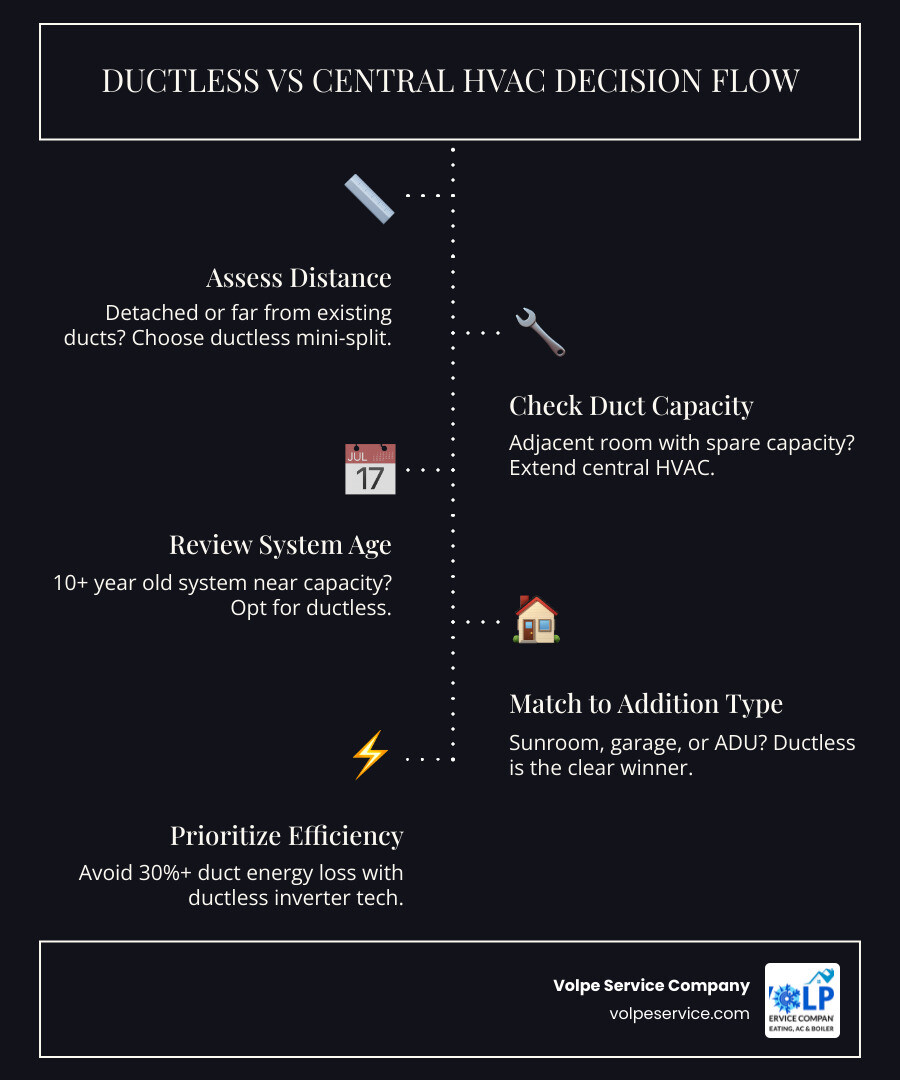
| Addition is detached or far from existing ducts | Ductless mini-split |
| Addition is adjacent to existing ductwork with spare system capacity | Central HVAC extension |
| Sunroom, garage conversion, or ADU | Ductless mini-split |
| Large multi-room addition on a new build | Central HVAC |
| Older home without existing ductwork | Ductless mini-split |
| Existing central system is 10+ years old or near capacity | Ductless mini-split |
The reality is that adding a room — whether it’s a home office, guest suite, sunroom, or full accessory dwelling unit — creates a real comfort challenge. Your existing heating and cooling system was sized for your home before the addition. Simply extending it may not cut it, and in many cases it can actually make comfort worse throughout your entire house.
Ductless mini-splits have become the go-to solution for most home additions in 2026, largely because they avoid the energy losses that come with ductwork — which can account for more than 30% of a central system’s energy consumption. But central HVAC extensions still make sense in the right circumstances.
This guide walks you through every factor that matters — efficiency, installation, zoning, air quality, maintenance, and available incentives — so you can make a confident decision for your specific addition.
Key terms for ductless vs central hvac for home additions:
- ductless heating and cooling for new jersey homes
- ductless hvac benefits for homeowners
- how ductless systems provide zone comfort
Understanding the Core Differences: Ductless vs Central HVAC for Home Additions
To make the right choice, it helps to look under the hood. While both systems keep you cool in July and warm in January, they go about it in completely different ways.
A traditional central HVAC system relies on a single, centralized indoor unit (usually a furnace or fan coil in the basement, attic, or utility closet) paired with an outdoor condenser. This system pushes conditioned air through a network of sheet metal or flexible ducts running behind your walls, ceilings, and floors. Air enters the room through registers and returns to the central unit through return grates.
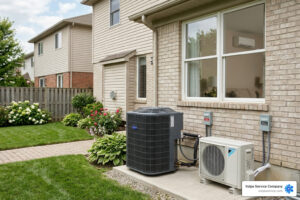
A ductless mini-split system, on the other hand, bypasses ductwork entirely. It pairs an outdoor compressor unit with one or more compact indoor air handlers mounted directly on the wall, floor, or ceiling of the target room. These units are connected by a small bundle of lines containing refrigerant pipes, electrical wiring, and a condensate drain. The lines run through a small, three-inch hole drilled in the exterior wall.
Because they deliver air directly into the room where they are installed, mini-splits avoid the friction and thermal losses associated with long duct runs. Understanding these core mechanics is the first step toward deciding Is a Mini Split Better Than Central Air for Your Home? when expanding your living space.
When to Choose Ductless vs Central HVAC for Home Additions
Your home’s existing layout and architecture play a massive role in this decision. For instance, if you live in one of Northern New Jersey’s historic properties—perhaps a century home in Morristown or Summit—adding ductwork can be a logistical nightmare. Thick plaster walls, solid wood framing, and a lack of closet space make running bulky sheet metal ducts nearly impossible without sacrificing architectural charm.
In these situations, choosing ductless is almost always the preferred path. It allows you to preserve your home’s historic integrity while gaining modern climate control. If you are struggling with the architectural constraints of an older property, you can explore Ductless vs Ducted: The Best Ways to Add AC to a Century Home to see how other local homeowners have solved this puzzle.
Even in modern homes, structural limitations can make ductless the clear favorite. If your new addition is built on a concrete slab—common for garage conversions and sunrooms—or if it is a second-story master suite with no attic access above it, routing new ducts back to your central system can require building bulkheads, lowering ceilings, or tearing open finished drywall. Ductless systems slip into these spaces with minimal structural disruption.
Evaluating Energy Efficiency: Ductless vs Central HVAC for Home Additions
Energy efficiency is one of the most compelling arguments for choosing a ductless mini-split over a central HVAC extension.
Central systems are inherently prone to duct leakage. According to industry data, typical residential ductwork systems lose more than 30% of their conditioned air through small gaps, loose seams, and uninsulated duct runs in attics or crawlspaces. When you extend your ductwork to a new addition, you are adding more surface area for this thermal loss to occur.
Ductless systems eliminate this problem entirely. By delivering conditioned air directly into the room, 100% of the energy used goes toward keeping you comfortable. Furthermore, modern ductless systems feature advanced inverter technology. While a traditional central system operates like a single-speed light switch—turning fully on or fully off—inverter compressors act like a dimmer switch. They constantly adjust their speed to match the exact heating or cooling load of the room, running continuously at ultra-low, highly efficient speeds.
This technology allows ductless systems to achieve incredible efficiency. In 2026, high-efficiency ductless systems can achieve ratings up to 35 SEER2, whereas top-tier central AC systems generally top out around 26 SEER2. To understand how these efficiency gains translate into lower monthly utility bills, take a look at our guide on Why Your Home Deserves a Ductless Upgrade.
Key Comparison Factors for New Spaces
When you are adding a room, you want the construction process to be as smooth, clean, and fast as possible. Let’s look at how these two HVAC strategies stack up across key daily-use factors.

| Feature | Ductless Mini-Split | Central HVAC Extension |
|---|---|---|
| Installation Time | 1 to 2 days | 3 to 7 days (including drywall work) |
| Home Disruption | Minimal (one 3-inch hole) | High (cutting walls, routing ducts) |
| Zoning Control | Independent thermostat per room | Shared with existing home zones |
| Energy Loss | Near 0% (no ductwork) | Up to 30% through duct leaks |
| Aesthetics | Visible wall, ceiling, or floor unit | Discreet wall registers |
| Indoor Air Quality | Multi-stage filtration per zone | Shared air (dust/allergens travel) |
| Lifespan | 15 to 20 years | 15 to 20 years (ducts last 10-15 years) |
Installation Requirements and Disruption
The physical process of installing these systems looks very different. Extending a central HVAC system requires opening up walls or ceilings to connect new branch lines to your existing trunk line. It often involves multiple trades, including HVAC technicians to run the sheet metal, carpenters to build soffits or bulkheads around the new ducts, and drywall specialists to patch, tape, and paint the disturbed areas. This process can stretch over a week, leaving your home dusty and noisy.
In contrast, a ductless installation is incredibly clean and fast. Our licensed technicians typically complete a single-zone mini-split installation in just one to two days. Because the only physical connection between the indoor and outdoor units is a small refrigerant line bundle, the disruption to your home is minimal. There are no major walls to tear open, no structural joists to cut, and no messy drywall dust to clean up. For a step-by-step breakdown of what this looks like in practice, you can read our detailed Guide to Ductless Installation.
Comfort Control and Zoning
Have you ever been in a home where the master bedroom is freezing but the kitchen is boiling? That is a classic symptom of an unbalanced central HVAC system. When you extend your existing central ductwork to a new addition, achieving temperature balance is notoriously difficult. The new room will be at the very end of the duct run, meaning it will receive less airflow and struggle to stay comfortable during extreme weather.
Ductless mini-splits solve this problem by providing true zoned comfort. The air handler in your new addition operates on its own independent thermostat. If you are using the new room as a home office, you can set it to a comfortable 72 degrees during the day without wasting energy to cool the rest of your house. If the room is a guest suite that sits empty for weeks at a time, you can put it in an eco-mode or turn it off completely.
This level of control keeps everyone happy and keeps your energy bills low. If you want to compare how zoning works across both system types, check out our HVAC AC Zoning System Installation Guide.
Best Applications for Each System Type
Every home addition is unique. The right choice for your project often depends on how you plan to use the new space, its proximity to your existing HVAC system, and your local climate.
When Central HVAC Extension Makes Sense
While ductless systems offer incredible benefits, extending your central HVAC system can still be a highly practical choice under the right conditions. This approach is usually best when:
- Your existing system has spare capacity: Before even considering an extension, our team must perform a Manual J load calculation to verify that your current furnace and air conditioner have the physical capacity to handle the extra square footage.
- The addition is adjacent to existing ducts: If your new room sits directly next to or above your home’s main utility space, running a short, direct duct line is relatively straightforward.
- You are planning a multi-room addition: If you are adding a large, multi-room wing to your home, a dedicated ducted system or a well-designed extension can provide uniform comfort across all the new spaces.
If your existing central system is already aging or if you want to understand what a full transition looks like, our guide on Switching Your Home to Central AC provides excellent context.
When Ductless Mini-Splits Are the Clear Winner
For many common home additions, ductless mini-splits are not just an alternative—they are the superior choice.
- Sunrooms: Sunrooms have a massive glass-to-wall ratio, which means they experience rapid temperature swings and high solar heat gain. A central system will struggle to keep up with these sudden shifts, often short-cycling or leaving the room uncomfortable. A mini-split’s inverter technology adjusts instantly to handle the heat, and many models feature dedicated dehumidification modes to keep the space comfortable.
- Accessory Dwelling Units (ADUs) and Guest Suites: If you are building a detached guest cabin or an ADU for rental income, independent climate control is essential. A mini-split allows your guests or tenants to control their own comfort without affecting your main home’s settings, and it makes tracking energy usage much simpler.
- Attic and Garage Conversions: Attics are naturally warmer due to rising heat, while garages often have poor insulation and concrete floors that retain cold. Extending central ducts to these spaces rarely works well because they have vastly different heating and cooling loads than your main living areas. A dedicated mini-split handles these extreme environments with ease.
If you are planning one of these projects, our Mini Split AC Complete Guide and our resource on Mini Split Installation Top Benefits will help you design the perfect setup.
Frequently Asked Questions About HVAC for Additions
Choosing how to heat and cool your new space is a big decision. Here are answers to some of the most common questions we hear from homeowners in Livingston, Morristown, and the surrounding New Jersey areas.
Will extending my ductwork strain my current heating and cooling system?
Yes, this is a very real risk. HVAC systems are sized precisely for the square footage of the home when they are installed. If you add 300 to 500 square feet of living space and simply tap into your existing ducts, you are forcing your system to condition more air than it was designed to handle.
This extra workload can cause your system to run constantly, leading to premature wear and tear, frequent breakdowns, and high energy bills. Even worse, it often results in poor comfort throughout your entire house, as the system struggles to satisfy the thermostat. This is why professional load calculations and correct system sizing are so critical. You can learn more about this in our article on Why Correct System Sizing Is the Secret to a Happy Home.
What incentives or tax credits are available in 2026 for high-efficiency systems?
The regulatory landscape in 2026 strongly favors high-efficiency heat pump systems. Under the Energy Efficient Home Improvement Credit (Section 25C of the Internal Revenue Code), homeowners can claim federal tax credits of up to $2,000 per year for installing qualifying high-efficiency heat pumps, including many ductless mini-split systems.
Additionally, depending on your utility provider in Northern New Jersey, you may qualify for local rebates and incentives for upgrading to high-efficiency, Energy Star-certified equipment. Our team can help you identify which systems qualify for these incentives to maximize your return on investment.
How do maintenance requirements differ between ductless and central systems?
Both systems require regular attention to run efficiently, but the tasks are slightly different:
- Ductless Mini-Splits: Because these units pull air directly from the room, their filters can clog faster with dust and pet dander. You should rinse the small, washable filters inside your indoor air handlers every 2 to 4 weeks during peak cooling or heating seasons. They also require an annual professional tune-up to clean the coils and check refrigerant levels.
- Central HVAC Systems: Central systems typically use a single large media filter that needs to be replaced every 30 to 90 days. However, because they rely on ductwork, you also need to factor in professional duct cleaning every 3 to 5 years to prevent dust, mold, and allergen buildup from circulating through your home.
Conclusion
Choosing between ductless vs central HVAC for home additions ultimately comes down to your home’s structure, your comfort goals, and the layout of your new space. While extending an existing central system can work well for simple, adjacent additions, a ductless mini-split offers unmatched energy efficiency, zoned comfort, and a fast, non-invasive installation process that preserves your home’s structure.
Since 1963, Volpe Service Company has been helping New Jersey homeowners find the perfect climate control solutions. Based in East Hanover, our licensed and highly trained technicians use a data-driven approach to evaluate your home’s unique requirements, ensuring you get honest pricing, clear communication, and a system that keeps you comfortable for decades.
Whether you are converting a garage in Livingston, adding a sunroom in Summit, or building a guest suite in Morristown, we are here to help you get the job done right.
If you are ready to explore your options and get a professional assessment for your home addition, visit our Ductless HVAC Services Parsippany NJ page or contact us today to schedule your consultation!